June 22, 2026
Master Data Management & AI Readiness 2026: Why 60% of AI Projects Fail Due to Weak Data Foundations

By Gernot Lepuschitz
Chief Technology Officer

Companies fail at AI initiatives—not because of technology or budget constraints, but because of their master data. Learn why master data management will become a prerequisite for any AI readiness strategy by 2026, what four factors cause data chaos, how a framework can transform your data foundation—and why the EU AI Act makes this a mandatory requirement.
Key Takeaways
According to Gartner, 60% of AI projects fail—not because of algorithms, but often due to poor data quality—making Master Data Management the critical lever.
A Golden Record is no longer an option: Anyone feeding AI models with fragmented master data in 2026 won’t be generating intelligence—they’ll be automating errors.
The four main causes of AI readiness roadblocks: system silos, missing golden records, manual data maintenance without governance, and an AI strategy without a data strategy.
According to Gartner, poor data quality costs companies an average of $12.9 million per year.
Article 10 of the EU AI Act explicitly requires relevant, representative, as error-free as possible, and complete training, validation, and test datasets for high-risk AI systems.
According to Bitkom, AI adoption among German companies has nearly doubled from 20% to 36% within a year—with data quality ranking among the key implementation hurdles.
Goldright’s AI Data Foundation Check 2026 provides you with a precise assessment of your data maturity in just 15 minutes.
According to MarketsandMarkets, the global MDM market is growing from $16.7 billion (2022) to $34.5 billion by 2027 (CAGR 15.7%).
MDM is not an IT project—it is a strategic prerequisite for any scalable AI initiative.
What is Master Data Management?
Master Data Management (MDM) refers to the enterprise-wide discipline of consolidating, cleansing, and managing all critical master data—including customers, suppliers, products, materials, locations, and legal entities—in a single, reliable, and consistent data source.
Gartner defines MDM as a technology-enabled discipline in which business and IT collaborate to ensure the uniformity, accuracy, governance, semantic consistency, and accountability of an organization’s official, shared master data.
IBM similarly describes MDM as a process that creates a unified, consistent set of identifiers and extended attributes that describe an organization’s critical master data entities across domains and systems.
The result of a functioning MDM setup is a so-called Golden Record: a single, authoritative data record per entity that all downstream systems and processes can trust. Without MDM, a corporation with numerous ERP, CRM, and cloud systems typically stores the same customer or supplier in multiple variations—with different spellings, addresses, classifications, and terms.
In practice, there are several implementation models:
Registry-Modell: MDM acts as a central directory with cross-references, without physically copying data.
Consolidation-Modell: Master data is consolidated and cleaned from source systems but remains in the original systems as well.
Coexistence-Modell: A hybrid—the MDM system maintains the golden record, while source systems retain local copies.
Centralized-Modell: The MDM system is the sole authoritative source; all systems read from it.
The centralized or coexistence model is crucial for AI readiness—only this approach ensures that AI models are trained and operated using a consistent data foundation.
Semantically related concepts: data governance, data stewardship, reference data management, data quality management, single source of truth, golden record, data mesh, data fabric.
Why is Master Data Management relevant in 2026?
In 2026, Master Data Management sits at the intersection of three strategic pressure points that are simultaneously impacting businesses: AI transformation, regulatory change driven by the EU AI Act, and growing competitive pressure from data-driven business models. Five key facts demonstrate just how significant this connection is.
1. Data challenges are the most common obstacle to AI adoption
In McKinsey’s 2024 Global AI Survey, a clear majority of respondents report difficulties in handling data—including defining data governance processes, rapidly integrating data into AI models, and insufficient training data sets.
2. Poor data quality costs companies an average of $12.9 million per year
Gartner estimates the average annual cost of poor data quality at $12.9 million per company—a figure that has been cited as an industry benchmark for years and encompasses productivity losses, compliance costs, and poor decision-making. In large corporations, these figures are often significantly higher.
3. The EU AI Act makes data quality a compliance requirement
Since the EU AI Act came into full effect, companies are required to demonstrate the quality of training data for AI systems. Article 10 of the EU AI Act explicitly requires that training data must be relevant, representative, error-free, and complete. MDM is therefore not an optional convenience—it is a compliance requirement.
4. AI use in companies is growing rapidly—and data quality is holding it back
According to the Bitkom 2026 study (a representative survey of 604 companies with 20 or more employees), the proportion of German companies actively using AI has nearly doubled within a year, from 20% to 36%. At the same time, data quality—alongside training
5. The MDM market is growing significantly faster than overall IT spending
MarketsandMarkets forecasts that the global MDM market will grow from $16.7 billion (2022) to $34.5 billion by 2027, representing a compound annual growth rate (CAGR) of 15.7%. Drivers include the increasing use of data quality tools and rising compliance requirements.
The figures paint a clear picture: MDM is evolving from an IT hygiene measure into a strategic prerequisite for any scalable AI initiative.
The 4 Root Causes: Why AI Projects Fail Due to Weak Data Foundations
If 60% of AI initiatives fail, we have to ask: What exactly is causing this?
In my daily work with enterprise architectures, I see the same four patterns—time and again, across industries, regardless of system size or budget.
Root Cause 1: Silos Between Systems
The silo problem is not a technical issue—it is an architectural legacy. Over the past 20 years, through M&A activities, decentralized IT decisions, and organic growth, companies have created system landscapes that resemble an archaeological excavation site: Layer by layer, each era with its own tools, standards, and data models.
The result: The same supplier exists in SAP S/4HANA as “Müller GmbH,” in CRM as “Mueller GmbH & Co. KG,” and in the procurement system as “Müller, GmbH.” Three entries, one supplier, zero consistency. An AI model that uses this data as a training basis learns chaos—it doesn’t automate it away.
The consequence for AI: Machine learning models require consistent, unique entities for training and inference. If the same entity exists in five variants, the model loses its reference point. The result is incorrect predictions, unreliable recommendations, and AI outputs that no CDO can truly trust.
The architectural solution starts here: A central MDM system acts as an integration hub—not as another data silo, but as a golden record generator that supplies all downstream systems with consistent master data.
Root Cause 2: No Golden Record
A Golden Record is more than just a consolidated data set. It is a technical commitment: “This representation of an entity is the sole authoritative one.” Without a Golden Record, a company lacks a common language—and without a common language, AI systems cannot make reliable decisions.
The problem isn’t that companies don’t know they need a Golden Record. The problem is the organizational complexity of implementing it. Who is the data owner for the customer dataset: CRM, ERP, or Marketing? Which domain is authoritative for product classification: Supply Chain, Product Management, or Finance?
These governance questions are not technical—they are political. And that is why they are put on the back burner in many organizations. That costs millions, every year.
The Golden Record as a prerequisite for AI: Without a Golden Record, there is no reliable feature engineering. Without reliable feature engineering, there is no reliable ML model. That is not an opinion—it is system architecture.
Root Cause 3: Manual Data Maintenance Without Governance
Excel spreadsheets, email chains, manual data entry without validation rules, and a lack of approval processes remain commonplace in many companies. The 2026 Bitkom study identifies data quality as one of the key obstacles hindering the productive use of AI in practice.
The core problem: Manual data maintenance without governance rules is antiscaling. Every employee who creates master data does so at their own discretion. Without required fields, validation rules, approval workflows, and clear ownership structures, every new data record creates new chaos.
This is particularly critical for AI initiatives: AI models scale with the volume of data—but not with data quality. A model trained with manually maintained, inconsistent master data learns the errors of the manual process. In this case, more data means more incorrectly learned patterns.
Governance as the solution: automated validation rules, role-based access controls, workflow engines for approval processes, and complete audit trails—these are the technical cornerstones that transform manual data anarchy into controlled master data management.
Root Cause 4: An AI Strategy Without a Data Strategy
This is the most dangerous root cause—because it stems from good intentions. Companies invest in LLM-based chatbots, predictive analytics platforms, and automation tools without first answering the question: What data foundation will all of this be built on?
An AI strategy without a data strategy is like a skyscraper without a foundation. The first few floors look impressive—until the structure collapses.
In practice, it looks like this: A company invests six months in implementing an ML-based demand forecasting system. The results are disappointing—forecast accuracy is below 60%. The cause: The product master data used to train the model has a duplicate rate of 23% and a completeness rate of 61%. The ML model doesn’t have bad algorithms—it lacks a reliable data foundation.
The strategic imperative for 2026: Every AI project must be preceded by a data readiness analysis. Every data readiness project must be preceded by an MDM strategy. This sequence is non-negotiable.
Article 10 of the EU AI Act specifically addresses this relationship, explicitly requiring that data quality be verifiably ensured prior to training for high-risk systems.
It’s not an AI problem—it’s a data problem
This is the fundamental misunderstanding that is being repeated in boardrooms from Munich to Vienna: People treat the failure of AI projects as a technology problem. They invest in better algorithms, more powerful models, and more expensive platforms.
That’s the wrong diagnosis.
LLMs remember probabilities. MDM delivers facts. No language model, no neural architecture, no Transformer stack in the world can derive reliable decisions from inconsistent, fragmented master data. It’s mathematically impossible.
Imagine the following scenario: Your AI system is supposed to automatically assess supplier risks. It analyzes transaction data, payment history, and contract terms. But the supplier’s master data exists in three different systems with different classifications, different credit scores, and different contact details. Which dataset does the model trust? All three—and thus produces statistical artifacts instead of reliable risk assessments.
The framing shift that CDOs must make by 2026:
Old Framing | New Framing |
“We have an AI problem” | “We have a data foundation problem” |
“We need better algorithms” | “We need better master data” |
“MDM is an IT project” | “MDM is a strategic investment in AI readiness” |
“Data quality is the responsibility of IT” | “Data governance is the responsibility of the business” |
“We optimize AI output” | “We optimize AI input” |
The shift is radical—but it’s the only one that works. Companies that adopt this approach stop treating symptoms. They start addressing the root causes.
Approach: The AI Data Foundation Framework in 5 Steps
A solid data foundation for AI readiness is not achieved through a one-time data migration. It is an iterative process that addresses technology, governance, and organization simultaneously.
Step 1: Data Readiness Assessment
Before a single line of code is written, the current state must be precisely understood.
The assessment includes:
Master data inventory: Which domains (customers, products, suppliers, locations, legal entities) exist? In which systems? What are the duplicate rates?
Data Quality Profiling: Completeness, accuracy, consistency, timeliness — measured per domain and system.
Governance Gap Analysis: Where do ownership structures exist, and where are they missing? Which manual processes need to be automated?
AI Use Case Mapping: Which AI initiatives are planned or active? Which master data domains are critical to their success?
The result: A data readiness score per domain and a prioritized action plan. This is exactly what Goldright’s AI Data Foundation Check 2026 delivers in a structured format.
Step 2: Define the Governance Framework
Technology without governance is ineffective.
In this step, the organizational foundations are laid:
Define data owners: Who is responsible for which master data domain? Ownership must be embedded in the business—not in IT.
Appoint data stewards: Operational personnel responsible for daily data maintenance, quality assurance, and escalation processes.
Formalize quality rules: Which fields are required? Which validation rules apply? Which approval workflows are needed?
Define data quality KPIs: Completeness > 95%, duplicate rate < 1%, recency < 30 days — measurable goals that are reported on regularly.
Step 3: Implement the Golden Record
With the governance framework in place, technical implementation can begin:
Matching & Deduplication: Algorithms and rule-based logic identify duplicates across system boundaries.
Merge & Survive Rules: Define which source system is authoritative for which fields. SAP for credit limits, CRM for contact data, ERP for classification.
Establish the Golden Record: The MDM system assumes control over the consolidated, cleaned-up data set.
API Integration: All downstream systems—ERP, CRM, BI, AI pipelines—are connected bidirectionally. The Golden Record is the single point of truth.
Step 4: Continuous Data Quality Assurance
A golden record that is not maintained loses its quality within months.
Continuous assurance means:
Automated validation rules catch errors during data entry—before they enter the system.
Workflow engines manage approval processes for new master data and changes.
Monitoring dashboards display data quality KPIs in real time—for data owners and management.
Point-in-time historization ensures that every change is traceable and documented in an audit-proof manner.
Step 5: AI Integration and Iterative Scaling
With a stable data foundation, AI initiatives can be built reliably:
Feature stores with golden records as the authoritative data source for ML models.
Retrieval-Augmented Generation (RAG) draws on verified master data rather than unstructured documents.
Automated data quality scoring for AI training data in accordance with EU AI Act Art. 10.
Iterative scaling: Start with a single domain (e.g., customers or suppliers), validate the approach, then roll it out to additional domains.

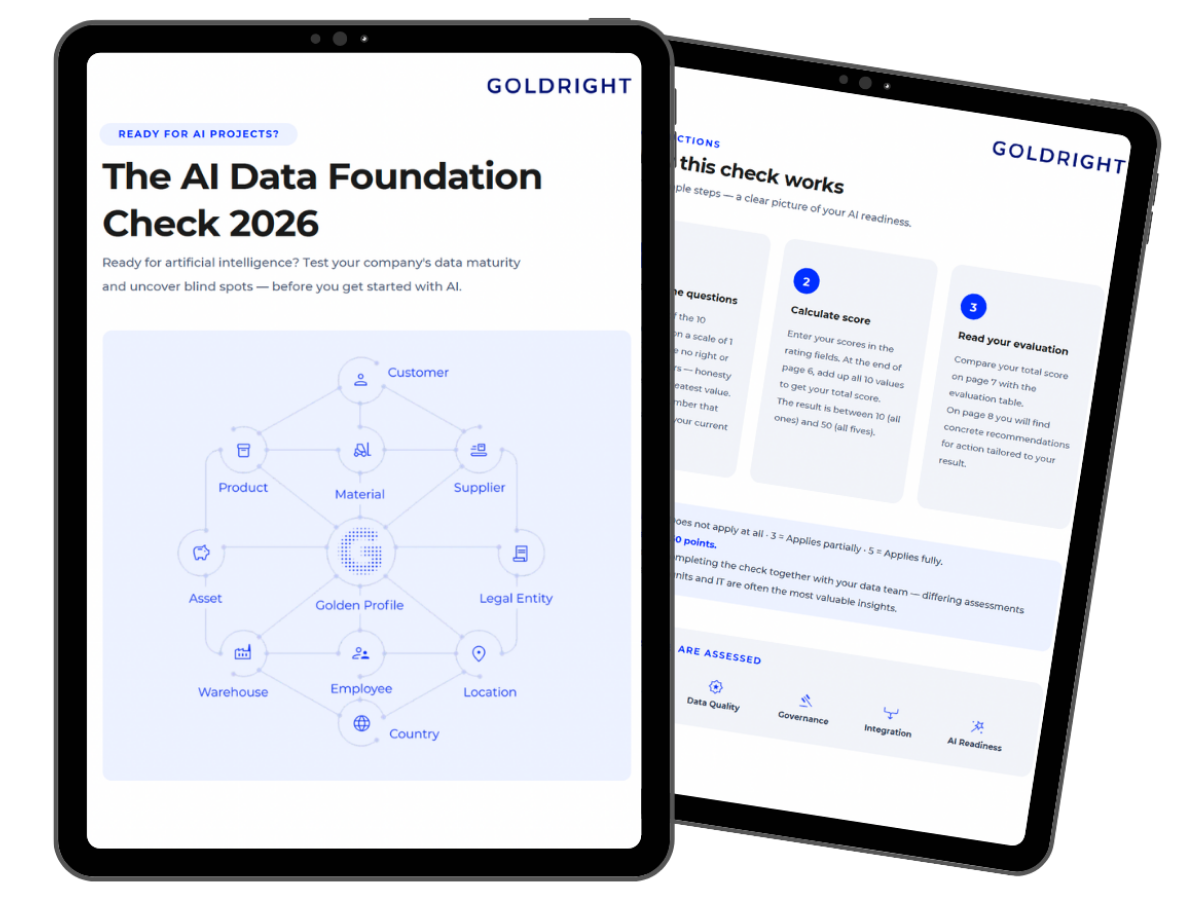
AI-Data Foundation Check 2026
Where does your company stand on the path to AI readiness? This assessment uses 10 targeted questions to show you where you stand today—and how you can make rapid progress.
9-page practical guide as a ready-to-use PDF
Evaluation score for all data dimensions
Ready-to-use roadmap template
100% free
Best Practices: What Really Works in the Enterprise
After more than two decades of experience in MDM implementations—ranging from mid-sized industrial companies to DAX-listed corporations—the key success factors have become clear. Here are the six best practices that make the difference between a successful MDM project and a costly failure:
1. Business First, Technology Second
The most common pattern of failure: MDM is launched as an IT project. IT delivers a technically flawless platform—which the business doesn’t use because the processes weren’t taken into account. MDM projects that achieve lasting success start with a C-level business sponsor and define business use cases before selecting a tool.
2. Address domains sequentially, not in parallel
Attempting to harmonize all master data domains simultaneously regularly leads to project failure. The recommended sequence: Start with the domain that has the greatest business impact and the highest level of ownership commitment. Typically, this is either the customer or the product.
3. Define data quality rules in collaboration with the business
Technical validation rules defined without business input can hinder operational processes. Every quality rule must be coordinated with the data owners from the business unit—with a clear answer to the question: “What happens operationally if this field is missing or incorrect?”
4. Prevent the “broken window” effect
A single substandard data record that slips through validation processes unnoticed opens the door for more. Automated data quality dashboards and consistent escalation processes prevent quality issues from creeping back in.
5. API-First Architecture for AI Readiness
By 2026, MDM systems must be designed with an API-first mindset. Not just for integration with ERP and CRM—but for the seamless connection of feature stores, AI pipelines, and RAG architectures. Configurable, bidirectional APIs are not an optional add-on—they are the prerequisite for AI readiness.
6. Historical Data as a Strategic Asset
Point-in-time historical data is viewed by many companies as a technical requirement—in reality, it is a strategic asset. A complete, audit-proof change history is indispensable for EU AI Act compliance, regulatory audits, due diligence processes, and the traceability of AI decisions.
The Comparison: MDM vs. Data Lakehouse vs. Data Mesh vs. Data Fabric
One of the most common questions in architecture discussions: How does MDM differ from other modern data management concepts—and when should I use which one?
This table provides the precise answer:
Dimension | MDM | Data Lakehouse | Data Mesh | Data Fabric |
Primary Goal | Consistent, authoritative master data (Golden Record) | Analytical workloads on raw/structured data | Decentralized data ownership per domain | Integrated data management across heterogeneous infrastructure |
Data focus | Master data (customers, products, suppliers, locations, legal entities) | Transaction and analytical data, all types | Domain-specific data products | All data types, across infrastructures |
Governance-Approach | Centralized, clear data owners | Metadata/catalog-driven | Federated by domain | Automated, cross-domain |
AI Readiness Contribution | Golden Record as a reliable feature basis | Scalable training data repository, often inconsistent without MDM | Scalable, but consistency across domains is challenging | Good infrastructure integration, no dedicated Golden Record |
Typical User | CDO, Data Governance Teams | Data Engineers, Data Scientists | Domain Teams, Data Product Owner | Enterprise Architects, Cloud Teams |
The key takeaway: MDM, data lakehouse, data mesh, and data fabric are not competing concepts—they are complementary. MDM provides the master data foundation upon which all other architectures can be reliably built. Without MDM, a data lakehouse is an analytical platform built on shaky ground.
Case Study: MDM as a Prerequisite for an AI Quality System
Names and specific metrics have been anonymized for confidentiality reasons.
Background:
An international industrial and pharmaceutical group headquartered in Germany, with approximately 40,000 employees worldwide, 12 production sites, 8 ERP instances (SAP-based), and over 200 integrated systems. Over the past 15 years, the company had built up a system landscape through several acquisitions that had grown organically—and was correspondingly fragmented.
The specific problems:
The same active ingredient existed in 4 different ERP systems under 11 different names and classifications.
Supplier master data had a duplication rate of 31%.
Monthly reporting cycles took 14 business days—8 of which were spent on manual data reconciliation.
Planned AI-based quality control could not go into production: The product master data had a completeness rate of 57% for AI-relevant attributes.
EU AI Act compliance for the planned AI quality system: unachievable without cleaned training data.
Implementation Approach
The project followed the AI Data Foundation Framework across four parallel workstreams over an 18-month period:
Workstream 1: Governance Framework — Data owners for all critical domains, role-based access controls, escalation processes.
Workstream 2: Golden Record for product and active ingredient master data — matching algorithms, merge-survive rules, API integration into all 8 SAP systems.
Workstream 3: Supplier master data — deduplication, validation rules, bidirectional synchronization.
Workstream 4: Point-in-time archiving and audit trail for EU AI Act compliance.
Results after 18 months:
KPI | Before | After | Improvement |
Monthly Reporting Cycle Time | 14 business days | 7.7 business days | -45 % |
Supplier Duplicate Rate | 31 % | 0.8 % | -97 % |
Completeness of Product Master Data (AI Attributes) | 57 % | 96 % | +68 % |
Manual Data Reconciliation Effort (FTE) | 4.2 FTE/Month | 0.6 FTE/Month | -86 % |
AI quality control | Not deployable | In production |
|
EU AI Act Art. 10 Compliance | Not met | Fully met |
|
The key finding:
The planned AI-driven quality system—the project’s primary business driver—could not go live until after the MDM implementation. The improvement in data quality was not a byproduct of the project; it was a prerequisite for the actual use case.
The ROI of the MDM project—calculated based on reduced personnel costs, accelerated reporting cycles, and avoided compliance costs—had a payback period of less than 24 months according to internal calculations. Not included in this calculation: the strategic value of the AI quality system, which could not have been realized without MDM.
Pitfalls: What You Must Avoid at All Costs
MDM projects often fail not because of a lack of technology—they fail due to avoidable mistakes. Here are the seven most common pitfalls I regularly observe in enterprise implementations:
Pitfall 1: Positioning MDM as a purely IT project
If there is no executive sponsor and the project is driven solely by the IT department, it will fail due to a lack of business buy-in. Master data belongs to the business—governance must be anchored there.
Pitfall 2: Underestimating the scope
“We’ll start with the customers; that will take three months.” The reality is: Every new domain brings new complexity. Not because the tool is complex—but because organizational coordination takes time. Build in buffers for governance discussions.
Pitfall 3: Treating data quality as a one-time project
A data migration that cleans up master data once, without establishing continuous governance mechanisms, will lose its quality again within 6–12 months. MDM is not a project—it is an ongoing operational process.
Pitfall 4: Forgetting to measure KPIs
“The data is better now” is not a measurable statement. Before the project starts, define clear baseline metrics and KPIs—completeness, duplicate rate, timeliness, error rate. Without measurement, there is no proof of business value.
Pitfall 5: Treating Integration as an Afterthought
A Golden Record that isn’t synchronized with operational systems in real time will quickly become an isolated file again. API integration must be planned for and built in from day one.
Pitfall 6: Underestimating the EU AI Act
Article 10 of the EU AI Act is not a vague requirement—it specifically mandates verifiable training data quality for high-risk AI systems. Companies that ignore MDM as a compliance issue risk having their AI systems banned from operation and facing regulatory sanctions.
Pitfall 7: Too many domains at once
Attempting to harmonize all master data domains in parallel regularly leads to project failure—too many stakeholders, too many conflicts, too little focus. Start with one domain. Achieve a measurable quick win. Then scale up.

AI-Data Foundation Check 2026
Is your master data ready for AI? Goldright’s AI Data Foundation Check analyzes your current data readiness and provides you with a clear, prioritized action plan.
9-page practical guide as a ready-to-use PDF
Evaluation score for all data dimensions
Ready-to-use roadmap template
100% free
FAQ: The Most Important Questions About Master Data Management & AI Readiness
What is the difference between MDM and PIM?
Master Data Management (MDM) and Product Information Management (PIM) are often confused—in fact, PIM is a subset of MDM. MDM addresses all critical master data domains within an organization: customers, suppliers, products, locations, and legal entities. PIM specializes in product information—primarily for marketing purposes such as e-commerce, catalogs, and sales channels.
The key difference: PIM optimizes product content for external communication. MDM ensures the operational and cross-system consistency of master data—including the product master data used in ERP, SCM, and finance processes. For AI readiness, you need MDM—a PIM system alone is not enough.
Do I need MDM if I have SAP S/4HANA?
Yes—and that is one of the most common misconceptions in enterprise IT projects. SAP S/4HANA is an excellent ERP system. It is not an MDM system. S/4HANA manages master data within its own system boundaries—but most companies do not have a pure S/4HANA landscape. They have S/4HANA plus CRM plus legacy systems plus cloud applications.
MDM complements SAP S/4HANA by acting as a cross-system integration hub: The Golden Record is managed in the MDM system and synchronized bidirectionally with S/4HANA and all other systems. In fact, an SAP S/4HANA migration is often the ideal time to introduce MDM in parallel—because the data migration is happening anyway.
How long does an MDM implementation take?
The honest answer: It depends heavily on the starting point, the number of domains, and organizational complexity. As a rough guide based on real-world experience: a pilot for a domain of medium complexity often takes several months; a broader implementation across multiple domains typically takes one to two years; and a group-wide MDM program takes several years and is implemented iteratively rather than as a “big bang.” These timeframes are general estimates based on experience and are not guaranteed.
How much does an MDM project cost for mid-sized companies?
Here, too, the range is wide: costs vary greatly depending on company size, the number of system integrations, and domains. A reliable, robust cost estimate can only be provided based on an individual assessment. Generic flat rates without a project-specific basis are deliberately not mentioned in this version of the article to avoid disseminating unsubstantiated figures. The ROI stems primarily from reduced error costs, accelerated processes, avoided compliance risks, and enabled AI use cases.
How does MDM help with compliance with the EU AI Act?
Article 10 of the EU AI Act requires that, for high-risk AI systems, training, validation, and test datasets be relevant, sufficiently representative, and, to the extent possible, error-free and complete, in relation to the intended use.
MDM addresses these requirements on three levels:
Data quality assurance: Automated validation rules and quality KPIs verify the quality of the training data.
Audit trail and historization: Point-in-time historization provides a complete record of which data was available when and in what state—crucial for demonstrating compliance.
Data lineage: Traceability of where a data record originates and how it was transformed—crucial for regulatory audits.
In short: Without MDM, EU AI Act compliance for data-intensive AI systems is structurally unachievable.
What is the difference between a Golden Record and a data warehouse?
A data warehouse is an analytical infrastructure—optimized for historical analysis, reporting, and business intelligence. It aggregates data from various sources for analytical purposes.
A Golden Record is the operational, authoritative representation of an entity (customer, product, supplier)—cleaned, consolidated, and synchronized with operational systems in real time. It is the foundation used in operational processes and AI pipelines.
Put simply: The data warehouse reports on what was.
The Golden Record defines what is.
Both are important—and complement each other.
What does “AI readiness” mean in the context of master data?
AI readiness describes a state in which master data is structured, of sufficient quality, and organized in such a way that AI models can be reliably built upon it. Specifically, this means:
Structural Readiness: Master data is available in a consistent, documented structure that AI pipelines can access.
Qualitative Readiness: Completeness > 95%, duplicate rate < 1%; timeliness and accuracy are measurable and met.
Architectural Readiness: MDM APIs enable real-time access to golden records for feature engineering and RAG architectures.
Compliance Readiness: Audit trails and data lineage meet the requirements of the EU AI Act.
How does MDM work in a microservices or cloud-native architecture?
MDM is not tied to a specific architecture—it is a capability, not a topology. In cloud-native and microservices architectures, MDM is typically implemented as a dedicated service that communicates with other services via well-defined APIs (REST, GraphQL, event streaming).
The golden rule here: API-first. The MDM system exposes the Golden Record as an API—other services consume it without needing to know the internal MDM logic. For event-driven architectures, master data changes are published as events (e.g., via Kafka), ensuring that all dependent services remain consistent in real time.
What is the difference between MDM and data governance?
MDM and data governance are closely related but not identical. Data governance is the overarching framework—the totality of all policies, processes, roles, and responsibilities for a company’s data management.
MDM is the operational implementation of data governance principles for master data. Data governance defines the rules of the game; MDM implements them for master data in terms of both technology and processes. A company can have data governance without MDM (usually ineffectively)—but no company can operate successful MDM without data governance.
What is a data steward, and how does this role differ from that of a data owner?
A data owner is the person—typically in the business unit—who bears ultimate decision-making responsibility for a master data domain. They define which data needs to be maintained, which quality standards apply, and who has access.
A data steward is the operational role—typically in a business unit or in IT—responsible for the day-to-day execution of data maintenance, quality assurance, and compliance with governance rules.
Put simply: The data owner decides what should happen to the data. The data steward ensures that it happens.
Which master data domains are typically the most critical for AI projects?
That depends on the use case—but based on experience, these are typically the most critical domains:
Product/Material: For supply chain AI, demand forecasting, and quality control.
Customers: For customer intelligence, next-best-offer, and churn prediction.
Suppliers: For supplier risk AI and procurement optimization.
Legal Entities: For compliance AI, risk modeling, and regulatory reporting.
Locations: For logistics AI, capacity planning, and ESG reporting.
Conclusion: The quality of your data is key to the success of your AI strategy
In 2026, we will reach a turning point. The euphoria of the first wave of AI—pilot projects, proof-of-concepts, strategic announcements—is giving way to a sobering realization: without a solid data foundation, AI remains an expensive hypothesis.
The companies that successfully scale AI in 2026 and beyond have one thing in common: they have understood the sequence. First, the data foundation. Then the AI architecture. Not the other way around.
Master Data Management is not the end, but the beginning. A well-implemented Golden Record, a scalable governance structure, and an API-first MDM architecture create the conditions under which AI models can be operated reliably, scalably, and in a manner that is documentable in accordance with Article 10 of the EU AI Act.
As a CTO, I see every day what happens when this step is skipped: millions invested in AI platforms that deliver no usable results. Not because the technology fails—but because the foundation is missing.
My recommendation: Start with the AI Data Foundation Check. Understand your current data maturity. Prioritize the domains that your AI use cases need first. And then—sequentially, measurably, sustainably—build the foundation that supports your AI strategy.
Because a skyscraper without a foundation will fall. Always.

Download free AI-Data Foundation Check now
Bibliography
All of the following sources were accessed in June 2026:
Gartner: Data Quality — https://www.gartner.com/en/data-analytics/topics/data-quality
Gartner: Lack of AI ready data puts AI projects at risk - https://www.gartner.com/en/newsroom/press-releases/2025-02-26-lack-of-ai-ready-data-puts-ai-projects-at-risk
Gartner Glossary: Master Data Management (MDM) – Definition — https://www.gartner.com/en/information-technology/glossary/master-data-management-mdm
McKinsey & Company: The State of AI in 2024 — https://www.mckinsey.com/capabilities/quantumblack/our-insights/the-state-of-ai-2024
EU Artificial Intelligence Act: Article 10 – Data and Data Governance — https://artificialintelligenceact.eu/article/10/
Bitkom e. V.: Press Release: “Breakthrough in Artificial Intelligence” (Bitkom AI Study 2026, Survey of 604 Companies) — https://www.bitkom.org/Presse/Presseinformation/Durchbruch-Kuenstliche-Intelligenz
MarketsandMarkets: Master Data Management Market – Press Release — https://www.marketsandmarkets.com/PressReleases/master-data-management.asp
IBM: What is Master Data Management? — https://www.ibm.com/topics/master-data-management
