August 11, 2026

Master Data Management: Definition & Practice

Gernot Lepuschitz

By Gernot Lepuschitz

Chief Technology Officer

Master Data Management: Reifegradmodell und Golden Record im Enterprise-Kontext

22 min read

Share this post

Anyone who reads this article will not only understand what master data management is, but also why it often gets stuck in most companies. You’ll get a solid definition, a direct comparison of the four implementation styles, a six-phase operating model, and the key metrics you can use to demonstrate progress.
Key Takeaways

  • Master Data Management is a discipline, not software. Gartner explicitly defines MDM as a technology-enabled business discipline in which business and IT work together to ensure the uniformity, accuracy, stewardship, governance, semantic consistency, and accountability of official master data.

  • The maturity gap is the real issue. According to Gartner, most large organizations are at Level 2 out of 5 (“Developing”) and are working toward Level 3 (“Defined”). The bottleneck rarely lies in the technology.

  • The costs are measurable. Gartner estimates the average annual cost of poor data quality at $12.9 million per organization.

  • The initial state is worse than assumed. In a Harvard Business Review study of 75 executives, an average of 47% of newly created data records contained at least one critical error; only 3% of data quality scores were acceptable even by the most generous standards.

  • Germany has a utilization problem, not a data problem. According to Bitkom, only 6% of companies fully leverage the potential of their available data.

  • The market is reevaluating this discipline. Grand View Research forecasts growth in the global MDM market from $19.9 billion (2023) to $60.7 billion by 2030—an annual growth rate of 17.4%.

  • The Maturity Assessment provides an evaluation of your current status. Goldright’s AI Data Foundation Assessment uses ten questions to show where your master data management stands today and which area should be addressed first.

What is Master Data Management?

Master Data Management (MDM), also known as master data management, is the enterprise-wide discipline used to define, consolidate, ensure the quality of, and responsibly manage an organization’s core business objects—customers, suppliers, products, materials, locations, employees, and legal entities—across all systems.

The result is a Golden Record: a single, authoritative representation for each entity that all downstream processes and systems access.

Gartner puts it succinctly: MDM is a “technology-enabled business discipline in which business and IT collaborate to ensure the consistency, accuracy, stewardship, governance, semantic consistency, and accountability of an enterprise’s official, shared master data.”

The word “discipline” carries significant weight here. It is not merely a rhetorical addition.

IBM describes MDM as a comprehensive approach to managing an organization’s critical data, utilizing technology, tools, and processes to create a unified master data service. In the discipline’s international standard reference work, the DAMA-DMBOK published by DAMA International, master data management is established as a distinct field of knowledge alongside reference data management.

What Is Master Data—and What Isn’t?

The most common mistake in defining master data in enterprise projects is equating it with “all important data.” This results in a scope that is unmanageable.

Gartner defines master data as “the smallest possible set of consistent and uniform identifiers and extended attributes that uniquely describe an organization’s core entities and are used across multiple business processes.” Two criteria are crucial: the smallest possible set and cross-process usage.

IBM distinguishes six data types that exist in every organization. This distinction forms the basis of any clear MDM scope definition:

Data Type

Description

Examples

MDM-relevant

Master Data

Core data that describes key business entities

Customer, Product, Supplier, Location, Legal Entity

Yes – Core

Reference Data

Data used to classify and categorize other data

Country, currency, and industry codes

Yes – closely linked

Hierarchical Data

Relationships Between Data

Organizational Structures, Product Lines

Yes – as a structure

Transaction Data

Business Events and Transactions

Orders, Invoices, Complaints

No – uses master data

Metadata

Data about other data

Report definitions, log files

No – supplementary

Unstructured Data

Documents without a fixed schema

Emails, specifications, PDFs

No – to be handled separately

The practical implication: An invoice is not master data. The customer listed on the invoice is. If you don’t draw this line early and firmly in the project, you’ll still be negotiating the scope two years later.

The Master Data Domains

IBM organizes master data into domains with associated subdomains—Customer (including employees and sales partners), Product (including parts and assets), Supplier (including contacts, delivery schedules, and contract terms), Location (including geographic divisions), as well as other objects such as contracts, warranties, and licenses.

In European enterprise practice, two additional domains are included that are often underestimated in Anglo-American models:

Legal Entities

Legal entities, ownership structures, shareholder relationships. Relevant for group consolidation, regulatory reporting, and compliance documentation.

Organizational Data

Organizational structure and processes, cost centers, functions, reporting lines. Relevant for authorizations, management, and HR processes.

At Goldright, both domains are represented as standalone products—in the Legal Entity Manager and the Organizational Data Manager. The reason for this is not product logic, but data logic: These objects have their own lifecycles, their own historical data requirements, and their own ownership structures.

The Golden Record

The Golden Record is the operational outcome of MDM. IBM describes it as a single source of truth that integrates and validates data from various sources so that everyone in the company works with the same information.

It’s important to make this distinction: A Golden Record is not a cleaned-up export. It is a continuously maintained, versioned, accountable data record with defined survivorship rules—that is, explicit specifications regarding which source system is authoritative for which attribute. We explore in depth how these rules are established in practice in the article “Golden Record Master Data: How to Create and Maintain It Properly”

Why Is Master Data Management Relevant in 2026?

The answer is not “because of AI.” AI intensifies the pressure, but it does not create it. The pressure stems from five verifiable trends that operate independently of one another.

Maturity Levels Are Stagnating—Across the Board

Gartner describes five maturity levels for MDM programs: initial, developing, defined, managed, and optimizing. Based on thousands of conversations with clients, Gartner concludes that most large organizations are at Level 2 (“Developing”) and are working toward Level 3 (“Defined”). More heavily regulated industries, such as financial services and healthcare, tend to be further along—because they are subject to mandatory compliance requirements.

This is the key figure in this article. Not because it sounds dramatic, but because it explains why budgets are being spent yet results are not materializing. Gartner states unequivocally: Simply implementing MDM software does not close the MDM gap.

Poor data quality costs $12.9 million per year

Gartner estimates the average annual cost of poor data quality at $12.9 million per organization. This figure has been used for years as a cross-industry benchmark and is therefore the most reliable basis available for calculating a business case.

When making the case to the board, what this figure is not is crucial: it is not an estimate of the cost of an MDM program. It is an estimate of the cost of not having one.

The measured baseline falls short of the self-assessment

The most rigorous study on actual master data quality comes from the Harvard Business Review. Tadhg Nagle, Thomas C. Redman, and David Sammon asked 75 executives to review 100 records each that had recently been created in their departments for obvious errors.

The result: On average, 47% of the newly created records contained at least one critical error. Only 3% of the data quality scores identified could be classified as acceptable, even by the most generous standards.

The methodology is deliberately simple and can be replicated in any company in just a few hours. That is precisely what makes it so useful for assessing the current state of affairs: it provides a baseline before any tool is selected.

German companies make little use of their data

In a representative survey of 603 companies with 20 or more employees, Bitkom examined the actual extent of data usage. Only 6% believe they are fully exploiting the potential of the available data. 31% exploit it to a fairly high degree, 42% to a fairly low degree, and 18% not at all.

Only 7% of companies see themselves as pioneers in data-driven business models. And among companies that do not share data with partners, one-third (33%) cite a lack of data compatibility as the reason.

Lack of compatibility is not a matter of network connections. It is a matter of shared definitions—which is precisely the focus of master data management.

Regulatorik macht Datenstrukturen prüfbar

According to the European Commission, the EU Data Act entered into force on January 11, 2024, and will be applicable as of September 12, 2025. It establishes harmonized rules for access to data from connected products, for switching between data processing services, and for interoperability.

Bitkom's findings on this matter are noteworthy: According to the survey, 44% of the companies surveyed have already had to halt innovation projects related to data usage frequently or on multiple occasions due to legal requirements or uncertainties.

Anyone required to disclose, port, or make data interoperable upon request needs unique entities, documented provenance, and traceable change histories. These are MDM capabilities, not legal ones.

The Market Confirms This Reassessment

Grand View Research estimates the global MDM market at $19.9 billion for 2023 and forecasts $60.7 billion by 2030, corresponding to an annual growth rate of 17.4% from 2024 to 2030. North America accounted for 38.9% of revenue in 2023.

According to the report, growth drivers include hybrid IT landscapes, omnichannel models, and regulatory requirements—not primarily AI.

The Four Root Causes: Why MDM Initiatives Get Stuck

The observation drawn from two decades of enterprise architecture is unspectacular: MDM programs rarely fail because of the tools. They fail due to four structural patterns that recur across industries.

MDM Is Managed as a Project, Not as an Operational Discipline

A project has a beginning, an end, and a budget. Master data has none of these. It is created anew every day, changes, and becomes outdated.

If MDM is set up as a project, it ends with a cleaned-up data set and a final presentation. Six to twelve months later, the duplicate rate is back at its initial level because the processes generating the duplicates have remained unchanged. The symptom was addressed, not the mechanism.

Gartner addresses precisely this point in its MDM Operating Model, which distinguishes seven functional components: data and analytics strategy, scope, metrics, governance, organization and roles, process, and technology. Six of these seven components are ongoing operational capabilities. Only one of them can reasonably be delivered as a project.

The consequence: Anyone budgeting for MDM must budget for operating costs—not just implementation costs.

Ownership Exists on Paper, Not in Decision-Making

The second cause is the most common and the most problematic. McKinsey describes the current state of affairs in many organizations as follows: Data often lacks a true “owner” who ensures that it is up-to-date and usable; furthermore, data sets—some of which are duplicated—reside in sprawling, isolated, and costly environments.

In practice, it looks like this: There is a data governance policy. There is a RACI matrix. There are designated data owners. And there is no authority to decide, in the event of a conflict, whether the customer classification from the CRM or the ERP takes precedence.

Ownership without decision-making authority is documentation, not governance. The question “Who decides when two departments have conflicting truths?” is the litmus test of every MDM program. If it goes unanswered, every survivorship rule escalates into a fundamental policy debate.

The architecture follows the company’s history, not the data model

Organically grown system landscapes are not a failure but the result of rational individual decisions made over two decades: Acquisitions with their own ERP instances, decentralized country organizations with their own CRM systems, and departmental solutions that were available faster than the corporate standard.

Each of these decisions was justifiable on its own. Taken together, they create a landscape in which the same entity exists in five systems under five different names—without a single key linking them.

IBM explicitly identifies mergers and acquisitions as one of the key MDM use cases: MDM facilitates the integration of different data systems and prevents the chaos caused by uncoordinated data synchronization processes.

The architectural solution is not to replace the existing landscape. It is a master data hub that sits above the systems, uniquely identifies entities, and supplies the source systems bidirectionally—without replacing them.

There is no baseline, and therefore no proof

The fourth cause is the most subtle. MDM programs often launch without a measured baseline. There is a perceived problem (“our supplier data is poor”), but no hard data.

Without a baseline, no progress can be demonstrated. Without proof, the budget dries up after the second year—not because the program fails, but because its success remains invisible.

Gartner lists metrics in its MDM Operating Model as a standalone functional component and describes the maturity progression from “no metrics” to “metrics as the basis for governance and investment decisions.”

The good news: The baseline is inexpensive. The method described by Nagle, Redman and Sammon—selecting 100 recently created records, flagging errors, and counting error-free records—delivers a reliable baseline value for each domain in just a few hours.

Not a data quality problem, but an operating model problem

Most organizations correctly identify that their data is poor. And they draw the wrong conclusion from this: a data cleanup.

A data cleanup is a change in state. But poor data quality is not a state—it’s a flow. It is produced anew every day—by processes without required fields, by interfaces without validation, by roles without decision-making authority.

Those who do not change the flow end up cleaning it up in cycles. And paying for it in cycles.

Common Framing

Precise Framing

“Our data quality is poor.”

“Our data creation processes lack quality rules.”

“We need an MDM tool.”

“We need an operating model—the tool enforces it.”

“MDM is an IT issue.”

“MDM is a business issue with technical implementation.”

“We are cleaning up the master data.”

“We are changing how master data is created and managed.”

“The project is complete.”

“Operations have begun.”

“Data quality is difficult to measure.”

“Data quality can be measured in hours per domain.”

“We’re starting with all domains.”

“We’re starting with the domain that has the greatest business impact.”

This shift in perspective may sound academic. It isn’t. It determines whether you request an 18-month budget or build a skill that pays off.

The Approach: A Six-Phase MDM Operating Model

The following model is structured around the functional components of the Gartner MDM Operating Model and supplemented by experience from European enterprise implementations. It is intentionally sequential: Each phase creates the prerequisites for the next.

Phase 1: Determine Maturity Level and Baseline

Goal: A number, not a gut feeling.

Determine two things in parallel. First, the organizational maturity level along the five Gartner stages—initial, developing, defined, managed, optimizing. Second, the actual data quality per domain using a simple, repeatable measurement.

Specifics to Collect:

  • Domain Inventory: Which master data domains exist, in which systems, and to what extent?

  • Duplicate rate per domain: How many data records describe the same real-world entity?

  • Completeness rate per domain: What percentage of business-critical attributes are populated?

  • Error rate for new entries: Using the HBR Method: Take 100 current data records, flag critical errors, and count the error-free ones.

  • Ownership map: For which domain is there a designated entity with decision-making authority?

Result: A maturity score and a baseline for each domain. You’ll need both for budget approval and for demonstrating impact later on.

Phase 2: Scope and Domain Prioritization

Goal: One domain. Not five.

Prioritization is based on two criteria, not one: business impact (which domain blocks the most value-adding processes?) and willingness to take ownership (is there a manager willing to take responsibility?).

The second question is regularly underestimated and is more often the deciding factor in success than the first. A technically simple domain without an owner will fail. A complex domain with a committed owner will succeed.

In this phase, also define the scope: Which attributes are master data, and which are not? The Gartner definition—the smallest possible set, used across processes—is the benchmark here, not the wish list from the business units.

Phase 3: Governance and Role Model

Goal: Decision-making paths, not documents.

Three roles need to be filled, namely:

  • Data Owner: Is responsible for a domain from a business perspective. Decides on definitions, quality standards, and access. Is based in the business unit, not in IT.

  • Data Steward: Is responsible for operational implementation: maintenance, quality assurance, and escalation. In the DAMA-DMBOK, data stewardship is one of the core components of the Reference & Master Data Management knowledge area—alongside golden record creation, matching, and hierarchy management.

  • Decision-making body: A designated committee with the mandate to resolve conflicts between domains. Without this role, governance remains ineffective.

At the same time, formalize the quality rules: required fields, validation logic, and approval workflows. And define measurable goals for each domain—such as completeness above 95%, a duplicate rate below 1%, and defined update deadlines.

McKinsey describes an ideal operating model in which data sets are managed like products—with a dedicated team, a defined owner, and continuous development. For master data, this is not a vision of the future, but the minimum requirement for sustainable operations.

Phase 4: Define the Data Model and Implementation Style

Goal: A deliberate architectural decision rather than a default setting.

The architectural decision is made only at this stage—after governance, not before. The four established implementation styles differ fundamentally in terms of effort, impact, and level of intervention. A detailed comparison follows in the next section.

At the same time, the canonical data model is developed: the binding definition of the entity and its attributes, independent of how it is represented in individual source systems. This model is the actual asset. Systems come and go, but the model remains.

Phase 5: Golden Record and Integration

Goal: An authoritative data record that feeds back into the operational workflow.

The technical implementation comprises four building blocks:

  • Matching and Deduplication: Rule-based and probabilistic methods identify data records that describe the same entity—across system boundaries and variations in notation.

  • Survivorship Rules: Explicitly defining which source system is authoritative for which attribute. These rules are business decisions, not technical configurations.

  • Historical Traceability: Point-in-time traceability of every change. The foundation for audits, due diligence, and regulatory compliance.

  • Bidirectional integration: The Golden Record supplies ERP, CRM, BI, and downstream platforms via configurable interfaces—and receives changes from them in a controlled manner.

The last point determines the impact. A Golden Record without feedback to the operational systems is merely a report.

Phase 6: Operation, Measurement, Scaling

Goal: Stabilize and roll out the capability.

Operations include automated validation at data entry, workflow-driven approvals, continuous monitoring of defined KPIs, and regular reporting to data owners.

Only when a domain has consistently met its target values for at least two quarters does the rollout to the next domain begin. This sequence is inconvenient because it seems slow. It is the only one that scales.

Is Your Master Data Ready for AI Projects?

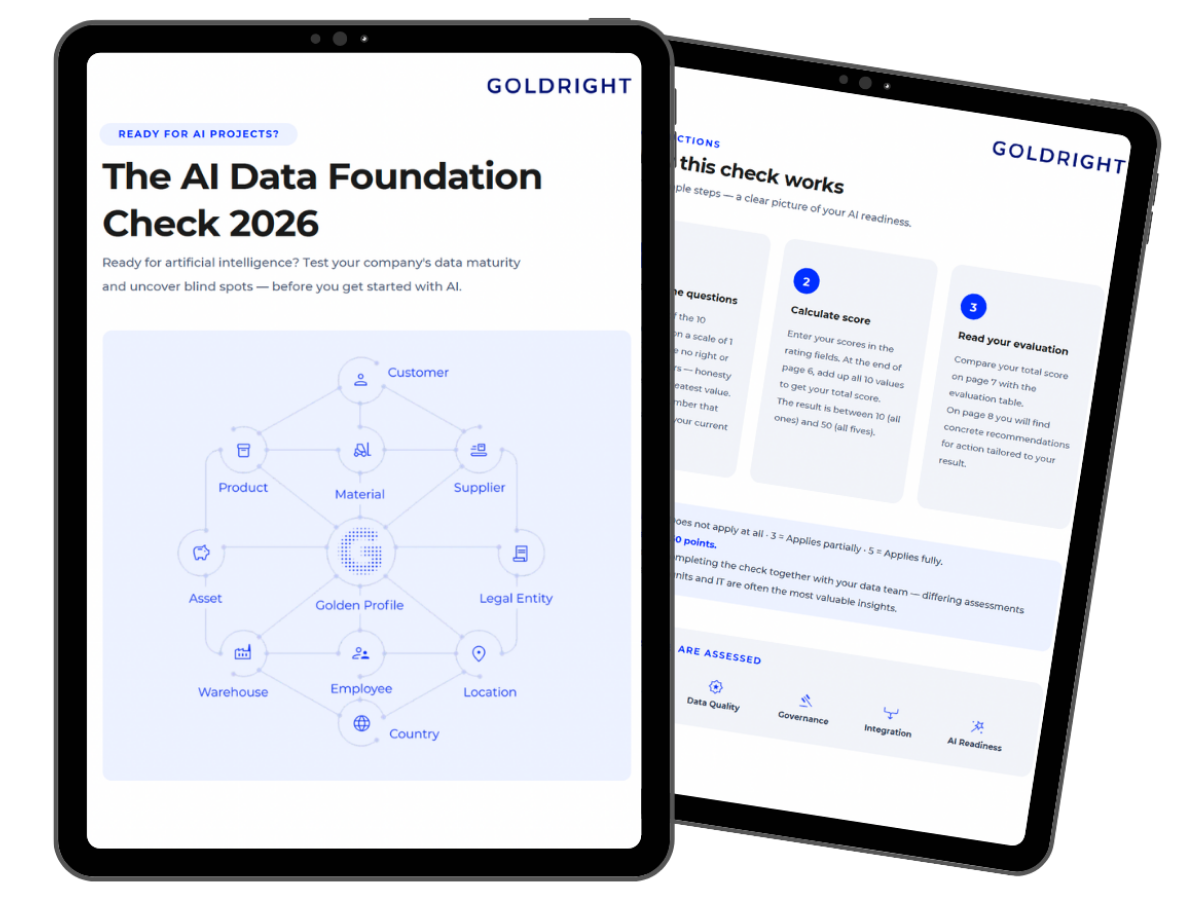
Many organizations overestimate the quality of their master data until their first AI project fails. Our AI Data Foundation Check provides you with a clear assessment of your current master data maturity in just 15 minutes and identifies specific areas for action.

  • Evaluation score for all data dimensions

  • Ready-to-use roadmap template

  • 100% free

Best Practices: What Works in Enterprise Settings

The following seven principles are drawn from MDM implementations in European mid-market companies and corporate structures. They are deliberately formulated as guidelines for behavior, not as a list of features.

Business sponsorship before tool selection.
Gartner puts it clearly: Implementing MDM software alone does not close the MDM gap. A program without a designated C-level sponsor from the business side will fail due to a lack of adoption—regardless of the platform’s quality.

One domain, one measurable success, then the next.
Attempting to tackle all domains simultaneously creates stakeholder complexity that no program can sustain. A sequential approach delivers visible results sooner and thus secures the budget for subsequent phases.

Define quality rules in collaboration with the business unit.
Every validation rule requires a business justification. The key question is: “What happens operationally if this field is missing or incorrect?” Rules without this answer block processes and will be circumvented.

Measure before you build.
The baseline is a prerequisite, not an afterthought. A duplicate rate that was not measured before the project started cannot be reconstructed retroactively—and thus no improvement can be demonstrated.

Plan for historical data tracking from the very beginning.
Introducing point-in-time traceability retroactively is time-consuming, if not impossible. It is a prerequisite for regulatory compliance, auditability, and the reconstruction of past states.

Adopt an API-first approach.
The Golden Record is only effective where it is consumed. Configurable, bidirectional interfaces to ERP, CRM, BI, and analytics platforms are not an expansion phase but part of the core architecture.

Separate the data model from the system.
Systems are replaced, migrated, and consolidated. A canonical data model, defined independently of the current landscape, survives these cycles and makes migrations manageable.

Comparison: The Four MDM Implementation Styles

The architectural decision is the most consequential one in the entire program. It determines the effort required, the extent of intervention in the source systems, and the level of consistency that can be achieved. Four styles have become established.

Criterion

Registry

Consolidation

Coexistence

Centralized

Principle

Central index with cross-references; data remains in the source systems

Master data is consolidated and cleaned; source systems remain the primary sources

MDM maintains the Golden Record; source systems maintain synchronized copies

MDM is the sole authoritative source; all systems read from it

Data Storage

Keys and references only

Copy for analysis purposes

Centralized “golden record,” distributed copies

Fully centralized

Writing Direction

None

Read-only

Bidirectional

Centralized writing

Impact on Source Systems

Minimal

Low

Medium

High

Achievable Consistency

Low to Medium

Medium

High

Very High

Implementation Effort

Low

Medium

High

Very High

Typical Use Cases

Initial visibility into duplicates; regulatory views

Reporting, analytics, group consolidation

Established landscapes with operational consistency requirements

New development, clear group guidelines, high regulatory pressure

Typical Limitation

Operational processes remain inconsistent

Improvements do not feed back into operations

Higher integration and operational costs

Often not feasible from an organizational standpoint

In European corporate structures, the coexistence model is the viable choice in most cases. It achieves operational consistency without requiring the replacement of established systems—a requirement that must remain realistic in environments with multiple ERP instances.

MDM in Relation to Related Disciplines

The second common question regarding its scope concerns related disciplines. The following overview provides clarity.

Discipline

Primary Goal

Data Focus

Relationship to MDM

Master Data Management

Consistent, authoritative master data (Golden Record)

Customers, products, suppliers, locations, legal entities

Data Governance

Rules, roles, and responsibilities for all data

All data types

Overarching framework; MDM is the operational implementation for master data

PIM

Product information for sales and marketing channels

Product data, media, descriptions

A subset of the product domain; channel-oriented rather than cross-system

CRM

Customer Relationships and Sales Process

Customer Data in the Sales Context

Source system for the customer domain; not a company-wide instance

Data Warehouse

Historical Analysis and Reporting

Aggregated Transaction and Analysis Data

Consumer of the Golden Record; not retroactive in operations

Data Catalog

Discoverability and Description of Data Sets

Metadata

Supplementary; describes data but is not responsible for it

The key point: These concepts are not in competition with one another. Data governance defines the rules of the game; MDM enforces them operationally for master data; PIM and CRM are specialized consumers and sources; and the data warehouse performs the analysis. Anyone who tries to replace MDM with one of the others is merely shifting the problem rather than solving it.

Practical Model: The Path from Maturity Level 2 to Maturity Level 3

The following pattern is derived from several real-world projects and is intentionally presented without naming specific companies. It describes a typical progression, not a case study.

Initial Situation

A manufacturing conglomerate with several national subsidiaries, having grown historically through acquisitions. Multiple ERP instances, two CRM systems, and a standalone procurement system. Suppliers are listed multiple times under different spellings and classifications. The monthly closing process involves several days of manual reconciliation. When asked about the duplicate rate, there is no specific figure—only estimates from individual departments.

According to the Gartner Maturity Model, this corresponds to Level 2: Initiatives exist, but there are no company-wide defined processes, roles, or metrics.

Approach

The program does not begin with a selection of tools, but with an assessment. According to the HBR Method, 100 recently created data records per domain are checked for critical errors. The result is regularly significantly lower than the organization’s self-assessment—and it is precisely this that creates the willingness to clearly define ownership in a binding manner.

Next, a domain is prioritized. In this example: suppliers. Not because it would be the simplest from a technical standpoint, but because the head of procurement takes responsibility and the business impact is immediately visible across procurement, compliance, and corporate reporting.

This is followed by governance and a role model with a designated decision-making body, then the canonical data model, then the architectural decision—typically coexistence—then matching, survivorship rules, and bidirectional integration.

Mechanism of Action

The measurable effect occurs in three areas. First, the effort required for manual reconciliation decreases because systems no longer need to be reconciled against one another. Second, processes that rely on supplier identity—such as approvals, risk assessments, and framework contract assignments—are streamlined. Third, regulatory reporting becomes reproducible because the history and origin of data are documented.

The Actual Transition

The leap from maturity level 2 to 3 does not occur when the platform goes live. It occurs when the organization makes a master data decision for the first time without the program team having to moderate it. From this point on, the discipline sustains itself.

Pitfalls: What Reliably Causes an MDM Program to Fail

The scope expands along with the requests from business units.
Each unit adds attributes that are “also important.” Without Gartner’s definition—the smallest possible set, used across processes—the data model grows until it can no longer be maintained. The scope is a decision, not a consensus.

Governance is documented rather than decided.
A RACI matrix without a decision-making body describes responsibility, not authority. The test: Who makes the decision within two weeks when two business units advocate conflicting definitions?

Data cleansing replaces process change.
A dataset that has been cleansed once loses its quality within six to twelve months if the source processes remain unchanged. Data cleansing without governance is a recurring expense.

Integration is planned as an afterthought.
A golden record without feedback to the operational systems does not improve processes. It creates yet another data source—and thus exactly the problem that was supposed to be solved.

All domains launch simultaneously.
Too many stakeholders, too many conflicting goals running in parallel, too little focus. The sequential approach may seem slower but delivers results sooner.

No operating budget is allocated.
After go-live, program funding ends, and the future of operations remains unclear. Data stewards are assigned on the side, monitoring comes to nothing, and key metrics quietly fall by the wayside.

The benefits are claimed rather than proven.
“The data is better now” is not a valid argument in the steering committee. Without a baseline, defined KPIs, and regular reporting, the value contribution cannot be demonstrated—and the follow-up budget cannot be justified.

Before You Invest in Technology: Do You Know Where You Stand?


Our AI Data Foundation Check guides you through the key dimensions that determine the success of an MDM program—domains, quality, ownership, architecture, and measurability.

  • Structured self-assessment across the relevant data dimensions

  • Evaluation score with classification

  • Roadmap template for prioritizing your first domain

  • 100% free

Conclusion: Master Data Management Is a Capability, Not a Project

The key takeaway from this article can be summarized in one sentence: The bottleneck in master data management is almost never the technology.

Gartner places the majority of large organizations at maturity level 2 out of 5—and at the same time makes it clear that implementing MDM software does not close the MDM gap. The leap to maturity level 3 occurs when the scope is defined, ownership is assigned with decision-making authority, and progress is measured.

The costs of inaction are better documented than the costs of taking action. Gartner estimates the consequences of poor data quality at an average of $12.9 million annually. The Harvard Business Reviewshows that the actual starting point is regularly far below self-assessments. And Bitkom reports that only 6% of German companies are fully leveraging the potential of their data.

The path to achieving this is unspectacular but effective: measure, prioritize a domain, clearly define ownership with binding authority, choose the appropriate implementation style, feed the Golden Record back into operational processes—and fund operations, not just the initial implementation.

Start with measurement. Everything else follows from there.

Frequently Asked Questions about Master Data Management

Master Data Management (MDM) is the centralized, cross-system management of key business data—such as information on customers, products, suppliers, and organizational units. The goal is to maintain a consistent “golden record” for each data object as a single source of truth, thereby providing a reliable data foundation for reporting, automation, and AI.
Master data consists of a company’s core data—which rarely changes—that describes business objects such as customers, suppliers, products, materials, and employees. It forms the stable reference system that all business processes rely on. It is also referred to as master data.
The most important types of master data include customer master data, supplier master data, material and item master data, HR master data, as well as legal entity and organizational data. As a rule of thumb: Anything that permanently describes a business object and is used by multiple processes is considered master data.
MDM addresses all critical master data domains within an organization: customers, suppliers, products, locations, and legal entities. PIM specializes in product information—primarily for marketing purposes such as e-commerce, catalogs, and sales channels. The key difference: PIM optimizes product content for external communication. MDM ensures the operational and cross-system consistency of master data.
MDM and data governance are closely related but not identical. Data governance is the overarching framework—the totality of all policies, processes, roles, and responsibilities for a company’s data management. MDM is the operational implementation of data governance principles for master data. Data governance defines the rules of the game; MDM implements them for master data in terms of both technology and processes.
Four styles have become established: Registry (centralized index with cross-references, no physical data storage), Consolidation (consolidation and cleansing for analytics; source systems remain the primary data sources), Coexistence (centralized golden record, synchronized copies in the source systems, bidirectional), and Centralized (MDM as the sole authoritative source). They differ in terms of the level of intervention, the consistency that can be achieved, and the effort required.
Yes. SAP S/4HANA is an excellent ERP system. It is not an MDM system. S/4HANA manages master data within its own system boundaries—but most companies do not have a pure S/4HANA landscape. They have S/4HANA plus CRM plus legacy systems plus cloud applications. MDM complements SAP S/4HANA by acting as a cross-system integration hub: The Golden Record is managed in the MDM system and synchronized bidirectionally with S/4HANA and all other systems.
The honest answer: It depends heavily on the starting point, the number of domains, and organizational complexity. As a rough guide based on real-world experience: a pilot for a domain of medium complexity often takes several months; a broader implementation across multiple domains typically takes one to two years; and a group-wide MDM program takes several years and is implemented iteratively rather than as a “big bang.” These timeframes are general estimates based on experience and are not guaranteed.
The range is wide: costs vary greatly depending on company size, the number of system integrations, and domains. A reliable, robust cost estimate can only be provided based on an individual assessment. Generic flat rates without a project-specific basis are deliberately not mentioned to avoid disseminating unsubstantiated figures. The ROI stems primarily from reduced error costs, accelerated processes, avoided compliance risks, and enabled AI use cases.
Operational responsibility lies with the data owners in the business units, while strategic oversight typically falls to the Chief Data Officer (CDO). IT provides the platform. This three-part structure—strategic leadership, business ownership, and technical platform—is the backbone of any effective master data management system.
The Golden Record is the single, consolidated, and authoritative version of a data entity—such as a customer, supplier, or legal entity. The data owner defines which attributes constitute the Golden Record and which source systems are considered authoritative. The Golden Record is the operational goal of every MDM-supported governance framework.
MDM is relevant for any company that works with multiple systems, multiple locations, or multiple domains. This includes medium-sized companies with approximately 200 or more employees and significant ERP landscapes.
MDM is a prerequisite for a functioning AI strategy, not a parallel initiative. AI models—whether for predictive analytics, generative AI, or process automation—are directly dependent on the quality, consistency, and completeness of the data. Without a Golden Record, AI scales errors—not efficiency.

Sources

Gartner: "Master Data Management: Build a Strong Process, Framework and Solution" - https://www.gartner.com/en/data-analytics/topics/master-data-management

Gartner: "Data Quality: Best Practices for Accurate Insights" - https://www.gartner.com/en/data-analytics/topics/data-quality

Harvard Business Review: "Only 3% of Companies’ Data Meets Basic Quality Standards" - https://hbr.org/2017/09/only-3-of-companies-data-meets-basic-quality-standards

Bitkom e. V.: "Press Release: Deutsche Unternehmen nutzen ihre Daten kaum" - https://www.bitkom.org/Presse/Presseinformation/Deutsche-Unternehmen-nutzen-ihre-Daten-kaum

Grand View Research: "Master Data Management Market Report" - https://www.grandviewresearch.com/industry-analysis/master-data-management-market-report

McKinsey & Company: "The data-driven enterprise of 2025" - https://www.mckinsey.com/capabilities/quantumblack/our-insights/the-data-driven-enterprise-of-2025

Europäische Kommission: "Data Act" - https://digital-strategy.ec.europa.eu/en/policies/data-act

IBM: "Was ist Master Data Management (MDM)?" - https://www.ibm.com/de-de/think/topics/master-data-management

DAMA International: "DAMA Data Management Body of Knowledge (DAMA-DMBOK)" - https://dama.org/learning-resources/dama-data-management-body-of-knowledge-dmbok/

DAMA-MN (Chapter von DAMA International): "Reference & Master Data Management (MDM)" - https://www.dama-mn.org/Reference-MDM