Organizational Data Manager. The Clear Structure for Your Entire Global Organization.
Transform rigid organizational charts into dynamic management tools. Connect employees, roles, and hierarchies across departmental boundaries into a transparent, unified organizational structure.
:format(webp))
Master complexity. Organizational resilience to strengthen.
Outdated structural data hinder your ability to act. The Organizational Data Manager harmonizes personnel and organizational data from isolated HR and ERP systems. Create a living, centralized view of your organizational structure to accelerate reorganizations, manage access rights, and deploy resources efficiently.

Dynamic Org Charts

Matrix Organizations

Roles and Permissions

Seamless Integration

AI that truly understands your data.
With native MCP integration, AI agents access your verified Golden Record directly and in real time — without additional interfaces and without data loss.
Fewer hallucinations thanks to verified real-time data
Granular permissions instead of uncontrolled access
Seamless audit trail for every AI response
Your Advantages
Shorten decision-making paths through clear and structured hierarchies
Maximize transparency across all headcounts and corporate cost centers
Accelerate major reorganizations and complex M&A integrations
Ensure compliance through precise assignment of roles and responsibilities
Automate all IAM processes through clean and high-quality master data
Eliminate manual maintenance of email distribution lists entirely
Synchronize HR data accurately with Active Directory and ERP systems
Abolish shadow IT for organizational charts across the company
Trust the Market Leaders
The MDM platform of choice for leading enterprises. Our solutions ensure measurable data quality and compliance in the most demanding industries.
We implemented a central online database with Goldright that enables collaborative management of organizational structures, dependencies, and connections. Time and cost savings, greater transparency, and easier handling are just some of the benefits.

Benedikt Stimpfl-Abele
Project manager, Andritz AG
With Goldright we have a professional standard solution that brings together both the capture and provision of highly complex master data and transactional data under one roof.

Dieter Matthes
Head of Investments, Thüga AG
With Goldright Legal Entity Manager, we can now access a wide range of information about our companies, including their contracts and documents, at the click of a mouse. The versioning function is particularly helpful, as it also allows historical data to be backed up and retrieved.

Kristiana Steiner
Legal Department and Compliance, Grazer Wechselseitige Insurance AG
We implemented a central online database with Goldright that enables collaborative management of organizational structures, dependencies, and connections. Time and cost savings, greater transparency, and easier handling are just some of the benefits.
Benedikt Stimpfl-Abele
Project manager, Andritz AG
With Goldright we have a professional standard solution that brings together both the capture and provision of highly complex master data and transactional data under one roof.
Dieter Matthes
Head of Investments, Thüga AG
With Goldright Legal Entity Manager, we can now access a wide range of information about our companies, including their contracts and documents, at the click of a mouse. The versioning function is particularly helpful, as it also allows historical data to be backed up and retrieved.
Kristiana Steiner
Legal Department and Compliance, Grazer Wechselseitige Insurance AG





Master Data: The Foundation for your AI-driven HR Strategy
The successful deployment of AI depends on excellent data quality. With our organizational management, you lay the foundation for your most advanced AI initiatives.
Operational Excellence
Automatically visualize complex organizational structures
Efficiently close data gaps across all reporting lines
Validate and ensure secure role-based access rights
Standardize personnel reporting across the entire company
AI-powered automation
Predict skill gaps and workforce requirements using AI
Simulate and identify optimal team compositions efficiently
Automate succession planning throughout the entire organization
Enable agile resource matching across the whole enterprise
Our Core Functions
The Goldright Enterprise Suite brings together all the critical functions for quality, governance, and seamless integration in a single system.
Flexible Hierarchies
Modeling complex structures, from classical lines to dynamic matrix organizations.

AI Assistant
Processes questions about the organization in natural language and provides immediate analyses.

Point-in-Time Historization
360-degree view into the past ("Who was the manager when?") for audit-compliant traceability.

Integrated Governance
Central management of job descriptions, approval rights and organizational rules.

Business Process Engine
Central management of job descriptions, approval rights and organizational rules.
Configurable APIs
Bidirectional synchronization with HCM systems (e.g., Workday, SAP) and identity providers.
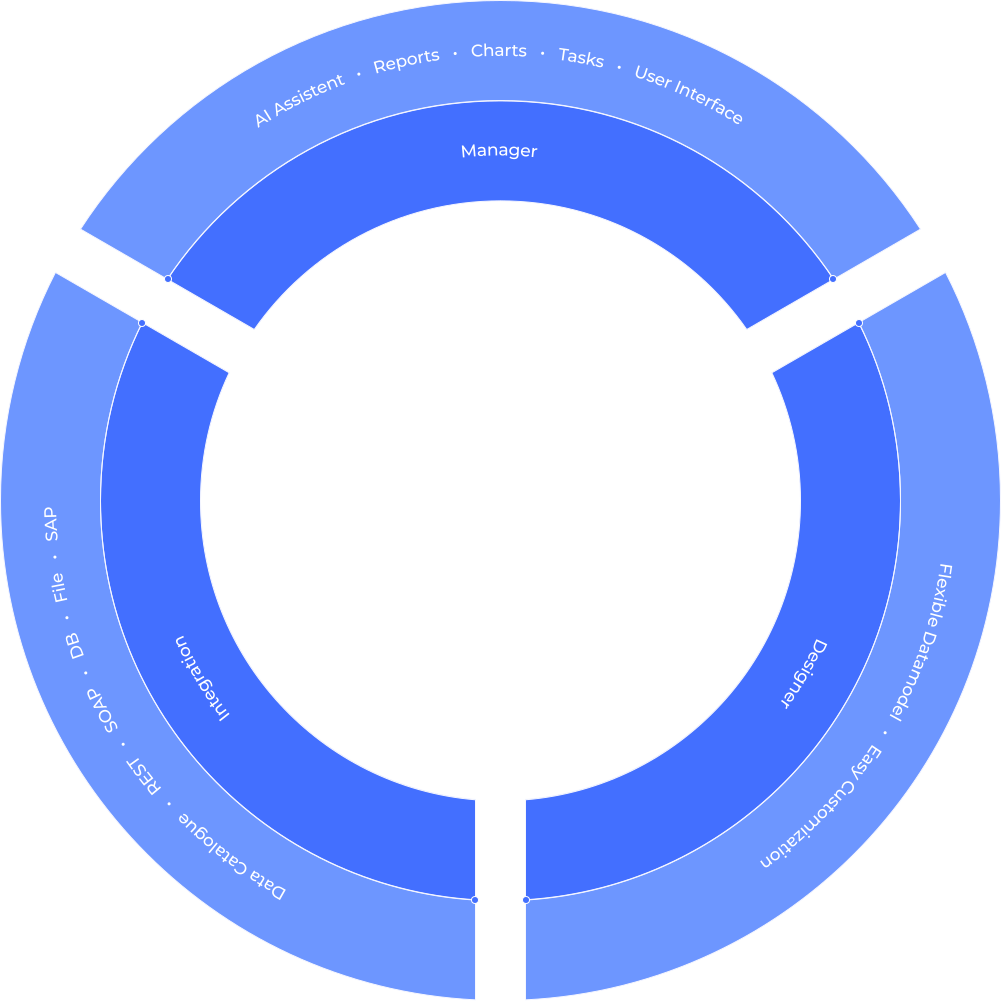
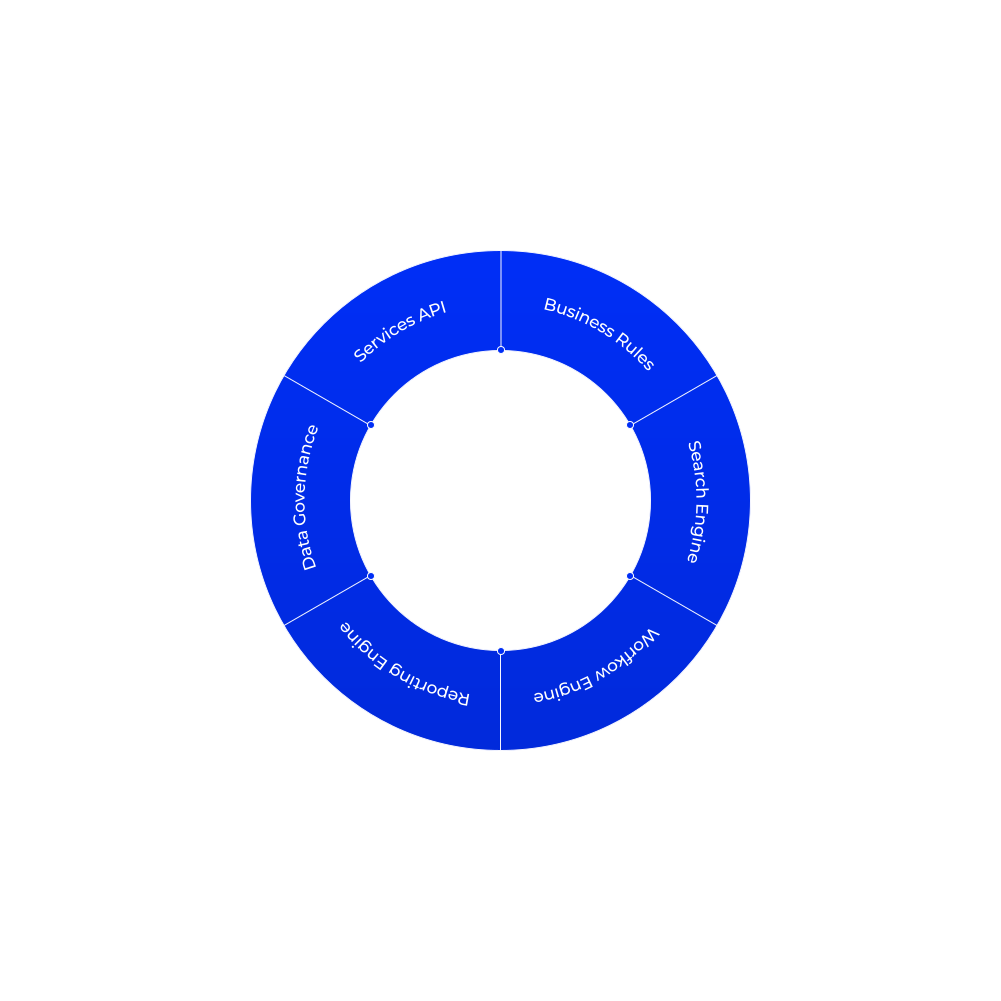
High-Level-Architecture of Our Solution
Connect your entire enterprise through seamless data relationships on one central platform.

Frequently Asked Questions about the Organizational Data Manager
- Organizational Data Management—also known as organizational data management—is the centralized, structured management of all data related to a company’s structural and operational organization: organizational units, roles, permissions, hierarchies, and their relationships. The goal is to maintain an up-to-date, consistent representation of the organizational structure at all times, serving as a reliable foundation for HR, governance, and AI.
- The organizational structure describes how a company is divided into units, roles, and reporting lines. It can only be kept up to date with a central data source: An Organizational Data Manager consolidates organizational data from HR and line-of-business systems so that changes—such as reorganizations—are automatically reflected everywhere, rather than in outdated individual files.
- HR master data describes individual employees (person, contract, start date). Organizational data describes the structure within which these individuals operate—units, roles, hierarchies, and dependencies. Only by combining the two in organizational data management can a complete, reliable picture of the organization be obtained.
- An Organizational Data Manager dynamically generates the organizational chart from central organizational data. If units, roles, or reporting lines change, the chart updates automatically. This ensures that the organizational chart is always up to date—even for complex matrix organizations—without the need for manual updates in presentation or spreadsheet programs.
- Organizational charts maintained manually quickly become outdated, contain inconsistencies across departments, and lack traceable version control. Reorganizations lead to errors and a lack of transparency. Centralized organizational data management ensures that the organizational structure remains consistent, traceable historically, and available as a reliable data source for downstream processes.
- Using open APIs, an Organizational Data Manager aggregates data from core HR systems (e.g., Workday, SAP SuccessFactors) and other sources and consolidates it into a central organizational structure. This prevents siloed solutions and Workday lock-in, and ensures that organizational data remains consistent across systems.
- Reliable organizational data forms the foundation for AI-powered HR and governance processes: roles, permissions, and responsibilities are managed based on rules and documented comprehensively. This enables decisions to be automated and compliance evidence to be provided with precision down to the specific reporting date.
- An Organizational Data Manager is ideal for organizations with complex, frequently changing structures—such as corporate groups with many units, matrix organizations, or companies following mergers. It creates a consistent database wherever manual organizational management becomes error-prone and lacks transparency.
Stop Planning. Start Mastering. Talk to an Expert.
:format(webp))