July 20, 2026

Data Governance Framework 2026: How CDOs Are Laying the Groundwork for Scalable Data Quality Now

RVZ

By Robbin van Zanten

Senior Account Executive

CDO analysiert Datenqualitäts-Dashboards am Bildschirm – Data Governance Framework in der Praxis

17 min read

Share this post

Anyone who views a data governance framework solely as a compliance task has already lost. This article explains what sets an effective framework apart from a paperless document—and why 2026 is the pivotal year for understanding that difference. You’ll learn about the four root causes of fragmented governance, a proven approach to building a framework, and the pitfalls that even experienced CDOs underestimate.
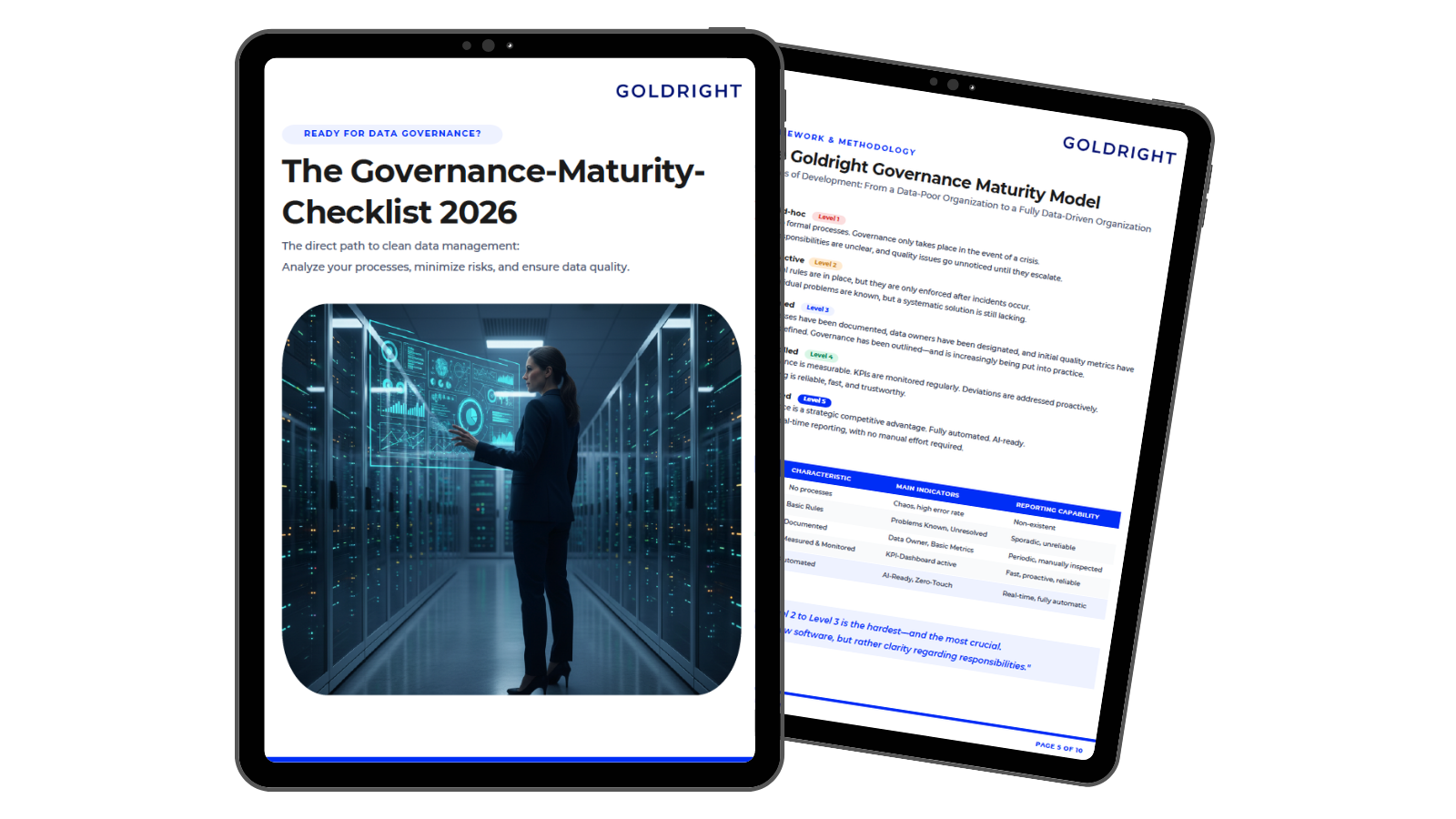
Key Takeaways

  • According to Gartner, poor data quality costs companies an average of €12.9 million per year—and 60% of all AI projects without AI-ready data will be abandoned by 2026.

  • A data governance framework defines roles, processes, policies, and technology—in exactly that order.

  • MDM and governance are not synonyms: MDM is the operational backbone; governance is the strategic framework.

  • Governance is not an IT problem—it is a strategic business problem with measurable ROI.

  • The Goldright Governance Maturity Model provides CDOs with a precise assessment of their current status.

  • Free download: Governance Maturity Checklist—10 questions, 15 minutes, clear results.

What is a Data Governance Framework?

A data governance framework is the formal system of policies, processes, roles, and technologies that defines how data is collected, maintained, used, and protected within an organization. It specifies who is responsible for which data, the quality standards by which it is managed, and how decisions are made in the event of data conflicts.

DAMA International defines data governance as “the establishment of policies, roles, and standards for managing data as a valuable business asset. It ensures compliance, accountability, and consistency across the organization.”

Governance is therefore not a one-time implementation task, but rather an organizational capability that must be maintained on an ongoing basis.

The Four Layers of a Comprehensive Framework

Layer 1 — Governance Structure (Roles & People): Data owners, data stewards, data custodians, and a data governance council define decision-making authority and responsibilities. Without clear ownership, every policy remains nothing more than a wish list.

Layer 2 — Governance Processes: How is data created, modified, approved, and archived? Who escalates conflicts? Processes are the operational procedures that keep the framework alive.

Layer 3 — Policies & Standards (Data Policies): Data protection policies, quality standards, classification schemes, and retention periods form the normative framework.

Layer 4 — Technological Enablers: Metadata management, data catalogs, MDM platforms, and data quality tools translate the framework into operational reality. Technology is the amplifier—not the starting point.

What a data governance framework is not:
It is not an IT project that ends once it goes live. It is not synonymous with data management. And it is not just another compliance document gathering dust on the intranet.

A robust framework is the foundation that makes AI initiatives, regulatory compliance, and scalable data growth possible in the first place. Without it, companies are building on sand—and they’ll feel the consequences by the next audit at the latest.

Why is a data governance framework more relevant than ever in 2026?

The question is no longer whether companies need a data governance framework. The question is how long they can afford to operate without one. Five verified data points:

€12.9 million in annual costs due to poor data quality

Gartner estimates the average annual cost of poor data quality at €12.9 million per company (based on a survey of enterprise customers regarding their actual costs).

80% of governance initiatives will fail by 2027

Gartner predicts that 80% of all D&A governance initiatives will fail by 2027—not because of technology, but because they do not address measurable business outcomes. “A D&A governance program that does not enable prioritized business outcomes fails.” (Saul Judah, VP Analyst, Gartner)

60% of AI projects without AI-ready data will be abandoned

Gartner: 63% of organizations have no or insufficient data management practices for AI. It is also predicted that by 2026, approximately 60% of all AI projects without AI-ready data will be abandoned.

4× More Investment = 65% Better Business Outcomes

According to Gartner, organizations with successful AI initiatives invest up to four times more in data foundations such as data quality and governance. Organizations with the highest D&A maturity achieve up to 65% better business outcomes.

23× Higher Probability of Acquiring New Customers

Data-driven companies are 23 times more likely to succeed in acquiring new customers, 6 times more likely to retain customers, and 19 times more likely to be profitable than competitors without a structured data strategy.

The 4 Root Causes of Governance Failure

We encounter the same pattern time and again in conversations with CDOs and data leadership teams: reporting cycles take too long, AI initiatives are put on hold, and audits reveal surprises. The problem is rarely a lack of technology. It is the absence of a structured governance framework. Four causes emerge with particular consistency:

Root Cause 1 — Lack of Data Ownership

No clear designation of a data owner or data steward. Data drifts without anyone taking responsibility—no one feels accountable until the problem escalates. The result: data silos, inconsistent master data, and endless rounds of clarification.

Symptom: “We have the same company in five systems under three different names.”

Root Cause 2 — Siloed Data Storage

Critical data sets are scattered across 5, 10, sometimes 20 different systems. Without a common master data layer, every integration becomes a one-off—and every report turns into a manual consolidation task.

Symptom: “It takes us three hours to gather the right data for an audit report.”

Root Cause 3 — Inconsistent Quality Standards

Every department defines “good enough” differently. What applies to Finance doesn’t apply to HR—and certainly not to consolidated reporting. The result: diverging KPIs depending on the data source and a loss of trust in reporting.

Symptom: “Which number is correct? Finance says one thing, HR says another.”

Root Cause 4 — Reactive Rather Than Proactive Governance

Quality issues only come to light when reporting deviates or an audit fails—never before. No early warning system, no monitoring, no defined escalation paths. Governance acts as a fire brigade rather than an architectural framework.

Symptom: “We knew about the problem, but we didn’t have a system that would sound the alarm in time.”

Framing Switch: This Isn’t an IT Problem—It’s a Strategic Business Problem

Here’s the uncomfortable truth: The biggest enemy of a functioning data governance framework isn’t bad technology. It’s the wrong framing.

As long as governance is positioned as an IT issue, it remains within the IT budget—and thus under the radar of the decision-makers who could actually make a difference. The result: a technically sound framework without organizational buy-in that ends up back in a drawer after 18 months.

The shift I make in every conversation with CDOs and CFOs:

Old Framing

New Framing

We need to improve our data quality.

Every day, we’re missing out on better decision-making.

IT needs to integrate our data systems.

Our growth strategy has a data foundation problem.

Compliance requires better documentation.

An audit risk costs more than the governance budget.

MDM is an IT project.

MDM is the infrastructure for AI ROI.

When a CFO realizes that poor governance jeopardizes their CSRD reporting—and thus exposes the company to fines in the millions—governance is no longer just an IT budget line item, but a strategic investment.

When a CDO realizes that their AI pilot project is failing because the underlying master data exists across five systems—then MDM is no longer a technical project, but the critical path to AI ROI.

Gartner confirms this empirically: Organizations that successfully deploy AI invest up to four times more in data foundations than those with poor AI outcomes.

The Goldright Governance Maturity Model: 5 Levels from Reactive to AI-Ready

Before a CDO launches a framework, they need to conduct an honest assessment of their current status. The Goldright Governance Maturity Model—distilled from 20 years of MDM practice—offers exactly that:

Level

Name

Characteristic

Key Indicator

Reporting Capability

L1

Ad hoc

No formal processes

Chaos, high error rate

None

L2

Reactive

Initial rules are in place

Issues are known but unresolved

Sporadic, unreliable

L3

Defined

Processes documented, data owners designated

Initial quality metrics

Checked periodically, manually

L4

Controlled

Measured & monitored

KPI dashboard active

Fast, proactive, reliable

L5

Optimized

Fully automated

AI-ready, zero-touch

Real-time, fully automated

The most important lesson from real-world experience: The leap from Level 2 to Level 3 is the hardest—and the most crucial. It doesn’t require new software, but rather clarity regarding responsibilities. Those who make this leap have crossed the critical threshold.

Where do you currently stand? The Governance Maturity Checklist (10 questions, 15 minutes) provides you with a precise assessment—including specific next steps for each level.

Stop Guessing. Start Governing.

Use this self-assessment to find out how robust your data foundation really is. With 10 targeted questions, this checklist shows you where you stand today—and where your greatest leverage for sound data governance lies.

  • 10-Question Checklist to Assess Your Governance Maturity

  • A field-tested 90-day plan you can start using right away

  • 100% free and independent

Approach: 6 Phases for the First 90 Days

Building a data governance framework that works isn’t rocket science—but it’s not a project that can be completed in three sprints. The following approach is based on Goldright’s 20 years of MDM experience and is deliberately pragmatic: no endless strategy documents, no big-bang implementation. Pragmatic, actionable—without external consulting, without a large budget.

Phase 1 — Inventory (Weeks 1–2)

Inventory of all data sources and systems. Who uses which data? Where are the critical dependencies and gaps? Don’t try to tackle everything at once—focus on the domain with the biggest pain point.

Deliverable: Prioritized list of data domains with a business case for each domain.
Responsible: CDO, IT Architecture.
Success criterion: All sources documented.

Phase 2 — Appoint Data Owners (Weeks 2–3)

Name and officially designate a person responsible for each critical data domain. Embed these roles in existing job descriptions and performance agreements—not just in organizational charts.

Deliverable: RACI matrix for all defined data domains.
Success criterion: Each domain has a designated owner.

Phase 3 — Define Quality Standards (Weeks 3–4)

Establish measurable quality dimensions: completeness, timeliness, consistency, and unambiguity—for each domain, in writing. A maximum of 3–5 KPIs. It’s better to have a few that everyone knows.

Deliverable: Written quality standards for each domain.
Success criterion: Standards adopted and communicated.

Phase 4 — Document the governance framework (Weeks 4–6)

Document guidelines, roles, and escalation paths in writing. A maximum of two hierarchical levels. Keep it short, clear, and binding—no 80-page manuals that no one reads. Limit escalation paths to a maximum of two levels: Complex structures are never put into practice.

Deliverable: Governance Policy Handbook (max. 20 pages, written in operational terms).
Success criterion: Policy adopted.

Phase 5 — Launch the pilot (Weeks 6–8)

Launch a specific use case—such as customer reporting or financial consolidation—as a pilot. Learn, adapt, scale. Demonstrate measurable results within 90 days. This builds credibility for expansion.

Deliverable: Pilot active, initial metrics visible.
Responsible: Data Owner, IT.

Phase 6 — Set up a monitoring and review cycle (Weeks 8–12)

Measure initial KPIs, set up a dashboard, and establish monthly governance reviews as a fixed calendar ritual—not quarterly, not ad hoc. What isn’t measured doesn’t improve.

Deliverable: Dashboard active, KPIs measured.
Success criterion: First governance report presented to executive leadership.

Best Practices: What Really Works in Practice

From 20 years of MDM experience with numerous enterprise projects in financial services, manufacturing, insurance, and real estate, we’ve distilled best practices that make all the difference:

1. Data Ownership First, Tools Second

Without clear ownership, every tool becomes a data graveyard. This is the most consistent lesson learned from practice—and, at the same time, the most frequently ignored piece of advice. Designate data owners before discussing technology.

2. Monthly governance reviews as a calendar ritual

Governance initiatives managed on a quarterly or ad hoc basis lose momentum. Monthly reviews—short, focused, with a fixed group of participants—keep the framework alive and ensure that identifiable problems remain manageable.

3. Establish the Golden Record as an operational anchor

The Golden Record—the single, authoritative version of an entity (customer, supplier, legal entity)—is the heart of every MDM-supported governance framework. Define early on: Which attributes are critical? Who is the authoritative source? How are conflicts resolved?

4. Speak business language, not IT language

Governance initiatives communicated using technical jargon die at the middle management level. Talk about “decision quality,” “audit assurance,” and “regulatory resilience”—not “metadata harmonization” and “data deduplication.”

5. Keep executive sponsorship visible

A Data Governance Council without C-level involvement lacks clout. Ensure that the CDO or CFO is visible in the governance steering committee at least once a month—not as a listener, but as an active decision-maker.

6. Plan for automation from the start

Manual governance processes do not scale. Data quality monitoring, data lineage, and automated approval workflows are not luxury features—they are prerequisites for Level 4+ on the maturity model. Only those who operate governance at Level 4+ can use AI safely and reliably.

Comparison: Data Governance Framework, MDM, Data Catalog, and More

One of the most common causes of confusion around governance is the mixing up of related concepts. This table provides clarity:

Concept

Definition

Primary Focus

Who is responsible?

Technological Enabler

Relationship to Governance

Data Governance Framework

Formal system of roles, policies, and processes for data management

Control, accountability, decision-making authority

CDO, Data Governance Council

Governance tools, policy management

The Foundation

Master Data Management (MDM)

A discipline for the centralized management of critical master data (customers, suppliers, products, legal entities)

Data quality, single source of truth

Data owner, MDM team

MDM platform (e.g., Goldright)

Operational backbone of governance

Data Management

The totality of all data processing practices (including storage, integration, and security)

Technical Data Management

IT, Data Engineering

ETL, Databases, Cloud Storage

A subdomain governed by governance

Data Catalog

Inventory of all data records with metadata, origin, and business context

Discoverability, transparency

Data stewards, business analysts

Alation, Collibra, Azure Purview

Technical tool to support governance

Data Quality Management

Processes to ensure completeness, consistency, and accuracy

Operational data quality

Data Stewards

DQ tools (Talend, Informatica)

Part of governance processes

Data Mesh

Decentralized architectural concept with domain-specific data ownership

Scalability, decentralization

Domain teams

Domain-specific platforms

Governance approach at the architectural level

The most important thing to remember: MDM and data governance are not alternatives, but complementary concepts. A framework without MDM lacks operational impact. MDM without a governance framework produces quality in the short term—but without sustainability.

Case Study: Legal Entity Governance Operationalized in 6 Months

Initial Situation (anonymized—Industry: Financial Services, >5,000 employees, international presence in 12 countries):

The company faced a classic governance dilemma: over 40 systems containing customer master data, no uniform definition of a “customer,” inconsistent legal entity structures within the corporate holding company, and an upcoming DORA audit. The existing governance document: 150 pages, not updated in two years, and impossible to find on the intranet.

Approach

In Week 1, we conducted a governance scope workshop with the CDO and the legal team. Focus: legal entity data as the pilot domain, as this was where regulatory pressure was greatest. Within six weeks, data owners and data stewards were designated for all 12 countries and consolidated in the Goldright Legal Entity Manager (LEM).

For the first time, the platform enabled point-in-time historical data retrieval—the corporate structure could be rolled back to any given reference date. This was the key functional component for DORA audits and regulatory reporting.

Results (Industry Benchmarks)

  • 40% faster delivery of structural data for audit and compliance reports

  • First-ever completeness of legal entity data across all 12 countries

  • DORA audit successfully passed—without last-minute data migration

  • Significant reduction in manual maintenance efforts by the legal team

What we learned from this: The key success factor was not the technology—but the CDO’s decision to be personally present in Week 1 and to make governance a strategic priority. Technology delivered quickly afterward.

Pitfalls: What to Avoid During Implementation

We see the following mistakes regularly—not among small businesses, but among large, well-resourced organizations with experienced data teams:

Pitfall 1 — Starting with Technology Instead of Processes

The most common misconception about governance: Procuring an MDM tool and then developing the governance process. The result is a flawless technology that no one uses. Rule: Processes first, then tools.

Pitfall 2 — Treating Governance as a One-Time Project

Governance is not a project with an end date. It is an organizational capability that must be maintained on an ongoing basis. Companies that consider governance “complete” after 12 months find that quality quickly erodes without ongoing maintenance.

Pitfall 3 — Involving Too Many Stakeholders Too Early

Governance-by-committee leads to governance-by-consensus—and consensus prevents quick decisions. Start with a small, effective core team. Expand governance gradually once quick wins have increased acceptance.

Pitfall 4 — Governance Without Measurement

What isn’t measured doesn’t improve. A surprising number of governance initiatives fail to define measurable KPIs. Without measurement, the framework lacks both the ability to steer the process and legitimacy in the eyes of senior management.

Pitfall 5 — Underestimating the Human Factor

Data stewards are often overburdened with operational tasks. Governance is an additional role that takes time—without any immediately visible personal benefit. Invest in change management, communication, and incentives. Governance without cultural buy-in is an empty promise.

Do you know your level of governance maturity?

Use this self-assessment to find out how robust your data foundation really is. Through 10 targeted questions, this checklist shows you where you stand today—and where your greatest opportunity for effective data governance lies.

  • 10-Question Checklist to Assess Your Governance Maturity

  • A field-tested 90-day plan you can start using right away

  • 100% free and independent

FAQ: Data Governance Framework — The Most Important Questions

What is the difference between data governance and data management?

Data governance defines the “why” and “how”—policies, responsibilities, and decision-making authority. Data management is the operational “what”—administration, storage, integration, and quality assurance. Governance guides management; both are necessary but not interchangeable.

How long does it take to implement a data governance framework?

An initial governance pilot in a single data domain can be operationalized in 8 to 12 weeks. Enterprise-wide implementation typically takes 12 to 36 months—depending on company size, system landscape, and organizational maturity. Governance is not a project with an end date, but rather a capability that must be maintained over the long term.

What roles are needed in a data governance framework?

Recommended set: Data Owner (business representatives for each data domain), Data Steward (responsible for operational quality), Data Custodian (IT-side system responsibility), and Data Governance Council (overarching steering committee with C-level participation).

What is a Data Governance Council?

A Data Governance Council is the overarching steering committee. It typically consists of Data Owners from all data domains, the CDO, and representatives from relevant business units (Legal, Compliance, Finance, IT). The Council makes decisions regarding governance policies, resolves cross-domain data conflicts, and prioritizes governance initiatives.

What is the Golden Record?

The Golden Record is the single, consolidated, and authoritative version of a data entity—such as a customer, supplier, or legal entity. The data owner defines which attributes constitute the Golden Record and which source systems are considered authoritative. The Golden Record is the operational goal of every MDM-supported governance framework.

How does data governance relate to the GDPR and DORA?

A robust governance framework makes regulatory compliance structurally easier. The GDPR requires transparent data management and deletion processes. DORA mandates demonstrable ICT risk management for financial institutions. Both are significantly easier to comply with if data ownership, classification, and quality standards are already defined within the governance framework.

When do I need an MDM system for data governance?

As soon as critical master data is maintained in more than two systems and inconsistencies lead to operational problems, an MDM system is the next logical step. MDM is not the foundation of governance—but without it, the framework lacks the operational backbone needed for implementation.

How do I measure the success of a data governance framework?

Recommended KPIs: data quality rate per domain (completeness, uniqueness, timeliness), number of open data conflicts and time to resolution, governance compliance rate, audit readiness (time to provide compliance reports).

Are there recognized standards for data governance?

Yes. The DAMA-DMBOK2 (Data Management Body of Knowledge) is a globally recognized standard. In addition, there is the DCAM Framework (EDM Council) and industry-specific standards such as BCBS 239 for banks. None of these are mandatory standards—but they provide structured guidance for framework development.

Conclusion: A data governance framework is the infrastructure of your data strategy

A data governance framework is not a project you set up once and then forget about. It is the infrastructure upon which everything else is built—regulatory compliance, AI initiatives, strategic reporting, and scalable growth plans.

The numbers speak for themselves: €12.9 million in annual costs due to poor data quality. 80% of governance initiatives fail not because of technology, but because of misplaced priorities. 60% of AI projects without AI-ready data are abandoned. Companies that invest in data foundations achieve up to 65% better business outcomes. This isn’t just an abstract statistic—it’s the operational reality in boardrooms worldwide.

What we see time and again in our work with international companies: The difference rarely lies in the technology. It lies in the courage to address governance as a strategic business issue—and in the discipline to keep the first step small and measurable.

The companies that will successfully scale AI initiatives, deliver ESG reports on time, and pass audits with flying colors by 2026 have one thing in common: they invested early on in a robust data foundation.

Do you know your governance maturity level?

Do you know where your organization stands on the maturity model? The Governance Maturity Checklist will give you the answer—in 15 minutes, free of charge.

Sources

Gartner: Data Quality: Best Practices for Accurate Insights - https://www.gartner.com/en/data-analytics/topics/data-quality

Gartner: Press Release "Gartner Predicts 80% of D&A Governance Initiatives Will Fail by 2027, Due to a Lack of a Real or Manufactured Crisis" - https://www.gartner.com/en/newsroom/press-releases/2024-02-28-gartner-predicts-80-percent-of-data-and-analytics-governance-initiatives-will-fail-by-2027-due-to-a-lack-of-a-real-or-manufactured-crisis-

Gartner via Neo4j: Gartner® report on how to evaluate AI data readiness - https://neo4j.com/whitepapers/gartner-evaluate-ai-data-readiness/

Gartner: Press Release "Gartner Says Organizations with Successful AI Initiatives Invest Up to Four Times More in Data and Analytics Foundations" - https://www.gartner.com/en/newsroom/press-releases/2026-04-16-gartner-says-organizations-with-successful-ai-initiatives-invest-up-to-four-times-more-in-data-and-analytics-foundations

McKinsey Global Institute via diwo: McKinsey’s 7 Characteristics of the Data-Driven Enterprise - https://diwo.ai/blog/7-characteristics-of-the-data-driven-enterprise

Forbes: Cleaning Big Data: Most Time-Consuming, Least Enjoyable Data Science Task, Survey Says - https://www.forbes.com/sites/gilpress/2016/03/23/data-preparation-most-time-consuming-least-enjoyable-data-science-task-survey-says/

EU-Kommission: CSRD-Guideline 2022/2464 - https://eur-lex.europa.eu/legal-content/DE/TXT/?uri=CELEX:32022L2464

EU-Kommission: DORA-Regulation (EU) 2022/2554 - https://eur-lex.europa.eu/legal-content/DE/TXT/?uri=CELEX:32022R2554

DAMA International: The heart of DAMA-DMBOK - https://www.damadmbok.org/copy-of-about-dama-dmbok

BaFin, KWG §24 / CRR / BaFin-Merkblatt: Regulatory Requirements for Legal Entities in Financial Institutions - https://www.bafin.de/DE/home_node.html