July 6, 2026
Golden Record Master Data: Why Clean Master Data Will Determine Your AI Success in 2026

By Philipp Seibald
Vice President Sales
:format(webp))
15 min read
Share this post
Anyone reading this article will understand why AI initiatives in companies fail—not because of the technology, but because of fragmented master data. You’ll learn what “Golden Record” really means in the context of master data, the four root causes of data chaos, and what structured approach can turn a master data problem into a strategic foundation for AI. Includes concrete best practices, a comparison of the most common data solutions, and an FAQ for executives. Translated with DeepL.com (free version)
What is a Golden Record in the context of master data?
At its core, a Golden Record—also known as the “Single Source of Truth” or “Master Record”—refers to the single, authorized, and trusted data record for an entity within a company. This entity can be a customer, a supplier, a product, an organizational unit, or a legal entity.
A Golden Record is not simply a copy or a database export. It is the result of a controlled, rule-based process in which data from various source systems—ERP, CRM, SCM, MES, BI—is consolidated, cleansed, validated, and subject to clear governance. The result is a single data record that all systems and teams within a company can trust.
Master Data Management (MDM) is the discipline that systematically and continuously ensures this process. MDM encompasses the technology, processes, and organizational rules that ensure master data remains consistent, complete, accurate, and up-to-date—across all systems, business units, and geographic regions.
In the context of AI and automation, MDM will become a prerequisite by 2026, not an option. This is because large language models (LLMs), predictive analytics, and AI-powered decision-making systems are only as good as the data used to train or operate them. A fragmented, inconsistent data set leads to AI hallucinations, incorrect predictions, and compliance-related errors—with potential
The term “Golden Record” originated in customer data management and gained popularity through CRM systems. Today, it is used across industries and domains: There are Golden Records for material master data in production, for ownership structures in the legal sector, for employee data in HR, and for asset data in real estate management. What they all have in common is the need for a single, reliable source of truth.
Why is a Golden Record so critical to business in 2026?
The relevance of Golden Records in master data management will no longer be merely academic by 2026—it will be a matter of survival. Several converging trends are driving this paradigm shift.
1. The pressure to invest in AI is real—but companies are often ill-prepared
According to McKinsey, over 88% of the companies surveyed already use AI regularly in at least one business function—an increase of 10 percentage points from the previous year. At the same time, only about one-third have begun to scale AI across the entire enterprise—the gap between adoption and measurable value is the real challenge.
Gartner predicts that by the end of 2026, around 60% of all AI projects will be abandoned—not because of poor algorithms, but due to a lack of AI-ready data. An accompanying survey of 1,203 data management leaders revealed that 63% of organizations have no data management practices for AI, or their practices are unclear.
Forrester Research identifies data quality as the primary limiting factor for the use of generative AI in B2B companies.
2. Regulatory pressure drastically increases the costs of poor-quality data
The EU AI Act sets clear requirements for data quality and data governance for AI systems in high-risk categories. Companies that cannot demonstrate verifiable data lineage and validated master data risk fines and operational restrictions.
3. The costs of fragmented master data are measurable
According to an analysis by Thomas Redman, poor data quality results in costs amounting to 15–25% of a company’s revenue—a finding confirmed by Gartner, which estimates the average annual loss per company at at least $12.9 million.
This is no exception: 84% of enterprise organizations struggle with incorrect or duplicated data—with direct impacts on operations, compliance, and customer experience.
In practice, Goldright regularly observes among its clients prior to project launch that over 30% of master data records contain duplicates, inconsistencies, or outdated information—a figure that aligns with industry benchmarks, according to which companies without formal MDM have duplicate rates of 10–30% or higher.
4. M&A Activities and Business Growth Exacerbate Data Chaos
Every corporate acquisition, every new branch, and every new ERP system brings its own data silos. Without centralized MDM, inconsistencies multiply. For companies operating globally—with hundreds of subsidiaries and thousands of suppliers—effective Golden Record Management is not a luxury but an operational foundation.
5. Competitors with a solid data foundation act faster
Companies that have already established a consolidated golden record can roll out new AI applications in weeks rather than months. According to Gartner, organizations with the highest level of maturity in AI-ready data and analytics capabilities achieve up to 65% better business results—including revenue growth and cost optimization. Companies with successful AI initiatives invest up to four times more in data foundations—such as quality, governance, and AI-ready data—than companies with poor AI outcomes.
The 4 Root Causes of Master Data Chaos
Before a company can implement a solution, it must understand the actual causes of its data problem. Based on over 20 years of experience at Goldright, four recurring root causes have emerged.
Root Cause 1: Ad-hoc System Landscapes Without Centralized Governance
Most enterprise organizations have grown over decades—both organically and through acquisitions. The result: a patchwork of SAP instances, legacy ERPs, in-house databases, and cloud applications, with each system maintaining its own version of the truth regarding customers, products, or suppliers. Without a central governance body, data chaos arises systematically and inevitably.
Root Cause 2: Lack of Data Ownership
“Whose data is this?”—In many organizations, this question has no clear answer. If no one is responsible for a data set, it is not actively maintained by anyone. IT departments maintain systems, but not content. Business units maintain content in spreadsheets, but not in the system. The result: conflicting versions, outdated master data, and manual reconciliation efforts.
Root Cause 3: No History Tracking and Versioning
Master data are not static objects. Suppliers change their addresses, corporate structures are reorganized, and product specifications are adjusted. Systems without point-in-time history tracking lose the
Root Cause 4: Process Automation Without a Solid Data Foundation
Many companies try to automate processes before their data foundation is ready. Robotic Process Automation (RPA), AI-powered approval workflows, or automated compliance checks only work if the underlying master data is accurate and consistent. Automation based on poor data amplifies errors—not efficiency.
Not a Data Problem—But a Corporate Strategy Problem
The biggest pitfall with Golden Records in master data management is misframing the issue: Many organizations treat MDM as an IT project—as a one-time technical cleanup to be carried out before moving on to the “real” strategic issue.
This is fundamentally wrong.
MDM is not an IT project. MDM is a strategic business decision that determines whether a company will remain competitive in the AI era.
Incorrect Framing | Correct Framing |
We have a data problem” | “We have a strategic governance problem” |
“IT is supposed to solve this" | “The CDO is responsible; the business is the owner” |
“One-time cleanup project” | “A continuous, managed process with clear rules” |
“MDM costs are IT overhead” | “Investment in AI readiness and compliance security” |
“We need better data” | “We need a Golden Record as the corporate standard” |


This shift in framing has practical implications: When MDM is treated as a strategic issue, it has a budget, C-level sponsorship, and a clear roadmap.
Gartner provides concrete evidence of this: 89% of the CDAOs surveyed describe effective data and analytics governance as essential for business and technological innovation. Furthermore, organizations that establish governance as a strategic priority achieve business results from their AI investments that are up to 65% better than average.
The Goldright Approach: Step by Step to the Golden Record
A Golden Record isn’t created simply by purchasing software. It is created through a combination of technology, process, and governance. The following framework describes the proven approach that Goldright uses in enterprise projects.
Step 1: Master Data Inventory and Domain Definition
Before anything can be consolidated, it must be clear what exists. This begins with a structured inventory: Which master data domains exist? Which source systems contain this data? What is the current level of inconsistency and redundancy? This inventory provides the basis for decision-making regarding prioritization and the business case.
Step 2: Data Model and Golden Record Definition
A canonical data model is defined for each domain: What are the required attributes of a golden record? Which fields are imported from which source system? Goldright’s Agile Data Manager (ADM) enables low-code configuration here—without months-long development projects.
Step 3: Establish a Governance Model and Data Ownership
Technology alone is not enough. The crucial question is: Who is the data owner for which domain? Goldright maps these processes directly within the system—fully configurable, without code. The result: clear responsibilities, automated workflows, and a complete audit trail for every data record.
Step 4: System Integration and Bidirectional Synchronization
Goldright connects bidirectionally with ERP systems (SAP S/4HANA, Microsoft Dynamics), CRM systems, BI platforms, and other applications via configurable APIs. Changes to the Golden Record are automatically propagated to all connected systems.
Step 5: AI Activation Based on Clean Data
Only once steps 1–4 have been completed do AI applications realize their full value. The integrated AI assistant in the Goldright Enterprise Suite enables natural language queries on trusted master data. External AI models can be connected to the Golden Record as a knowledge source.
Step 6: Monitoring, Archiving, and Continuous Quality Assurance
A Golden Record is not an endpoint—it is an ongoing process. Goldright provides automatic monitoring of data quality KPIs, point-in-time archiving for each data record, and rule-based alerts for quality deviations.
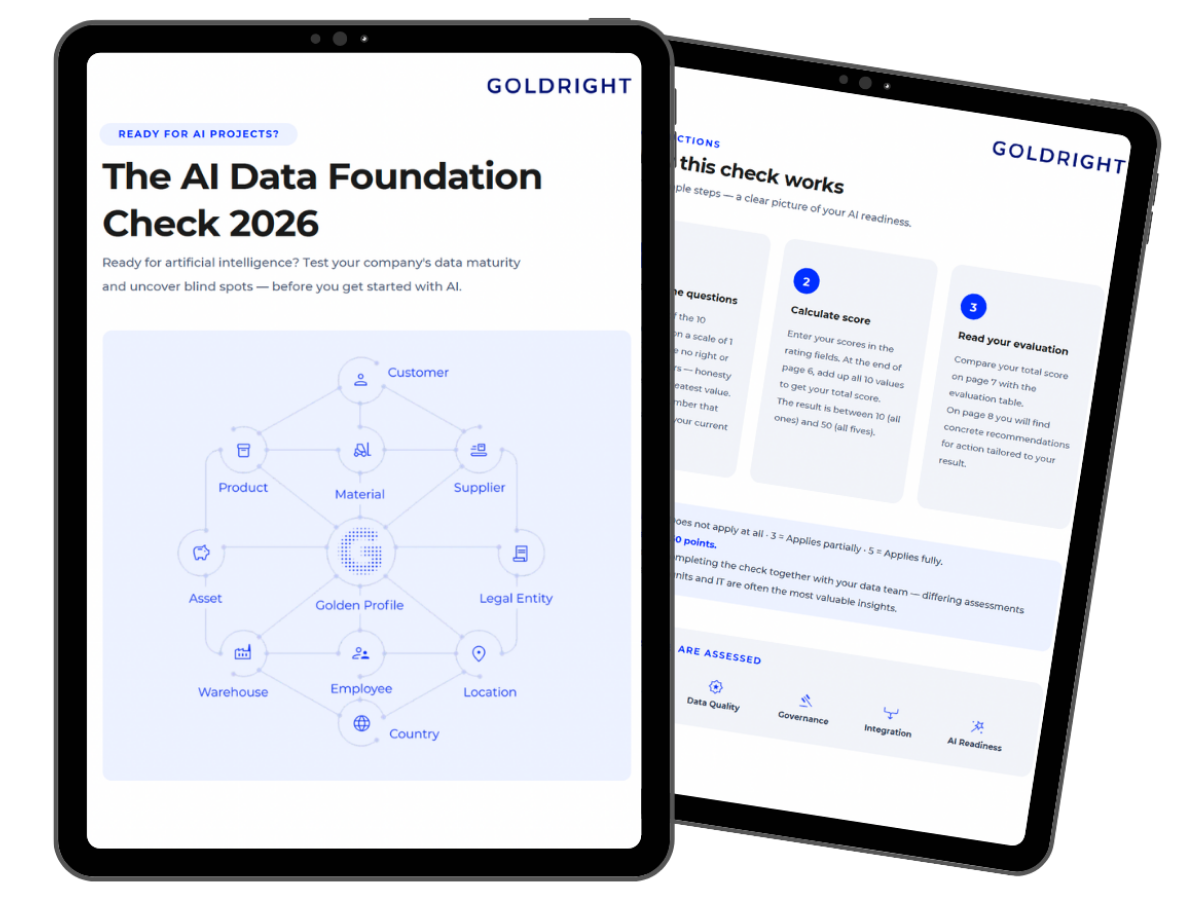
Is Your Data Ready for AI?
Many organizations underestimate how far their data foundation is from true AI readiness—until their first AI project fails. Our AI Data Foundation Check provides you with a clear assessment of your current master data maturity in just 15 minutes and identifies specific areas for action.
Evaluation score for all data dimensions
Ready-to-use roadmap template
100% free
Is Your Data Strategy AI-Ready—or a Risk?
Most CDOs know that their master data is a problem—but very few realize just how big the problem really is—until an AI project or an audit brings it to light. The AI Data Foundation Check tells you in 15 minutes:
Where are your biggest risks?
Which domains are critical?
What is the next strategic step?
Frequently asked Questions about Golden Records in Master Data Management
- The terms are often used interchangeably, but there is a subtle difference: A Master Record refers to the central data record in a specific system. A Golden Record is the result of a consolidation process across multiple systems—the verified, system-agnostic truth.
- The most common reasons are a lack of C-level sponsorship, a “technology-first” approach without a governance model, a lack of a clear definition of data ownership, a “big bang” implementation, and the absence of measurable quality goals. MDM projects almost never fail because of the technology—they fail due to organizational and political factors.
- An initial domain can go live in 3–6 months using a proven approach. A complete, enterprise-wide MDM platform spanning multiple domains typically requires 12–24 months, implemented in phases.
- MDM is a prerequisite for a functioning AI strategy, not a parallel initiative. AI models—whether for predictive analytics, generative AI, or process automation—are directly dependent on the quality, consistency, and completeness of the data. Without a Golden Record, AI scales errors—not efficiency.
- ERP systems manage transactional processes and include master data modules as a byproduct. MDM is a specialized discipline that operates across domains, is system-independent, and is governance-oriented. MDM is the overarching entity that supplies ERP systems with validated master data.
- MDM is relevant for any company that works with multiple systems, multiple locations, or multiple domains. This includes medium-sized companies with approximately 200 or more employees and significant ERP landscapes.
- The CDO is the key success factor—not as a tool buyer, but as a strategic sponsor. He defines the data strategy, secures the budget, enforces data ownership structures, and positions MDM as an enterprise standard.
- Point-in-time historization means that every master data record is accompanied by a complete audit trail. This enables the exact reconstruction of the data state at any point in time—which is critical for audits, regulatory reports, and AI models trained on historical data.
- Data lineage describes the complete traceability of where a dataset comes from and how it was transformed. The EU AI Act requires traceable data provenance for high-risk AI systems. An MDM system with complete data lineage is therefore a direct compliance requirement.
- Companies in industries with high regulatory pressure (financial services, insurance, energy), complex global structures (manufacturing, mechanical engineering, automotive), intensive B2B data management, and M&A activities benefit particularly strongly.
- What sets Goldright apart from other MDM providers is its combination of architectural flexibility and depth of content: a flexible low-code data model, native history tracking and versioning as a core feature, and native MCP server integration for the AI infrastructure of tomorrow. Goldright brings particular expertise to often-neglected domains such as master data, investment, organizational, and identity data management—reflecting an adaptable platform approach.
Download AI-Data Foundation Check for free now