October 6, 2026
UBO: Who Is the Beneficial Owner—and Why Your Transparency Register Entry Will No Longer Be Sufficient Starting in 2027

By Philipp Seibald
Vice President Sales
:format(webp))
36 min read
Share this post
The UBO (Ultimate Beneficial Owner) is the natural person who ultimately exercises ownership or control at the end of a chain of ownership. Sounds simple, but in a corporate group with holding companies, trust arrangements, and voting agreements, it’s not. Starting July 10, 2027, the new EU Anti-Money Laundering Regulation (AMLR) will apply directly in all EU member states—with a new threshold and calculation methodology. This guide shows how you can structure your UBO data so that every report is robust.
Key Points
UBO (Ultimate Beneficial Owner) refers to the natural person who ultimately owns or controls a company. Under German law, this person is called the “beneficial owner” (Section 3 GwG); in Austria, the “economic owner” (Section 2 WiEReG); and in Switzerland, the “beneficial owner” (TJPG).
The threshold is changing: Currently, the threshold in Germany and Austria is “more than 25%.” The EU Anti-Money Laundering Regulation (EU) 2024/1624 will set the threshold at “25% or more” effective July 10, 2027. Anyone holding exactly 25% will thus become the UBO.
The calculation logic is changing: The AMLR requires that indirect holdings be calculated across all levels and that parallel chains be added together. Control is assessed in parallel with ownership, not merely as a secondary consideration.
Switzerland will launch its own, non-public transparency register at the Federal Office of Justice on October 1, 2026.
Supervision is becoming data-driven: The number of discrepancy reports submitted to the German transparency register rose from 8,857 (2020) to 80,585 (2023, as of September 8). By September 2023, the Federal Administrative Office had imposed fines totaling approximately 7.6 million euros.
The key insight: UBO is not a reporting problem, but a master data problem. Those who maintain their ownership structure as a “golden record” can generate and substantiate any report at the push of a button.
Next step: The Legal Entity Audit Check provides a structured assessment of how robust your UBO data is today.
What Is a UBO? Definition of the Ultimate Beneficial Owner
A UBO (Ultimate Beneficial Owner) is any natural person who ultimately owns or controls a company. It does not matter who is listed as a shareholder in the commercial register. What matters is who is at the end of the chain—across holding companies, foundations, trustees, or agreements.
The term “Ultimate Beneficial Ownership” describes the concept behind this: a person should be identifiable behind every legal entity. The goal is to combat money laundering and terrorist financing. The Financial Action Task Force (FATF) establishes the international framework for this with its Recommendation 24. The FATF strengthened this recommendation in March 2022: Information on beneficial owners must be “adequate, accurate, and up-to-date,” and countries must maintain a registry or an equivalent mechanism.
Two Ways to Qualify as a Beneficial Owner: Ownership and Control
A natural person qualifies as a beneficial owner in two ways:
Through ownership: The individual holds, directly or indirectly, a relevant share of the capital or voting rights. In Germany, this threshold currently stands at more than 25 percent of the capital shares or voting rights.
Through control: The individual exercises comparable control in other ways. Typical examples include voting agreements, veto rights, and the right to appoint the managing director
If, after a comprehensive review, no such person is identified, a fallback rule applies. In Germany, the legal representative, the managing partner, or the partner is then deemed to be the fictitious beneficial owner. This fallback rule is explicitly the last resort—not the easy way out.
Terminology in the DACH region
Term | Country | Legal Basis | Register |
Wirtschaftlich Berechtigter | Germany | Section 3 of the Money Laundering Act (GwG) | Transparency Register (Bundesanzeiger Verlag, supervised by the Federal Administrative Office) |
Wirtschaftlicher Eigentümer | Austria | Section 2 of the Beneficial Owners Register Act (WiEReG) | Register of Beneficial Owners (Federal Ministry of Finance) |
Wirtschaftlich berechtigte Person | Switzerland | Federal Act on the Transparency of Legal Entities (TJPG) | Transparency Register (Federal Office of Justice) |
Beneficial Owner | EU (effective July 10, 2027) | Regulation (EU) 2024/1624 (AMLR) | National registers, interconnected across the EU |
In practice, the terms UBO, Ultimate Beneficial Owner, and “wirtschaftlich Berechtigter” (beneficial owner) are used interchangeably. Banks typically refer to the UBO in the KYC (Know Your Customer) process, while lawyers in the German context use the term “wirtschaftlich Berechtigter.” They all refer to the same person.
Calculation Example: When Is Someone Considered a UBO?
A simplified example illustrates why determining this is rarely straightforward:
Ms. A holds a 60% stake in Holding X. Holding X holds a 40% stake in Target Company Z. When calculated directly, Ms. A holds only 24% of Z. Nevertheless, under applicable German law, she is the beneficial owner: She exercises majority control over X, and X holds more than 25% of Z. The logic follows the chain of control, not multiplication.
Mr. B directly holds a 20% stake in Z and an additional 45% stake in Holding Y, which in turn holds a 20% stake in Z. Currently, Mr. B does not control the holding company Y; his indirect stake is essentially not attributed—at 20%, it falls below the threshold. Under the AMLR, stakes from different chains are added together: 20% directly plus 9% indirectly (45% × 20%) equals 29%. Mr. B thus becomes the UBO.
This example has been deliberately simplified and does not replace a legal review of individual cases. However, it illustrates the core problem: To answer the UBO question, one needs the complete ownership structure with percentage values at every level. An extract from the commercial register for each company is not sufficient for this purpose.
UBO, KYC, and the Transparency Register: How These Obligations Are Interrelated
Anyone dealing with UBO comes across three terms that are often confused: the transparency obligation, the KYC verification, and the reporting of discrepancies. For CFOs and compliance officers, distinguishing between them is important because each affects different roles within the company.
Role 1: Your Company as a Reporting Entity
Every company subject to transparency requirements must identify its beneficial owners, keep the information up to date, and report it to the national registry. In Germany, this involves reporting to the Transparency Register; in Austria, to the Register of Beneficial Owners; and in Switzerland, starting in October 2026, to the Transparency Register via EasyGov. This obligation applies to every single company in the group—not just the parent company.
In practice, this means that a group with 80 companies in three countries has not one UBO reporting obligation, but 80—under three different legal systems. If the structure at the top changes—for example, due to an investor acquiring a stake in the holding company—this can affect the reports of all downstream companies.
Role 2: Your Company as a Bank Customer
Banks, insurance companies, auditors, notaries, and other obligated entities must identify and verify their clients’ UBOs as part of their due diligence obligations. This is the KYC process. For your company, this means that for every new business relationship, every new line of credit, and during periodic reviews, the bank will inquire about your ownership structure and cross-check it against the registry.
The more complex the structure, the more time-consuming the review. Incomplete or contradictory information prolongs the onboarding process. The 2025 Fenergo study reports onboarding times of over six weeks for British corporate client banks. The treasury department feels the impact of this directly.
Role 3: Your Company as a Regulated Entity
Many companies overlook the fact that they themselves may be obligated entities under anti-money laundering laws. This applies not only to financial institutions but also, depending on their activities, to commodity traders, real estate brokers, or companies with financial services subsidiaries. In such cases, they must in turn identify the UBOs of their customers or business partners—and report any discrepancies with the registry as inconsistencies.
This third role brings us full circle: The discrepancy report is the tool through which obligated entities are expected to improve the quality of the registers. In Germany in 2023, according to Parliamentary Document 20/8480, nearly all discrepancy reports came from obligated entities. Any discrepancy in your registry data will therefore be discovered sooner or later by a third party.
Why These Roles Must Be Considered Together
All three roles rely on the same data: Who belongs to the group, who holds which shares, who controls what, and who is at the end of the chain? Companies that maintain this data separately in three different places—once for the registry, once for bank inquiries, and once for their own KYC checks—increase both their workload and their risk of errors. A shared database is therefore not only more efficient but also the most secure defense against discrepancy reports.
Why is UBO relevant for CFOs and compliance?
The issue of Ultimate Beneficial Ownership was long considered a formality to be dealt with once a year. That has changed. Three developments are converging simultaneously: regulation is being standardized and tightened across Europe, regulators are conducting data-driven audits, and banks and business partners alike are making reliable UBO data a prerequisite for doing business.
The numbers behind the pressure
Key Figure | Value | Source |
Reports of discrepancies submitted to the German Transparency Register | 8,857 (2020) → 80,585 (2023, as of Sept. 8) | |
Fines Imposed by the Federal Administrative Office for Violations of the Transparency Register | 6,740 fines, totaling approximately 7.62 million euros (as of September 13, 2023) | |
Criminal networks that abuse legal corporate structures | 86% of the 821 most dangerous networks in the EU | |
Annual costs of financial crime compliance in EMEA | $85 billion; increased at 98% of financial institutions | |
Financial institutions that lost customers due to inefficient onboarding | 70% (2025), up from 67% (2024) and 48% (2023) | |
Average annual cost of poor data quality per company | $12.9 million |
What These Numbers Mean for You
Regulators detect errors before you do. Reports of discrepancies come almost exclusively from obligated parties—that is, banks, auditors, notaries, and law firms. According to Parliamentary Document 20/8480, of the 80,585 reports submitted in 2023, 80,579 came from obligated parties and only 6 from government agencies. Every bank that onboards your group cross-checks your registry entries against its own records. If there is a discrepancy, the bank is required to report it.
Gaps are the rule, not the exception. As of the cutoff date of September 11, 2023, according to the federal government, 957,878 of 1,527,931 GmbHs were registered in the Transparency Register. Since the elimination of the so-called “deemed notification” provision on August 1, 2021, all companies subject to transparency requirements must actively report their beneficial owners. The transition periods expired in 2022.
Fines are made public. Pursuant to Section 57 of the Anti-Money Laundering Act (GwG), the Federal Administrative Office publishes final fine decisions along with the company’s name. For a CFO, this is a reputational issue vis-à-vis banks, investors, and the supervisory board—not just a cost item.
Onboarding time is capital time. If a bank cannot quickly verify your group’s UBO structure for a new credit line or account, the transaction is delayed. The 2025 Fenergo study shows just how costly inefficient onboarding has become for banks. The problem does not lie solely with the banks: Incomplete ownership data from the customer is a key factor in every KYC delay.
The number of affected parties is growing. Under the AMLR, legal entities outside the EU may also be subject to registration requirements—for example, if they acquire real estate in the EU, enter into business relationships with companies in the EU, or participate in public procurement. For internationally structured groups, this expands the scope of UBO management.
Access to registries remains inconsistent across Europe. Transparency International tested access for individuals with a legitimate interest in 14 EU countries. In two countries, requests were denied; response times ranged from immediate to over 20 days; and not a single registry provided historical ownership data. For companies, this means: You should not rely on external registries as a reliable source of information for your own group. You must maintain a reliable source yourself.
The Timeline: What Will Happen by 2027
Date | Event | Source |
November 22, 2022 | ECJ Overturns Unrestricted Public Access to UBO Registers (C-37/20, C-601/20) | |
June 19, 2024 | AMLR (EU) 2024/1624 published in the Official Journal | |
July 10, 2025 | Access for persons with a legitimate interest must be guaranteed under AMLD6 | |
July 10, 2026 | Further register-related provisions of AMLD6 must be implemented | |
October 1, 2026 | Swiss Transparency Register and revised Anti-Money Laundering Act enter into force | |
July 10, 2027 | AMLR applies directly in all EU member states; general implementation deadline for AMLD6 |
For budget and project planning, this means: If you want your UBO data to meet AMLR standards by 2027, you must begin building the database in 2026. The change in the threshold and the calculation logic affects not just a single filing, but every company in the group.
The 4 Root Causes of Incorrect UBO Data
When talking to CFOs about their UBO filings, you rarely hear that no one is responsible. Instead, you tend to hear: “The legal department handles that, the numbers come from corporate accounting, and the bank then checks with Treasury.” That is precisely where the problem lies.
Inaccurate UBO data rarely results from negligence. It stems from structures in which no one has the big picture.
Root Cause A: Ownership Data Is Stored in Silos
In many corporate groups, the ownership structure is documented in multiple places. The legal department maintains lists of shareholders and articles of incorporation. Group accounting manages the scope of consolidation, including ownership percentages.
Treasury manages account authorizations. The tax department maintains its own overview of tax-unified groups. Each of these views is correct for its intended purpose—but none is complete.
However, UBO identification requires all of this information simultaneously: equity interests, voting rights, special rights, fiduciary relationships, and the individuals behind them. Anyone who manually compiles this data from four sources for each filing will inevitably introduce discrepancies. And these discrepancies end up as discrepancy reports with the registry.
Root Cause B: Reporting Is an Event Rather Than a Process
Traditional UBO reporting is treated as a one-time project: It is completed once a year, before an audit or in response to a bank inquiry. However, the ownership structure changes throughout the year. Capital increases, share transfers, new holding companies, restructurings as part of M&A, or a change in voting rights immediately affect UBO status.
The law therefore treats this maintenance as an ongoing task. In Austria, legal entities must fulfill their due diligence obligations at least once a year and report changes within four weeks. Under the AMLR, changes must be reported immediately, or within 28 days at the latest. An annual project cannot accommodate this timeline.
Root Cause C: Control Beyond Capital Is Not Modeled
Most ownership overviews show percentage shares of capital. This is sufficient for consolidation, but not for UBO purposes. Voting rights may differ from capital—for example, in the case of preferred shares, multiple voting rights, or voting agreements. Veto rights, rights to appoint management, and fiduciary agreements establish control without changing a single percentage.
The AMLR tightens this requirement. The control test applies in parallel with the ownership test, not merely as a fallback option. Control explicitly includes rights such as the appointment or removal of the majority of board members, veto rights, or decisions regarding profit distributions. Anyone who fails to systematically document these rights will not pass the control test.
Root Cause D: Lack of History and Documentation
A bank or regulatory authority rarely asks simply, “Who is the UBO today?” Instead, the question is often: “Who was the beneficial owner as of reference date X, and on what basis did you determine this?” Without historical data and archived documentation, answering this question requires a great deal of effort.
Austrian law makes documentation a mandatory obligation. Anyone who fails to retain the required copies of documents for at least five years after the end of beneficial ownership commits a financial offense under Section 15(2) of the WiEReG. The AMLR also requires complete ownership chains with percentage values at every level. An Excel file showing the current status does not meet any of these requirements.
UBO is not a reporting issue, but a master data issue
Most companies treat UBO as a compliance task that ends with filling out a form. The question then becomes: “How do we get the report into the registry on time?” This question is too narrow.
The right question is: “Do we have a single, reliable source for our ownership structure from which every UBO filing can be automatically derived?”
The difference is fundamental. An UBO filing is nothing more than an analysis of master data: legal entities, ownership relationships, voting rights, control rights, and natural persons. If this master data is accurate, complete, and maintained historically, the filing is simply a report. If it is not, every filing is a reconstruction.
What Changes with This Shift in Perspective
Dimension | UBO as a Reporting Issue | UBO as a Master Data Issue |
Key Question | Was the report submitted on time? | Is the ownership structure accurate, complete, and supported by documentation? |
Data Source | Manual compilation for each report | Golden Record of Legal Entities as the Single Source of Truth |
Frequency | Annually or as needed | Continuous, event-driven |
Responsibility | Legal department only | Clear data ownership across Legal, Finance, and Compliance |
Results of Bank Inquiries | Research Takes Days to Weeks | Analysis at the Click of a Button with Documentation |
Benefits Beyond UBO | None | Consolidation, Client Management, M&A, Reporting, AI Readiness |
This shift in perspective has a second consequence. The data you need for the UBO is the same data your corporate accounting department needs for the scope of consolidation, your legal department needs for client management, and your M&A team needs for due diligence. Once you set it up properly, you solve several problems at once. The UBO is thus not just a regulatory requirement, but a strong business case for a clean legal entity database.
Read more about the role of central master data in our guide, “Master Data Management: Definition and Practice.”
Approach: 6 Steps to Reliable UBO Data
The following approach is described in a technology-neutral manner. It serves as a framework for any corporate group—regardless of whether you implement it using specialized legal entity management software or, initially, with internal resources.
Step 1: Complete Inventory of All Legal Entities
It all starts with a simple but often underestimated question: Which legal entities belong to the group? These include not only consolidated subsidiaries but also minority interests, joint ventures, foundations, partnerships, dormant companies, and foreign entities.
Master data is recorded for each legal entity: company name, legal form, registered office, registration number, LEI (if applicable), date of incorporation, status, and relevant registry. This inventory serves as the foundation for all subsequent steps.
Step 2: Model the ownership chain as a network
An ownership structure is not a tree, but a network. Companies hold cross-shareholdings, and individuals hold shares both directly and indirectly. Therefore, each ownership relationship should be recorded as a separate data object—with distinct attributes:
Percentage of equity
Percentage of voting rights (if different)
Special rights (veto, appointment rights, profit distribution rights)
Trust or nominee arrangement
Effective-from and effective-until dates
Supporting document (list of shareholders, contract, resolution)
This modeling approach allows both calculation logics to be represented: the current chain of control under the GwG and WiEReG, as well as the calculation and aggregation under the AMLR.
Step 3: Define the Rules for Each Jurisdiction
The UBO thresholds and logic vary by country and time period. A robust system defines them as rules rather than relying on the expert knowledge of individual persons:
Germany today: more than 25% of capital or voting rights, indirect attribution via control
Austria today: more than 25%, annual review, reporting within four weeks
Switzerland as of October 1, 2026: at least 25% of capital or voting rights, reporting via EasyGov
EU as of July 10, 2027: 25% or more, aggregation across all levels, parallel control test; for certain high-risk categories, threshold may be lowered to 15%
This makes it possible to simulate today which individuals will additionally be considered UBOs starting in July 2027.
Step 4: Automatic Determination and Reconciliation with the Registers
Based on inventory, network, and regulatory framework, the UBO attribute is automatically calculated—for every company and every individual. The result is then reconciled with the entries in the national registers.
This reconciliation is the key lever. It flips the logic of discrepancy reporting: Instead of a bank finding the discrepancy, you find it yourself—and correct it before anyone else reports it.
Step 5: Event-Driven Maintenance with Deadline Management
Every change in the ownership structure triggers a recalculation. If this changes a person’s UBO status, a task with a deadline is automatically created: four weeks in Austria, 28 days under the AMLR. In addition, there are recurring deadlines such as the annual review under WiEReG.
Deadline management does not belong in a personal calendar, but rather in the system that also stores the data. This is the only way to ensure that data maintenance remains independent of individual persons and vacation periods.
Step 6: Audit Trail and Supporting Documentation
Every change is versioned with a timestamp, the person who made the change, and supporting documentation. This makes it possible to reconstruct at any time who was the beneficial owner as of a specific date and what the determination was based on.
In Austria, this documentation can also be filed with the registry via the compliance package. This makes it easier for obligated parties, such as banks, to review the documentation and reduces the need for follow-up inquiries. Our checklist for audit-proof documentation in investment management outlines the key requirements for audit-proof documentation.
How robust is your UBO data today?
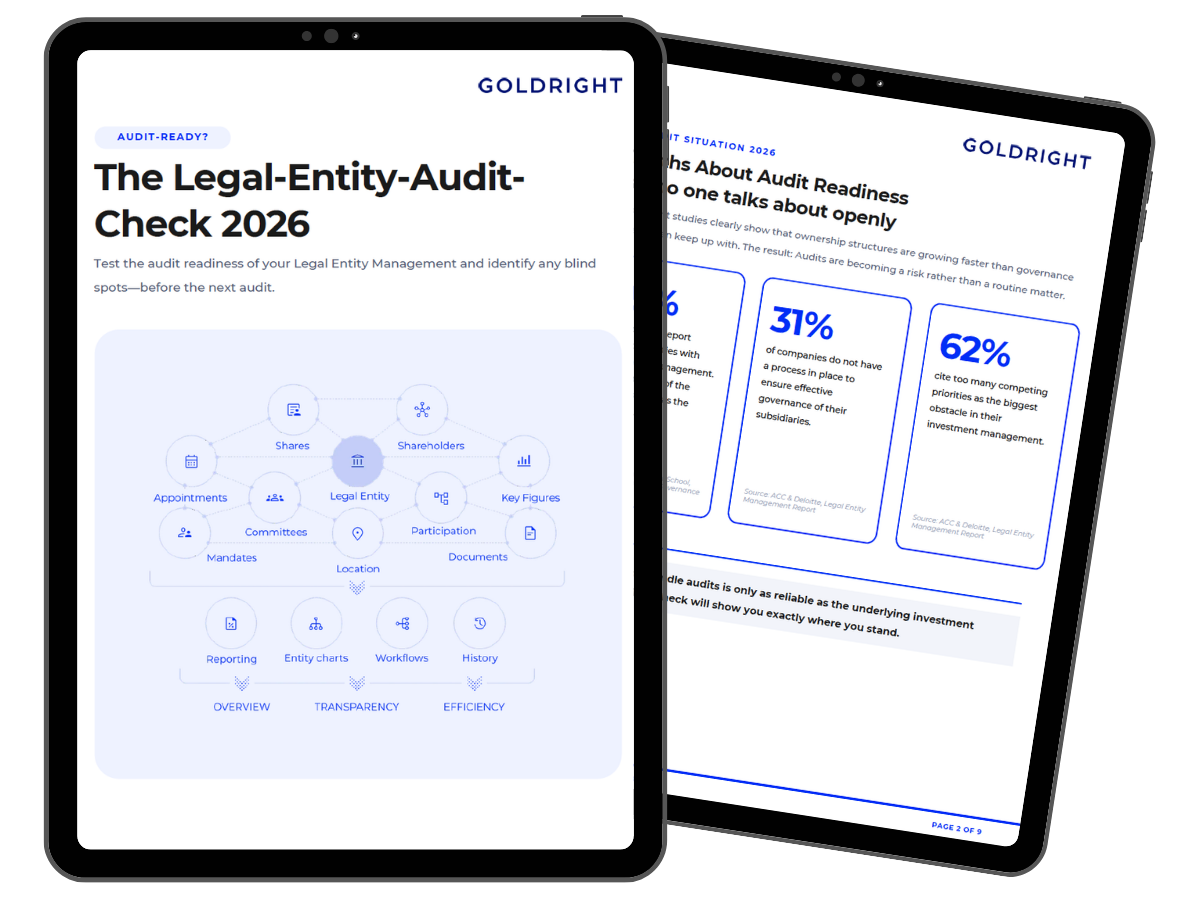
The Legal Entity Audit Check provides a structured overview of where your ownership data has gaps—regarding the completeness of legal entities, the mapping of voting and control rights, deadline management, and supporting documentation. It’s ideal as a foundation for preparing for AMLR 2027.
9-page practical guide as a ready-to-use PDF
Prioritized recommendations for action based on your score
100% free
Special Cases: When Identifying the UBO Becomes Particularly Challenging
The basic rules are easy to explain. In practice, however, most questions arise in structures that deviate from the standard case of a GmbH with few shareholders. The following scenarios warrant special attention.
Family-Owned Businesses with Multiple Family Branches
In family-owned businesses, shares are often distributed among several family branches, frequently through separate holding companies. In addition, there are pooling agreements or voting agreements that enable the family to vote as a unified bloc. Such agreements can establish control, even if no single family member reaches the capital threshold.
The new threshold will become particularly relevant starting in July 2027. Under current law, four family branches, each holding exactly 25%, are not considered UBOs based solely on their equity stake. This will change under the AMLR, which defines a UBO as holding “25% or more.” Family businesses should therefore assess their structures early on according to both sets of criteria.
Foundations and Trusts
Foundations and trusts follow their own logic because they do not have shares in the traditional sense. According to the AMLR, in the case of trusts, the settlor, trustee, protector, and beneficiaries must be identified as beneficial owners. In the case of foundations, it is the founders, the members of the governing body, and other controlling persons.
For corporate groups headed by a foundation, this means that the UBO question does not end with the foundation. It extends to the individuals who serve on the foundation’s governing bodies or are beneficiaries. These individuals and their roles must be maintained as master data with validity periods, since board members and beneficiaries change over time.
Joint Ventures and Minority Interests
In the case of joint ventures, the UBO issue is often not within your control but depends on your partner’s structure. For the joint venture itself, the beneficial owners of all partners who meet the threshold must be identified. This requires that your partner disclose its own structure and keep it up to date.
It has proven effective to establish information and cooperation obligations regarding UBO identification in the joint venture agreement itself. This ensures that changes on the partner’s side reach you in a timely manner and that reporting deadlines can be met.
International Holding Structures
International groups operate companies in multiple jurisdictions, each with its own UBO rules. A Luxembourg intermediate holding company, a Swiss subsidiary, and a German sub-subsidiary may be subject to different thresholds, deadlines, and reporting channels. Starting in 2027, the AMLR will harmonize these rules within the EU; outside the EU, the differences will remain.
In addition, national registries are to be interconnected via a European platform. This will enable authorities to consistently access ownership information across national borders. As a result, discrepancies between the disclosures of different group companies will become more easily apparent.
Trust and Nominee Structures
Trust arrangements are the classic case in which the registry shows something different from the actual control. The trustee is listed in the commercial register, while the settlor may be the beneficial owner. In 2022, the FATF explicitly formulated stricter requirements for nominee arrangements.
For your database, this means: Every ownership interest requires an attribute that identifies trust or nominee arrangements, as well as a link to the actual beneficial owner. Without this information, the automatic UBO calculation will inevitably be incorrect.
The UBO Audit Trail for a Single Company
Regardless of the structure, the UBO determination for each company can be organized using the same seven questions. This audit trail serves as a set of working instructions for investment management and as a basis for documentation.
1. Who are the direct shareholders? The basis for this is the list of shareholders, the stock register, or the commercial register—in each case as of a specific date.
2. Which shareholders are natural persons, and which are legal entities? For each legal entity, the next level is examined until the chain ends with natural persons.
3. What are the capital and voting rights shares at each level? Capital and voting rights are recorded separately, and any discrepancies are explained.
4. Is there control beyond the shareholdings? Voting agreements, pooling agreements, veto rights, appointment rights, and fiduciary agreements are reviewed.
5. Which individuals exceed the threshold—under applicable law and under AMLR? Both results are documented to prepare for the transition in 2027.
6. Does the result match the registry entry? Discrepancies are corrected, and the correction is reported in a timely manner.
7. Has all supporting documentation been filed and assigned to the data record? In the absence of supporting documentation, the finding is considered unsubstantiated in case of doubt.
The value of this audit trail lies in its repeatability. If it is applied consistently for every company and documented in the system, every finding can be traced and explained to banks, auditors, or regulatory authorities.
Best Practices: What Really Works in UBO Management
The six steps describe the “what.” The following best practices describe the “how.” They are drawn from real-world legal entity management experience and determine whether a UBO process is effective in day-to-day operations.
One Person Is Responsible for Data Quality, Not the Filing
The most effective organizational measure is clear data ownership. A designated role—often in investment management or Group Legal—is responsible for the accuracy of the investment master data. Filing with the registry is then merely a downstream step.
It is important to make this distinction: The data owner does not have to collect every piece of information personally. However, they are responsible for ensuring that changes from Finance, Legal, and M&A are reliably incorporated into the central database.
Record changes where they occur
Changes in ownership occur at shareholder meetings, during notary appointments, in M&A transactions, and during restructurings. The best UBO process starts right there. A shareholder resolution regarding a capital increase should immediately trigger an update to the ownership data—not just the next annual audit.
Fixed handover points have proven effective in practice: The M&A team reports closing dates, Group Legal reports amendments to the articles of association, and Group Accounting reports changes to the scope of consolidation. The list of shareholders, as the primary source, plays a central role in this process.
Strictly Separate Capital, Voting Rights, and Control
If you track only a percentage value per equity interest, you lose information. Track capital share, voting rights, and control rights as separate fields. This takes a little more time during initial data entry but ensures that any subsequent analysis is reliable—both for UBO reporting and for consolidation.
Establish Register Reconciliation as a Routine
Regularly reconcile your internal database with the entries in national registries. This applies to the Transparency Register in Germany, the Register of Beneficial Owners in Austria, and, starting in October 2026, the Transparency Register in Switzerland. This allows you to identify discrepancies before they are reported as inconsistencies.
Do not rely solely on registry extracts
Registry extracts are an important source, but not the only one. The AMLR explicitly requires obligated parties to verify identities using identification documents, electronic identification in accordance with eIDAS, or appropriate measures—and not exclusively through central registries. For your company, this means that banks will increasingly request primary evidence. Keep this evidence organized and readily available.
Conduct the AMLR Simulation Now
Calculate your UBO structure today using both current law and AMLR logic. The difference will show you which individuals will become subject to additional reporting requirements starting in July 2027 and what supporting documentation you’ll need for them. This simulation provides the best foundation for budget and resource planning.
Maintain Master Data with the Same Level of Care
The AMLR expands the information required for beneficial owners to include, among other things, the full date of birth, place of birth, and full residential address. This is personal data that requires a high level of protection. You therefore need an authorization policy that logs access and limits it to what is strictly necessary. Data protection and UBO transparency are not mutually exclusive—but they must be considered together.
Roles and Responsibilities in the UBO Process
A UBO process rarely fails because of technical issues, but rather because of unclear responsibilities. The following breakdown has proven effective as a starting point and can be adapted to your own organization.
Task | Investment Management / Group Legal | Group Accounting | Compliance | CFO |
Maintenance of Investment Master Data | Responsible | Submits Changes | Informs | Informs |
Recording of Control and Special Rights | Responsible | – | Advises | – |
UBO Calculation and Registry Reconciliation | Responsible | – | Verifies | Informs |
Report to the Registers | Responsible | – | Informs | Informs |
Processing of discrepancy reports | Responsible | Liefert Informationen | Verifies | Eskalation |
Regulatory framework by jurisdiction (e.g., AMLR) | Advises | – | Responsible | Informs |
Budget and Prioritization | Advises | Advises | Advises | Responsible |
What matters most is not so much the exact distribution of responsibilities as it is accountability. Every task requires exactly one person to be responsible for it. And the CFO should regularly review the key metrics of the UBO process—such as outstanding discrepancies and missed deadlines.
Comparison: UBO Rules in Germany, Austria, Switzerland, and the EU-AMLR
This table summarizes the most important parameters. It is intended as a guide and does not replace legal advice in individual cases.
Criterion | Germany | Austria | Switzerland | EU-AMLR (effective July 10, 2027) |
Term | Wirtschaftlich Berechtigter | Wirtschaftlicher Eigentümer | Wirtschaftlich berechtigte Person | Beneficial Owner |
Legal Basis | Section 3, Sections 18 et seq. of the Money Laundering Act (GwG) | WiEReG | TJPG (effective as of October 1, 2026) | Regulation (EU) 2024/1624, supplemented by AMLD6 (EU) 2024/1640 |
Threshold | More than 25% of capital or voting rights | More than 25% | At least 25% of capital or voting rights | 25% or more; may be lowered to as low as 15% for high-risk categories |
Indirect Participation | Attribution through Control of the Intermediate Company | Attribution through Control of the Intermediate Company | Direct or indirect | Tracing through all levels, summing parallel chains |
Verification Test | Verification “in a comparable manner” | Verification by other means | Verification in another way | Concurrently with the ownership test |
Fallback Rule | Deemed Beneficial Owner (Legal Representatives) | Senior Management | Senior Management Level (Fallback Rule) | Senior Managing Officials, only if both tests yield no results |
Registers | Transparency Register | Register of Beneficial Owners (Federal Ministry of Finance) | Transparency Register (Federal Office of Justice) | National Registers, Networked Across the EU |
Public Access | Only upon demonstration of a legitimate interest | Only upon demonstration of a legitimate interest | Not public | Legitimate interest (AMLD6) |
Deadline for Reporting Changes | Immediately | Within four weeks; annual review | Within the statutory deadline | Immediately, no later than 28 days |
Penalties | Fine of up to €150,000; for serious, repeated, or systematic violations, up to €1 million or twice the amount of the benefit; publication pursuant to § 57 GwG | Financial offenses: up to €200,000 (intent), up to €100,000 (gross negligence); Coercive penalties | Subject to criminal penalties under the TJPG | Sanctions under national implementation |
Sources for the table: IHK Berlin, JUHN Partner, § 15 WiEReG (JUSLINE), BMF-FAQ WiEReG, Binder Grösswang, Bundesamt für Justiz, Bratschi, Virtue Compliance, Baker McKenzie, HLC, eucrim.
Tool Comparison: How Companies Manage UBO Data
Criterion | Spreadsheet (Excel) | Registry extracts and data providers | Legal entity management platform |
Complete ownership chain | Manual, prone to errors | Only publicly registered data | Complete, including internal information |
Voting and Control Rights | Rarely structured | Usually not included | As separate data objects |
Automatic UBO Calculation | No | Partially, based on external data | Yes, according to stored rules |
History and Audit Trail | No | As of a specific date | Seamlessly versioned |
Deadline Management | External (Calendar) | No | Integrated |
Supporting Documents | Separate Filing | Register Extract | Linked to the data record |
Benefits Beyond UBO | Low | Low | Consolidation, Mandates, Committees, M&A |
Suitable for | Very small structures | Due diligence on business partners | Corporate groups with their own ownership structure |
Registry extracts and external data providers are particularly valuable for vetting business partners. They are not sufficient for your own group because they only reflect what has already been reported—including potential errors.
The Business Case: How Reliable UBO Data Benefits the CFO
UBO compliance is often viewed purely as a cost center. This perspective is too narrow. The data set you need for UBO compliance contributes to several objectives of the finance department. The business case is based on four levers.
Lever 1: Avoided Risk and Sanction Costs
The most direct lever is the avoidance of fines and legal proceedings. In Germany, the Federal Administrative Office had imposed a total of 6,740 fines amounting to approximately 7.62 million euros as of September 2023. However, the greater damage often arises indirectly: through the publication of fine decisions, inquiries from banks, and the internal effort required to clarify the matter.
Lever 2: Faster Onboarding with Banks and Partners
Every banking relationship, every credit line, and every new account is subject to a KYC review. Those who can provide their UBO structure with supporting documentation at the click of a button can shorten this verification process. The 2025 Fenergo study shows that 70% of the financial institutions surveyed have lost customers due to inefficient onboarding. Companies with clean data thus become preferred customers for banks.
Lever 3: Less Manual Work in Legal, Finance, and Compliance
When the same ownership data is used for UBO reporting, the scope of consolidation, mandate management, and bank inquiries, duplicate data entry is eliminated. The example of RLB Steiermark shows that consolidating separate systems primarily reduces manual effort and automates analyses.
Lever 4: Faster and More Secure M&A Transactions
In the context of acquisitions, divestitures, and restructurings, the ownership structure is a key focus of any due diligence process. A historical, well-documented database streamlines the preparation of the data room and reduces the risk of warranty breaches. After closing, it ensures that the UBO filings for all affected companies are updated in a timely manner.
The Business Case Logic at a Glance
Leverage | Impacts | Key Metrics for the CFO |
Risk and Penalty Costs | Fines, legal costs, reputation | Number of discrepancy reports, pending proceedings |
Onboarding | Treasury, Financing | KYC request turnaround time in days |
Manual Effort | Legal, Finance, Compliance | Person-days per reporting cycle |
M&A | Transaction speed, warranty risks | Data room preparation time |
Specific values for these metrics depend on the size and complexity of your organization. It is important to collect them before the project begins. This is the only way to reliably demonstrate the benefits later on.
UBO and AI: Why Automated Compliance Needs a Clean Data Set
Artificial intelligence is rapidly gaining ground in the KYC and AML landscape. According to Fenergo, the percentage of financial institutions using advanced AI tools in KYC and AML rose from 42% in 2024 to 82% in 2025. Banks will therefore increasingly verify their UBO information automatically and cross-check it against registry data.
This has two consequences for companies. First, discrepancies will be detected more quickly and systematically. What would have been overlooked in a manual review is immediately flagged by an automated comparison. Second, the same principle applies to a company’s own automation as it does everywhere else: AI can only provide answers as good as the data it works with.
Anyone wishing to automate UBO identification, deadline monitoring, or registry reconciliation internally therefore first needs a reliable AI foundation: complete, structured, and historical ownership data. Gartner estimates the average cost of poor data quality at $12.9 million per company per year. In the context of compliance, another factor comes into play: An automated but incorrect UBO report is no less incorrect than a manual one—it’s just faster.
Case Study: Raiffeisen-Landesbank Steiermark
Addressing UBO issues starts with a clear ownership structure. Raiffeisen-Landesbank Steiermark demonstrates how this works in practice.
The starting point: RLB Steiermark managed approximately 300 equity investments in separate systems. This resulted in a high level of manual effort and gaps in transparency. In addition, the existing software was no longer technically viable for the future. At the same time, a bank’s investment division serves as a data source for numerous other departments—from accounting to reporting.
The Solution: Using the Goldright Legal Entity Manager, the separate data sets were consolidated into a central platform, cleaned up, and made free of inconsistencies. The software enables the seamless integration of information from external systems such as SAP. Analyses and reports are automatically generated.
The result: A centralized, up-to-date database for all investments with automated reports. Tatjana Skalé, an employee in the Investment Management department at RLB Steiermark, describes it this way:
“A product that brilliantly combines functionality and user-friendliness. Data maintenance and subsequent output are possible at the push of a button. It’s a great help in our day-to-day work, where the investment division serves as a data provider for many other departments.”
What this means for the UBO: The RLB Steiermark project was an investment management project, not a pure UBO project. That is precisely the point. A consolidated investment structure with a history is a prerequisite for being able to automate UBO identification, registry cross-checking, and record-keeping in the first place. Those who have this foundation can address the UBO issue as an analysis—not as a project.
Pitfalls: The Most Common Mistakes in UBO Identification
Misinterpreting the 25 Percent Threshold
Today, the rule in Germany and Austria is “more than 25%.” Under current law, a stake of exactly 25% alone does not constitute UBO status. This will change under the AMLR: then, 25% or more will suffice. Joint ventures with four equal partners or family structures with exactly 25% per family line will thus be subject to reporting requirements starting in July 2027.
Relying Too Quickly on the Fictitious Beneficial Owner
The catch-all rule is intended for cases where, after a comprehensive review, no natural person can truly be identified. Anyone who uses it as a default solution simply because the research is time-consuming risks submitting an incorrect report. Under the AMLR, senior managing officials may only be reported if both the ownership and control tests yield no results.
Overlooking Trustees, Nominees, and Voting Agreements
A trustee listed in the commercial register is not the UBO—the settlor may be. Voting agreements between shareholders can establish control that is not visible in any register. In 2022, the FATF explicitly tightened the requirements for nominee arrangements and bearer shares. These agreements must be systematically documented.
Focusing Only on the Immediate Level
Many errors arise because only the immediate shareholder is examined. The UBO determination requires examining the entire chain all the way down to the natural person. Under the AMLR, parallel chains are also aggregated. Those who examine only individual levels will inevitably overlook these aggregates.
Forgetting Foreign Companies and Legal Systems
In international groups, the rules of each company’s country of incorporation apply. In addition, there are cases where non-EU entities may become subject to registration requirements in the EU due to real estate acquisitions, business relationships, or procurement procedures. Without a set of rules for each jurisdiction, it becomes impossible to maintain an overview.
Treating Discrepancy Notifications as a Formality
A discrepancy report is a signal that a third party views your data differently than the registry does. Those who fail to resolve such discrepancies promptly and in a documented manner risk inquiries from the registry authority and, in serious cases, administrative fines. The ninefold increase in reports between 2020 and 2023 demonstrates how actively obligated parties are now using this tool.
Planning UBO as a One-Time Project
The most common strategic mistake: Setting up the UBO cleanup as a project with an end date. Once completed, the data becomes outdated again until the next audit or bank inquiry. Only a process based on a continuously maintained database is sustainable.
AMLR 2027: Is Your Ownership Data Ready?
The new threshold, the requirement to aggregate data across all levels, and the 28-day deadline are fundamentally changing the requirements for your legal entity data. With the Legal Entity Audit Check, you can quickly assess where your group stands today and which areas you should address before July 2027.
9-page practical guide as a ready-to-use PDF
Prioritized recommendations for action based on your score
100% free
Conclusion: The UBO is the litmus test for your legal entity data
The UBO is more than just an entry in the transparency register. It is the result of a calculation that takes into account every level of your ownership structure: capital, voting rights, control rights, and the people behind them. As long as this data remains siloed and is only consolidated on an ad hoc basis, every UBO filing will remain a reconstruction with residual risk.
Regulatory requirements are tightening noticeably. Switzerland will launch its transparency register on October 1, 2026. Starting July 10, 2027, the AMLR will take effect with a new threshold, cross-level calculations, and a 28-day deadline. And regulators have long been operating in a data-driven manner: banks, notaries, and auditors report discrepancies before you even notice them yourself.
The good news: The problem can be solved. Those who view UBO as a master data issue can build a robust database once and for all—a “golden record” for the entire group. From this single source of truth, UBO reports, registry reconciliations, consolidation scopes, and M&A analyses can all be derived.
This not only reduces compliance risk. It also shortens onboarding times at banks and creates transparency for the supervisory board and investors.
Our advice to CFOs and compliance officers: Don’t use the time remaining until July 2027 for another round of data cleanup, but rather to establish a sustainable process. Start by conducting an honest assessment of your current situation.
Your next step: The Legal Entity Audit Check shows you how robust your UBO and ownership data are today and where you should focus your efforts ahead of AMLR 2027.
Glossary: Key UBO Terms
AMLA: The new EU authority for combating money laundering and terrorist financing, headquartered in Frankfurt am Main. It is part of the EU AML package.
AMLD6: The Sixth EU Anti-Money Laundering Directive (EU) 2024/1640. Among other things, it regulates national registers, their interconnection, and access for persons with a legitimate interest.
AMLR: The EU Anti-Money Laundering Regulation (EU) 2024/1624. It will apply directly in all member states as of July 10, 2027, and contains uniform rules for determining the UBO.
Beneficial Ownership: The English umbrella term for the economic ownership of a legal entity. “Ultimate Beneficial Ownership” emphasizes that the chain is traced all the way to the final natural person.
Compliance Package: An Austrian tool that allows professional party representatives to file documents identifying beneficial owners in the registry.
Deemed Beneficial Owner: A fallback rule under which legal representatives or comparable persons are reported if, after a comprehensive review, no natural person can be identified as the UBO.
Golden Record: The single, consolidated, and authoritative data record for an object—in this case, a legal entity and its ownership structure. It is the single source of truth from which reports and analyses are derived.
KYC (Know Your Customer): A process in which regulated entities, such as banks, identify and verify the identity of their customers and their beneficial owners.
Transparency Register: The German register of beneficial owners. Switzerland will also use this term for its register starting in October 2026.
Discrepancy Report: A report submitted by a regulated entity or an authority to the register when register entries differ from the entity’s own findings.
Wirtschaftlich Berechtigter: German legal term for the UBO under Section 3 of the Anti-Money Laundering Act (GwG).
Frequently Asked Questions
- UBO stands for Ultimate Beneficial Owner. It refers to the natural person who ultimately owns or controls a company. Under German law, this person is called the “wirtschaftlich Berechtigter” (Section 3 of the Money Laundering Act [GwG]); in Austria, the “wirtschaftlicher Eigentümer” (Section 2 of the Economic Ownership Act [WiEReG]); and in Switzerland, the “wirtschaftlich berechtigte Person.”
- In Germany and Austria, the current rule is: more than 25% of the capital shares or voting rights, either directly or through controlled intermediate companies. In Switzerland, a threshold of at least 25% will apply starting October 1, 2026. As of July 10, 2027, the AMLR in the EU will require “25% or more,” with indirect holdings across all levels being calculated and aggregated.
- Yes. Anyone who exercises control in other ways is also considered a beneficial owner. Typical examples include voting agreements, veto rights, the right to appoint the majority of the management, or fiduciary agreements. Under the AMLR, this control test is conducted in parallel with the ownership test.
- If, after a comprehensive review, no natural person can be identified as the UBO, the legal representative, managing partner, or partner is considered the deemed beneficial owner in Germany. This fallback rule is the last resort. Under the AMLR, it is permissible only if neither the ownership test nor the control test yields a result.
- Regulation (EU) 2024/1624 will apply directly in all EU member states as of July 10, 2027. The threshold effectively drops from “more than 25%” to “25% or more.” Indirect holdings are calculated across all levels, and parallel chains are aggregated. Changes must be reported within 28 days at the latest, and the information required regarding individuals will be expanded.
- Since the European Court of Justice ruling of November 22, 2022 (C-37/20, C-601/20), unrestricted public access is no longer permitted. In Germany and Austria, access is granted to government agencies and obligated entities such as banks; the general public may access the register only if they can demonstrate a legitimate interest. The Swiss transparency register is not public.
- In Germany, Section 56 of the Anti-Money Laundering Act (GwG) provides for fines of up to 150,000 euros; in cases of serious, repeated, or systematic violations, fines of up to 1 million euros or twice the economic benefit may be imposed. Final decisions are published. In Austria, under § 15 WiEReG, fines of up to 200,000 euros may be imposed for intentional violations and up to 100,000 euros for gross negligence.
- In Austria, legal entities must perform their due diligence at least once a year and report the results within four weeks. In Germany, changes must be reported immediately. Under the AMLR, an EU-wide deadline of no later than 28 days after a change applies. In practice, this means that UBO data maintenance is an ongoing process.
- Entities subject to reporting requirements—such as banks, notaries, or certified public accountants—must report to the Transparency Register if the entries in the register differ from their own findings. In Germany, the number of such reports rose from 8,857 in 2020 to 80,585 in 2023 (as of September 8, 2023). Companies should identify such discrepancies themselves before third parties report them.
- Because incorrect UBO data has direct financial consequences: fines, delayed bank onboarding, additional due diligence efforts in M&A, and reputational risks due to published fine decisions. Furthermore, the underlying ownership data is the same data that corporate accounting uses for consolidation and reporting.
- No, not on its own. Registry extracts only show what has already been reported—including any potential errors. The AMLR requires obligated entities not to rely exclusively on central registries. Companies should therefore maintain primary evidence—such as lists of shareholders, contracts, and resolutions—in a structured manner.
- For a company’s own group, legal entity management platforms like the Goldright Legal Entity Manager are suitable; these platforms map ownership chains as a network, record voting and control rights separately, calculate UBOs based on rules, and maintain a historical record of every change. Spreadsheets quickly reach their limits when dealing with multi-tiered structures.
Sources
European Union: Regulation (EU) 2024/1624 (AMLR), Official Journal of June 19, 2024
European Union: Directive (EU) 2024/1640 (AMLD6)
FATF: Public Statement on revisions to R.24, März 2022
FATF: Guidance on Beneficial Ownership of Legal Persons, März 2023
German Bundestag: Response from the Federal Government, Parliamentary Document 20/8480, September 2023
Federal Administrative Office: Decisions on Fines in the Transparency Register
Federal Ministry of Finance (AT): FAQs on the Register of Beneficial Owners, as of February 2025
§ 15 WiEReG: Penal Provisions
Federal Office of Justice (CH): Swiss Transparency Register
IHK Berlin: Obligation to Report to the Transparency Register
Baker McKenzie: European Union – New UBO Rules Come into Force, Juli 2026
HLC: Changes in Beneficial Ownership rules under the new EU AMLR
eucrim: New Anti-Money Laundering Directive (AMLD 6)
CMS: Germany Restricts Access to the Transparency Register Following a CJEU Ruling
CMS: Transparency Register – All Transition Periods End in 2022
Binder Grösswang: CJEU Halts Public Access to National Transparency Registers, 2022
JUHN Partner: Transparency Register – What Fines Are at Risk?
Bratschi: The New Transparency Register – Effective October 1, 2026
Virtue Compliance: JPG 2026 – Transparency Register & UBO Reporting, June 2026
Europol: Leveraging legitimacy, December 2024 (summary via eucrim); original report
LexisNexis Risk Solutions: True Cost of Financial Crime Compliance EMEA, 06.03.2024
Fenergo: Financial Crime Industry Trends 2025, 07.10.2025
Gartner: Data Quality – Why It Matters
Transparency International: Countdown to new EU beneficial ownership rules, 30.09.2025