August 17, 2026
Legal Entity Management: Why Excel Spreadsheets Are Your Biggest Audit Risk

By Philipp Seibald
Vice President Sales
:format(webp))
28 min read
Share this post
Readers of this article will learn exactly what legal entity management entails, why 89% of companies reach their limits in this area, and the four underlying causes of nearly every governance gap. You’ll discover a tried-and-true approach that helps legal, compliance, and finance teams move from an Excel spreadsheet to an audit-ready, historized investment management system—including a free self-assessment.
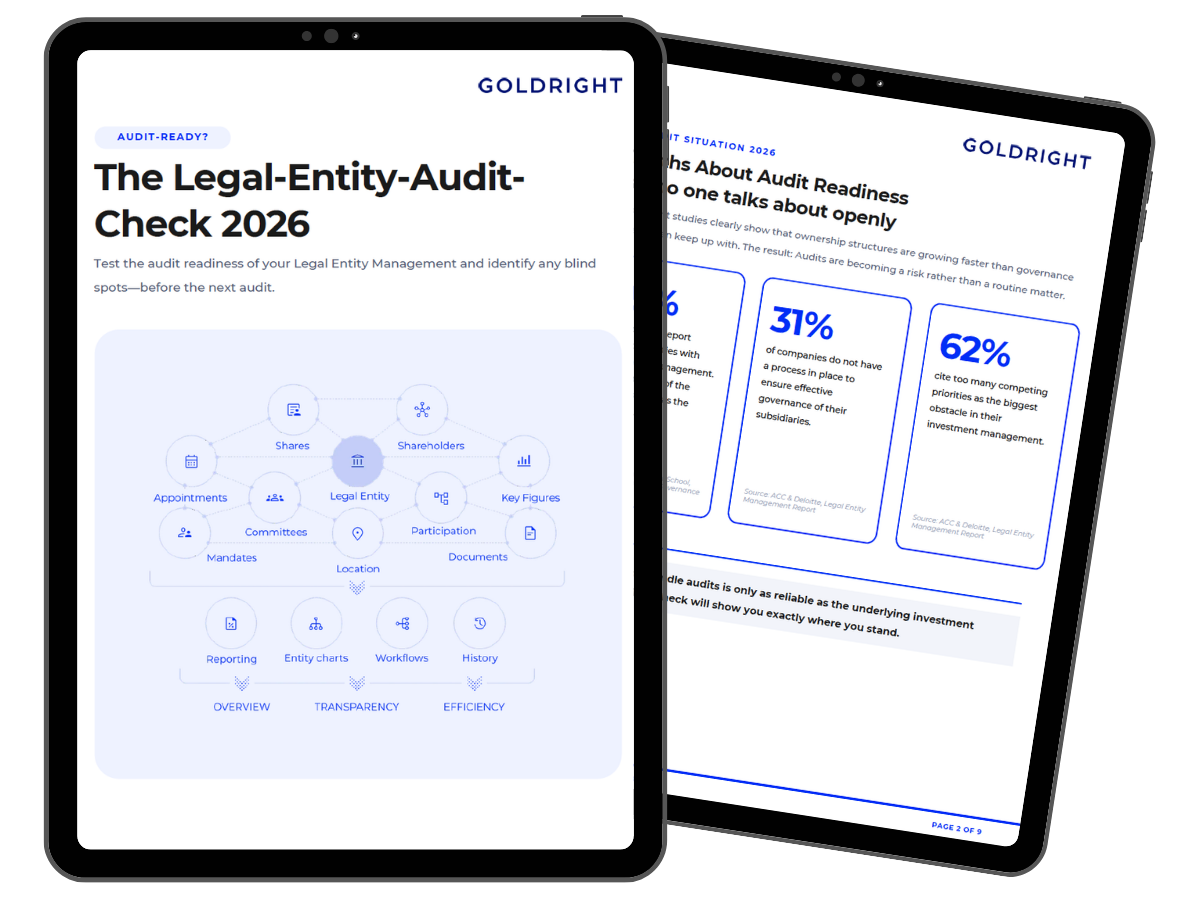
Where does your legal entity management stand today?
The 2026 Legal Entity Audit Check assesses your audit readiness through 10 questions across five dimensions—master data, historical data, governing bodies, regulatory compliance, and automation. Developed based on over 20 years of practical experience and real-world projects at more than 30 companies.
9-page practical guide as a ready-to-use PDF
Prioritized recommendations for action based on your score
100% free
Before your next audit: Do you know your blind spots?
In just 15 minutes, use 10 targeted questions to assess how audit-ready your legal entity management really is—and receive specific recommendations tailored to your results.
9-page practical guide as a ready-to-use PDF
Prioritized recommendations for action based on your score
100% free
Frequently asked question about Legal Entity Management
- Legal Entity management is the centralized administration of all companies, equity interests, mandates, and reporting obligations of a corporation. It answers the questions of who owns which company and what percentage, who represents it, and what legal obligations are associated with it. Put simply, investment management is a corporate group’s “memory” for its own legal structure—those who master it can respond reliably and quickly to inquiries.
- Beteiligungsmanagement is the term commonly used in German-speaking countries, while legal entity management (LEM) is the international term for the same field of activity. In terms of content, the two terms are largely synonymous: They encompass master data, ownership structures, governing bodies, reporting, and document management for legal entities. In international corporations, both terms are often used interchangeably, de
- Legal Entity Management maps out the legal and organizational structure of companies (shares, board seats, reporting requirements). Investment controlling focuses on the financial management of these investments, for example through key performance indicators, budgets, and performance. In practice, both disciplines build on each other: Without accurate investment master data, robust investment controlling cannot be carried out, because KPIs must always refer to specific, correctly defined companies.
- Key responsibilities include maintaining corporate master data, documenting shareholdings and control relationships, managing corporate bodies and mandates, fulfilling statutory reporting and disclosure obligations, and linking relevant documents to the respective company. In addition, there are operational tasks such as preparing shareholder meetings, providing support for company formations, conversions, and liquidations, and ongoing coordination with Tax, Finance, and Compliance.
- Depending on the organization, responsibility lies with the legal department, group controlling, a corporate secretary function, or a combination of legal, tax, and compliance. It is crucial that responsibilities are clearly documented for each company—regardless of which department is formally in charge. In larger corporate groups, a dedicated legal entity management function is increasingly being established to serve as the central interface between the relevant departments.
- Manual spreadsheets are prone to errors, lack version control, and are difficult to keep up to date. As corporate structures grow, this leads to conflicting data, missed deadlines, and a lack of traceability—all of which pose a compliance risk. A centralized LEM platform validates data, logs every change, and provides a comprehensive, audit-ready overview.
- The market offers both standalone solutions for specific aspects (e.g., committee management) and integrated legal entity management systems that collectively handle master data, historical records, committees, and regulatory reporting. Goldrights Legal Entity Manager is an example of such an integrated approach. When making a selection, it’s worth considering whether a solution truly covers all five dimensions—master data, historical data, governing bodies, regulatory compliance, and automation.
- Depending on the industry and legal form, these include, among other things, commercial registry entries, group reporting, and—in the financial sector—reporting obligations under Section 24 of the German Banking Act (KWG). In the insurance and real estate sectors, UBO identification and related-party disclosures also apply. Which specific obligations apply depends on the legal form, industry, and country of incorporation and requires a legal review on a case-by-case basis.
- Continuous updates whenever changes occur are preferable to periodic reviews. In addition, it is recommended to perform at least one full reconciliation per year with registry data and external sources to identify discrepancies early on. Companies with a high frequency of M&A activity or those in highly regulated industries should perform this reconciliation more frequently—for example, quarterly—to ensure reliable compliance with reporting deadlines.
- The duration depends on the number of companies and the initial state of the data. The first visible results—such as a cleaned-up central master data sheet—can often be achieved within a few weeks, while full integration, including historical data and interfaces, can take several months. A phased approach that starts with the largest gaps typically delivers visible benefits more quickly than attempting to roll out all dimensions at once.
- The costs are rarely immediately apparent, but they manifest as time lost during audits, the effort required for retroactive data entry and delayed reporting—and, in the worst-case scenario, fines or delayed transactions. According to IBM, more than a quarter of companies lose more than $5 million annually due to poor data quality, with investment data accounting for a significant portion of this. Added to this are harder to quantify consequences such as slowed M&A processes and reputation loss.
- Master Data Management is the overarching approach to managing all types of corporate master data—such as customers, suppliers, products, and materials. Legal Entity Management is a specialized form of this that focuses exclusively on legal entities, equity interests, and organizational structures.
- Centralized, validated data with a complete change history and timestamps provide an audit-proof view of ownership interests. Auditors and stakeholders receive evidence accurate as of the reporting date, and governance rules are enforced by the system—which reduces the effort and risk associated with audits.