July 20, 2026
Data Governance Framework 2026: How CDOs Are Laying the Groundwork for Scalable Data Quality Now
By Robbin van Zanten
Senior Account Executive
:format(webp))
14 min read
Share this post
Anyone who views a data governance framework solely as a compliance task has already lost. This article explains what sets an effective framework apart from a paperless document—and why 2026 is the pivotal year for understanding that difference. You’ll learn about the four root causes of fragmented governance, a proven approach to building a framework, and the pitfalls that even experienced CDOs underestimate.
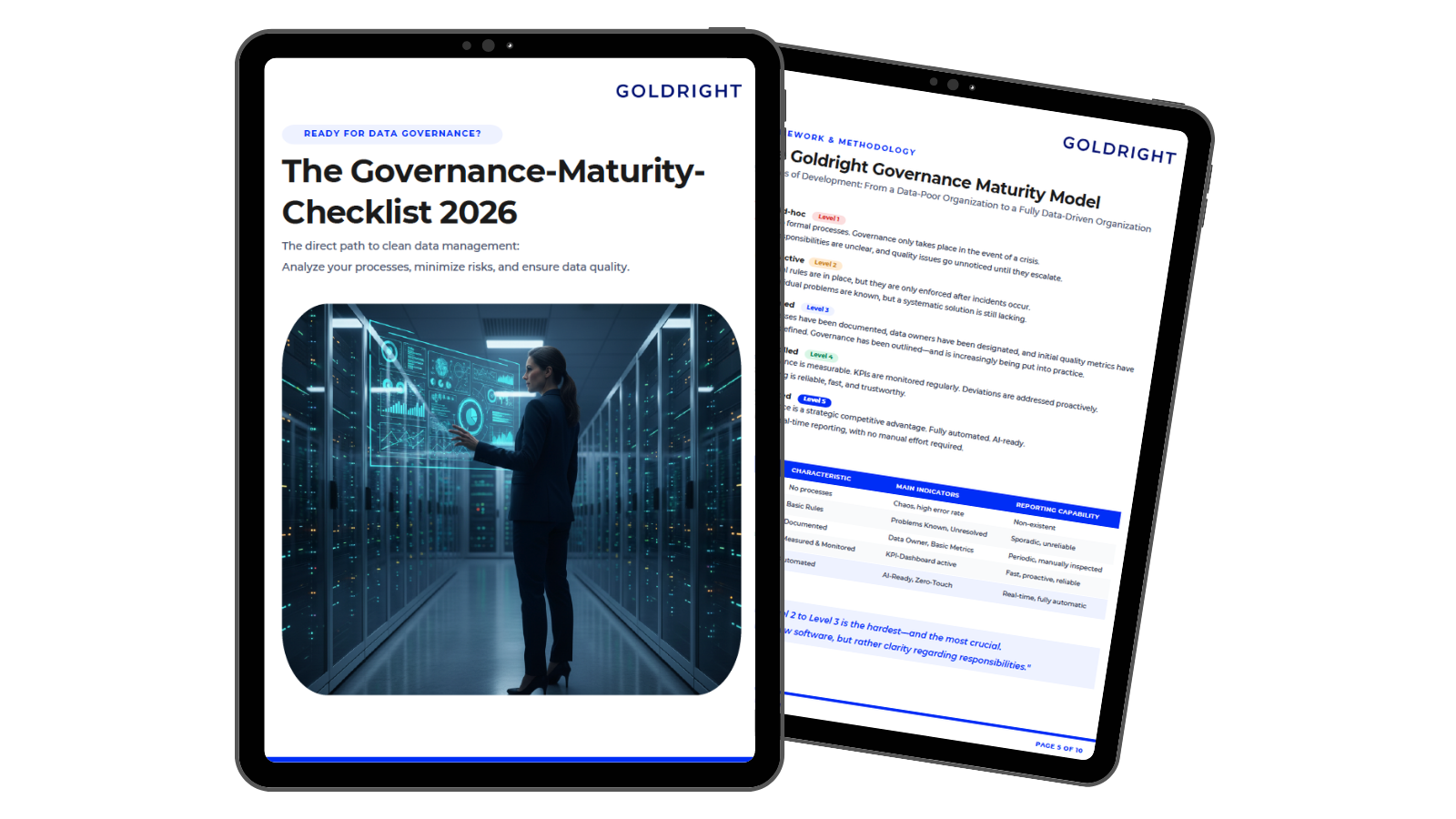
Stop Guessing. Start Governing.
Use this self-assessment to find out how robust your data foundation really is. With 10 targeted questions, this checklist shows you where you stand today—and where your greatest leverage for sound data governance lies.
10-Question Checklist to Assess Your Governance Maturity
A field-tested 90-day plan you can start using right away
100% free and independent
Do you know your level of governance maturity?
Use this self-assessment to find out how robust your data foundation really is. Through 10 targeted questions, this checklist shows you where you stand today—and where your greatest opportunity for effective data governance lies.
10-Question Checklist to Assess Your Governance Maturity
A field-tested 90-day plan you can start using right away
100% free and independent
Frequently asked Questions about the Data Governance Framework
- Data governance defines the “why” and “how”—policies, responsibilities, and decision-making authority. Data management is the operational “what”—administration, storage, integration, and quality assurance. Governance guides management; both are necessary but not interchangeable.
- An initial governance pilot in a single data domain can be operationalized in 8 to 12 weeks. Enterprise-wide implementation typically takes 12 to 36 months—depending on company size, system landscape, and organizational maturity. Governance is not a project with an end date, but rather a capability that must be maintained over the long term.
- Recommended set: Data Owner (business representatives for each data domain), Data Steward (responsible for operational quality), Data Custodian (IT-side system responsibility), and Data Governance Council (overarching steering committee with C-level participation).
- A Data Governance Council is the overarching steering committee. It typically consists of Data Owners from all data domains, the CDO, and representatives from relevant business units (Legal, Compliance, Finance, IT). The Council makes decisions regarding governance policies, resolves cross-domain data conflicts, and prioritizes governance initiatives.
- The Golden Record is the single, consolidated, and authoritative version of a data entity—such as a customer, supplier, or legal entity. The data owner defines which attributes constitute the Golden Record and which source systems are considered authoritative. The Golden Record is the operational goal of every MDM-supported governance framework.
- A robust governance framework makes regulatory compliance structurally easier. The GDPR requires transparent data management and deletion processes. DORA mandates demonstrable ICT risk management for financial institutions. Both are significantly easier to comply with if data ownership, classification, and quality standards are already defined within the governance framework.
- As soon as critical master data is maintained in more than two systems and inconsistencies lead to operational problems, an MDM system is the next logical step. MDM is not the foundation of governance—but without it, the framework lacks the operational backbone needed for implementation.
- Recommended KPIs: data quality rate per domain (completeness, uniqueness, timeliness), number of open data conflicts and time to resolution, governance compliance rate, audit readiness (time to provide compliance reports).
- Yes. The DAMA-DMBOK2 (Data Management Body of Knowledge) is a globally recognized standard. In addition, there is the DCAM Framework (EDM Council) and industry-specific standards such as BCBS 239 for banks. None of these are mandatory standards—but they provide structured guidance for framework development.
Do you know your governance maturity level?
Do you know where your organization stands on the maturity model? The Governance Maturity Checklist will give you the answer—in 15 minutes, free of charge.