June 11, 2026
Artificial Intelligence in Manufacturing: Why Your Smart Factory Is Failing Because of Master Data—and How to Fix It

By Philipp Seibald
Vice President Sales
:format(webp))
24 min read
Share this post
Artificial intelligence in manufacturing can help predict machine breakdowns, adjust plans, and detect defects before a part leaves the factory. In many cases, however, it remains at the pilot project stage. The reason rarely lies in the algorithm itself, but in material numbers, bills of materials, and equipment data, which mean something different in every system. This guide shows which data the most important AI use cases actually need—and how you can turn a pilot project into a scalable operation.
Key Takeaways
AI has made its way into the industrial sector, but it hasn’t scaled up yet: 40% of German industrial companies use AI in production, yet 46% still consider themselves laggards.
Data is the bottleneck: 44% of companies that have considered AI but have not implemented it cite problems with data availability or quality.
No AI-ready data, no operations: Gartner expects that by the end of 2026, 60% of AI projects will be abandoned due to a lack of AI-ready data.
The three strongest use cases—AI in maintenance, production planning, and quality assurance—all rely on the same master data: material, bill of materials, equipment, work plan, and supplier.
The core problem is identity: An AI must know what an object is before it can learn how it behaves. This is achieved by maintaining a “golden record” for each material and piece of equipment.
The path to scaling begins with the use case, not the platform: If you build the data foundation for one use case properly, you can reuse it for the next one.
Regulation is taking shape: The EU Data Act has been in effect since September 12, 2025, and the AI requirements for machines under the EU AI Act take effect on August 2, 2028.
What Is Artificial Intelligence in Manufacturing?
Artificial intelligence in manufacturing refers to the use of learning algorithms that analyze data from production, logistics, and engineering to prepare or automatically make decisions. This includes machine learning, computer vision, time-series analysis, optimization methods, and, increasingly, generative AI and AI agents.
Typical goals include higher equipment availability, more consistent quality, shorter lead times, and reduced energy and material consumption. Data sources range from sensors and control systems to the Manufacturing Execution System (MES) and ERP systems such as SAP S/4HANA and PLM solutions.
Key to understanding this: AI in manufacturing processes two types of data. Transaction data describes what happens—temperature trends, cycle times, inspection results, orders. Master data describes what these events refer to—which material, which machine, which work plan, which supplier. Without reliable master data, transaction data lacks context.
Distinguishing Between AI, Smart Factory, and Industry 4.0
These terms are often used interchangeably. However, they describe different levels:
Industry 4.0 is the vision of networked, digitally controlled production—featuring IoT platforms, digital twins, and end-to-end data exchange.
The Smart Factory is the concrete implementation of this vision within a plant: machines, systems, and people exchange information in real time and largely control processes autonomously.
Artificial intelligence in manufacturing is the analysis and decision-making layer of this Smart Factory. It uses connected data to generate predictions, recommendations, and actions.
In short: Industry 4.0 connects, the smart factory organizes, and AI decides. And all three levels require that every object in the factory be uniquely identified. We describe what this fundamentally means for master data in the article “MDM & AI Readiness: Why Data Determines AI Success.”
How widespread is AI in manufacturing? The figures for 2026
The question is no longer whether AI will take hold in manufacturing. The question is why so few companies are making the transition from pilot projects to full-scale operation. Current studies paint a clear picture.
Key Figure | Value | Source |
Manufacturing companies in Germany using AI in production | 40% (an additional 38% plan to do so) | |
Manufacturing companies that consider themselves laggards in AI | 46 % | |
Manufacturing companies that are already making good use of AI’s potential | 24 % | |
Companies with 250+ employees that use AI (all industries) | 57 % | |
AI initiatives that delivered the expected ROI | 25 % | |
AI initiatives that have been scaled company-wide | 16 % | |
Companies without (secure) AI-ready data management practices | 63 % |
Three key findings stand out.
First: Adoption is growing, but the impact is not keeping pace.
According to the McKinsey State of AI 2026, nearly nine out of ten organizations surveyed use AI regularly in at least one function. However, only 6% are considered “AI High Performers,” attributing at least 5% of their EBIT to AI.
Second: Those who scale up reap the rewards.
The Deloitte 2025 Smart Manufacturing Survey of 600 executives at large industrial companies reports approximately 20% higher production output, 20% higher employee productivity, and 15% additional capacity freed up through smart manufacturing initiatives. At the plant or network level, however, only 29% are using AI and machine learning.
Third: The hurdle is the data infrastructure.
In the IBM study, half of the 2,000 CEOs surveyed admit that rapid investments have led to a fragmented technology landscape. 68% consider an integrated, enterprise-wide data architecture to be crucial. The German figures confirm this: For 44% of companies that have considered AI but have not implemented it, data availability or quality is an obstacle.
The World Economic Forum’s Global Lighthouse Network shows what top-performing plants do differently. 94% of the transformations recognized there combine multiple technology fields—AI is most often used in conjunction with IoT, the cloud, and digital twins. This only works if all these systems refer to the same objects.
AI in Manufacturing: The Most Important Use Cases and Their Data Foundation
Not every AI use case has the same requirements. To understand why a pilot project is stalling, you must ask for each use case: What master data does the model rely on—and how reliable is it?
AI in Maintenance: Predictive Maintenance
AI in maintenance is the most common entry point. According to Bitkom, as early as the beginning of 2025, 32% of industrial companies were already using AI for machine condition monitoring, while another 42% were planning or discussing its implementation.
The principle: Models detect patterns in vibration, temperature, or current data that precede a failure. Maintenance teams can then plan ahead instead of reacting.
For this to succeed, the model needs more than just sensor data. It must know which piece of equipment a sensor belongs to, where that equipment fits in the equipment hierarchy, which model series it belongs to, and which replacement parts are installed. Without this context, the AI learns from time series data that it cannot reliably associate with any specific machine. The result is false alarms—and a maintenance team that stops trusting the system after just a few weeks.
AI in Production Planning
AI in production planning optimizes sequences, setup times, and capacities. It responds to rush orders, material shortages, or machine malfunctions and suggests new plans. AI agents go one step further: they initiate rescheduling on their own.
The data foundation for this consists of bills of materials, work plans, workstations, material master data with lead times, and supplier master data. Any discrepancy here has a direct impact. An outdated bill-of-materials item results in a plan that reserves a part that is no longer used. An incorrect lead time results in a plan that waits for material that never arrives.
According to McKinsey’s State of AI 2026, companies in advanced manufacturing prioritize AI agents primarily in supply chain management, inventory management, and process optimization. It is precisely in these areas that the quality of master and structural data determines the value of the solution. We explain why the bill of materials is central to this in “Why Your Bill of Materials’ Master Data Is the Heart of Your Products.”
AI in Quality Assurance
AI in quality assurance primarily uses computer vision: Cameras inspect surfaces, weld seams, or assemblies and detect deviations faster and more consistently than a visual inspection. In addition, there are models that link process parameters to inspection results and identify the causes of scrap.
Here, too, context is key. The AI must know which material variant is currently being inspected, what tolerances apply, which supplier delivered the batch, and on which production line the part was manufactured. If variants are configured differently in ERP and MES, the model is comparing apples to oranges. It reports errors where none exist and overlooks real ones.
Manufacturing Optimization and Energy Management
Production optimization encompasses process parameters, lead times, scrap rates, and energy consumption. Industrial companies see particularly great potential in energy management: 85% cite it as the application area with the greatest AI opportunities.
To assign energy to a product, an order, or a piece of equipment, AI again requires the same foundation: uniquely identified equipment, uniquely identified materials, uniquely identified cost centers, and locations. This is all the more true when the results are incorporated into sustainability reporting.
Generative AI and AI Agents on the Factory Floor
In addition to traditional machine learning, generative AI is making its way into factories. Maintenance assistants answer questions about error codes, work planners have inspection instructions drafted, and buyers query supplier evaluations using natural language. AI agents go a step further and trigger actions on their own—an order, a rescheduling, or a maintenance request.
For these systems, the same rule applies in an even more stringent form. A language model can still formulate a convincing response even when it uses the wrong source. If a technician asks about the maintenance interval for a pump, the assistant must know which pump, which model series, and which revision level are being referred to. If the manual is linked to the wrong piece of equipment, the answer will be precisely worded but still incorrect.
Agents amplify this effect because they not only respond but also take action. Rescheduling based on an outdated bill of materials is no longer just a display error but a real intervention in production. The more autonomy a system is given, the more reliable the master data on which it relies must be.
Overview of Use Cases and Data Requirements
The following table summarizes which master data each use case requires, which data errors are typical, and what they trigger in the AI model.
Use Case | Critical Master Data | Typical Data Error | Consequence in the AI Model | Master Data Leverage |
AI in Maintenance | Equipment, Equipment Hierarchy, Model Series, Replacement Parts, Location | Sensor is not uniquely assigned to any piece of equipment; the same piece of equipment is named differently in the MES and the maintenance system | False alarms; models that cannot be transferred between lines | Golden Record per piece of equipment with a binding hierarchy |
AI in Production Planning | Material, Bill of Materials, Work Plan, Work Center, Supplier, Lead Time | Outdated BOM items; differing units of measure between ERP and MES | Unrealistic plans, incorrect reservations, planners overriding the system | Synchronized material and BOM data across PLM, ERP, and MES |
AI in Quality Assurance | Material variant, inspection characteristics, tolerances, supplier, line | Variants created multiple times; tolerances maintained only locally | False-positive and false-negative inspection decisions | Unambiguous variant logic and centrally maintained inspection characteristics |
Production Optimization and Energy | Plant, Cost Center, Location, Material, Order | Energy meters not clearly assigned to plants or cost centers | Consumption cannot be allocated according to the source | Consistent organizational and plant structure |
Generative AI and AI agents (e.g., maintenance assistant) | All of the above, plus documents and manuals for each piece of equipment | Documents not linked to the correct equipment | Responses related to the wrong machine or revision | Golden Record as a reference for document linking |
The pattern is clear: Regardless of the use case, every model is based on a handful of objects. Once you manage these objects properly, you lay the foundation for all future use cases.
Why AI Projects in Manufacturing Get Stuck in the Pilot Phase
In conversations with plant managers, IT managers, and maintenance managers, we rarely hear that the model was flawed. What we hear is: “The pilot went well. But it didn’t work at the second plant.” There are almost always the same underlying causes behind this statement.
One Component, Many Identities
The classic example: The warehouse lists a part as “Screw A,” accounting as “Part 123,” and production as “Silver Fastener.” This is annoying for people. For AI, it’s a mystery.
In companies with multiple plants, the problem multiplies. Each plant has created its own material numbers, its own short descriptions, and its own classifications. After acquisitions, additional ERP tenants are added.
A model trained at Plant A won’t recognize the same parts at Plant B. Duplicates in the material master data are therefore not just a cost issue for purchasing and warehousing. They are the most common reason why AI models cannot be transferred.
Sensor Data Without Context
Many smart factory initiatives start with an IoT platform. Sensors deliver millions of data points, which are stored in a data lake. What’s missing is the connection to the business reality.
A sensor tag like “L3_M07_TEMP_02” tells the model nothing about the type of equipment, when the last maintenance was performed, or which product is currently being produced. This information is stored in the maintenance and ERP systems—often under a different name. Bitkom reports that digital twins and IoT platforms are already in use at 45% of industrial companies. However, without authoritative equipment master data, the digital twin remains a representation without identity.
Discrepancies in Bill of Materials Between PLM, ERP, and MES
The design department works with the engineering bill of materials in the PLM system. The manufacturing department works with the manufacturing bill of materials in the ERP and MES systems. Between the two lie different revision statuses, variants, and local adjustments.
This is critical for production planning with AI. A model that predicts material requirements must know which version is currently valid. If the PLM, ERP, and MES systems are out of sync, the AI optimizes for a structure that does not actually exist on the shop floor.
No one is responsible for the data
The fourth cause is organizational. In many companies, master data is maintained by whoever needs it at the moment—on the shop floor, in purchasing, or in engineering. There are no binding rules specifying who maintains and approves which fields.
This is not a criticism of the teams. It is a structural problem. According to Bitkom, 42% of industrial companies lack the expertise to integrate AI into existing processes. A large part of this integration involves data governance: clear data owners, defined approval workflows, and measurable quality rules.
Not an algorithm problem, but an identity problem
At this point, it’s worth shifting perspectives. Most discussions about AI in manufacturing revolve around models, platforms, and computing power. The crucial question is a different one: Does your AI know what it’s talking about?
A machine-learning model learns correlations between features and outcomes. For it to do so, every observation must be uniquely assigned to an object: this sensor to this pump, this test value to this variant, this order to this bill of materials. If this association is missing, the model learns noise. This isn’t a lack of data volume—it’s a lack of identity.
This fundamentally changes the project logic:
Instead of collecting more data, determine which objects a use case needs to know.
Instead of letting each AI project clean its own data, create a common reference.
Instead of delegating the problem to data scientists, make master data the responsibility of the plant, purchasing, and engineering departments.
This shared reference is the Golden Record: a binding, consolidated dataset for each material, piece of equipment, or supplier that all systems rely on. It replaces neither ERP nor MES; rather, it ensures that both systems are on the same page. Our article “Golden Record Master Data: Structure, Maintenance & Governance” describes how a Golden Record is structured and maintained over the long term.
For management, this shift in perspective translates into a simple calculation. Gartner estimates the average cost of poor data quality at $12.9 million per company per year. In manufacturing, there’s a second effect: every AI use case based on unclear master data incurs the cost of data cleansing all over again.
Approach: Six Steps from a Pilot to Scalable AI in Manufacturing
The following approach starts with the use case, not the platform. It follows the same logic that Gartner recommends for AI-enabled data: align data with specific use cases, establish governance, and continuously ensure data quality.
Step 1: Select a Use Case with a Solid Business Case
Start with a use case whose benefits can be expressed in euros: unplanned downtime, scrap costs, inventory value, setup times. AI in maintenance is often a good place to start because downtime costs are well-known in most plants.
It is important to select a use case that can be applied across multiple plants or production lines. Only then will the work on master data pay off many times over.
Step 2: Create the data map for this use case
Identify which objects the model needs to recognize—for example, equipment, model series, spare parts, and location.
Then, for each object, check: In which systems is it stored? Under what number? Who maintains it? How complete is it?
This map reveals where the actual gaps lie. It often becomes apparent that it is not the sensor data that is missing, but rather the mapping between the IoT platform, the maintenance system, and the ERP.
Step 3: Establish Golden Records for Critical Objects
Consolidate the objects from the data map into golden records. This means: identifying and merging duplicates, defining required attributes, standardizing classifications, and determining which system is the primary source for each attribute.
Start with the objects that the use case actually needs. A complete material master project across all plants is a multi-year undertaking. A clean asset master for a single production line can be completed in a matter of weeks—and is immediately usable.
Step 4: Embed Governance in the Plant
Assign a data owner to each object who is technically responsible. Define approval workflows for new materials, assets, and changes. Establish quality rules that are automatically checked.
Governance only works in manufacturing if it’s close to the plant. A central data team sets the rules, while maintenance takes place where the knowledge resides. Our article on the four data dimensions for consistently high master data quality describes exactly what such workflows look like.
Step 5: Integrate the Master Data Context into the AI Pipeline
Now connect the golden records to the systems from which the model learns and to which it writes back: IoT platform, MES, data lake, ERP. Through interfaces, every time series and every test result receives a binding object reference.
For generative AI and AI agents, there is an additional approach. Using the Model Context Protocol (MCP), AI assistants can access verified master data directly and in a controlled manner, rather than relying on copies in documents. Goldright’s native MCP integration for enterprise AI demonstrates how this is implemented.
Step 6: Measure, Validate, Scale
Measure two things in parallel: the impact of the use case (such as avoided downtime) and the quality of the underlying master data (such as completeness, duplicate rate, and timeliness). Both metrics belong in the same report.
Once the first use case is running smoothly, roll it out to the next plant. The effort required decreases significantly because the objects are already properly managed. With each additional use case, the shared database grows—and with it, the return on investment.
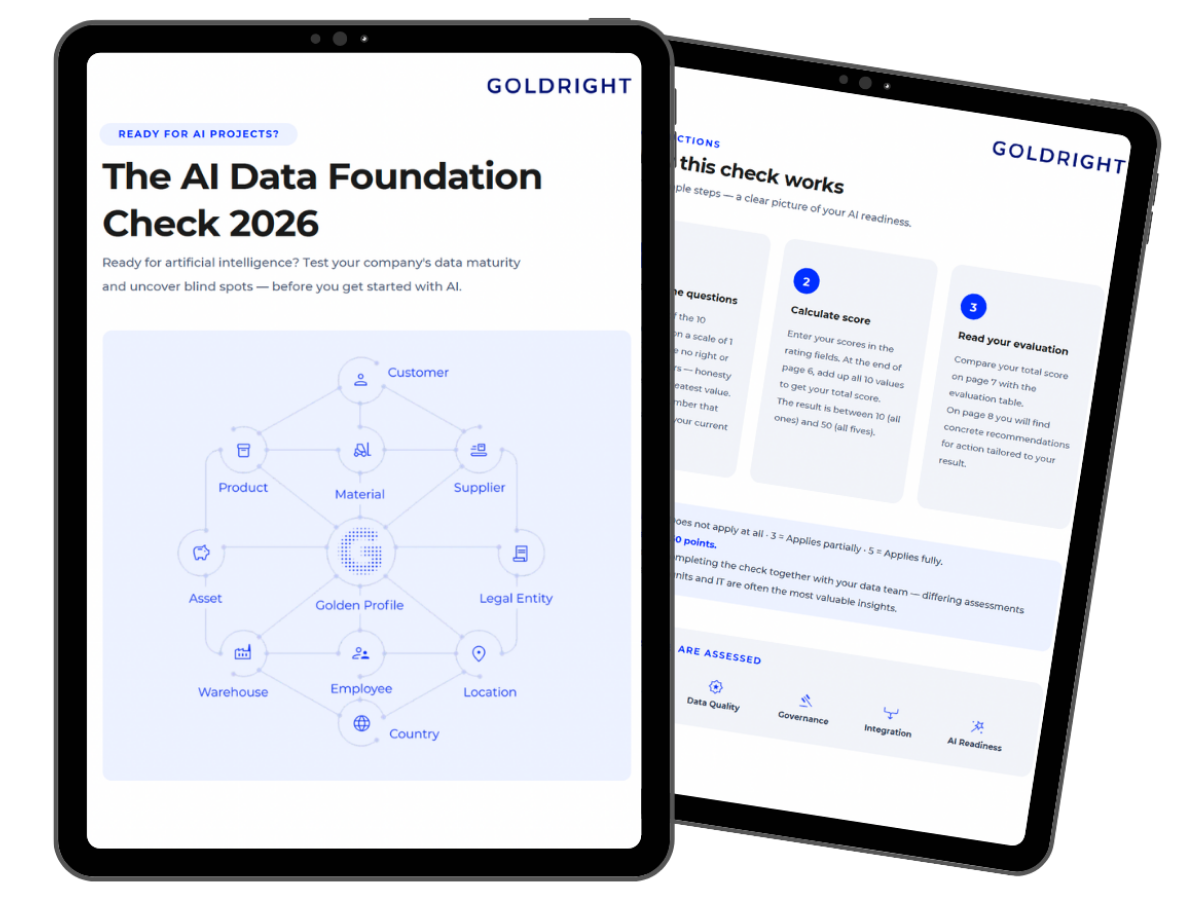
How AI-ready is the master data in your plant?
The AI Data Foundation Check quickly shows you the current status of your material, bill of materials, and asset data—and identifies the gaps that are holding back your AI use cases in maintenance, planning, and quality assurance. It provides clear prioritization for your first scalable use case.
What This Means for Your Role
AI in manufacturing is not merely an IT project. It changes the way senior management, the plant, and IT work together. The perspectives differ, but the foundation is the same.
For senior management, it’s all about return on investment. Investments in smart factory technology should have a measurable impact—on equipment availability, on-time delivery, and unit costs. The key question is: Can what worked in the pilot be scaled to all plants? A consistent master data foundation is essential for the answer to be “yes.”
For plant management and operations management, it’s all about reliability. A planning system that shift supervisors don’t trust will be overridden. A maintenance alert that has been wrong three times will be ignored. Accurate material and equipment data is therefore not an end in itself, but the foundation for acceptance on the shop floor.
For IT leadership, it’s about architecture and effort. Every point-to-point interface between ERP, MES, PLM, and IoT platforms that converts data is a potential source of error. A central “golden source” reduces these mappings and frees up time for new use cases instead of data repairs.
For maintenance, quality, and work planning, it’s all about day-to-day operations. A system that knows the right piece of equipment, the right variant, and the right status reduces the workload. A system that constantly needs to be corrected creates new work. Anyone who contributes here as a data steward helps shape the tools they’ll use in the future.
Best Practices: What Really Works with AI in Manufacturing
Successful projects reveal certain patterns that apply regardless of industry or company size.
Start with downtime, not with the technology.
Projects that begin with a specific metric—downtime hours, scrap rate, on-time delivery—gain support more quickly on the shop floor. The choice of technology follows the problem, not the other way around.
Budget for master data as part of the AI project.
Data cleansing is not preparatory work that happens “on the side.” Plan it as a separate work package with assigned responsibility, time, and budget. Those who fail to do so shift the costs to a later project phase, where they become more expensive.
Make the plant a co-creator.
Maintenance staff and shift supervisors know which equipment is incorrectly assigned in the system. Involve them early on, for example as data stewards for their line. This improves data quality and acceptance of the AI results.
Create a single reference source for all systems.
Don’t let each system maintain its own version of the truth. A central “golden source” for materials, equipment, and suppliers distributes authoritative data to ERP, MES, PLM, and IoT platforms. This creates the “common vocabulary” that a smart factory needs.
Use standards where they exist.
Classification standards such as ECLASS and the Asset Administration Shell concept from the Industry 4.0 platform facilitate data exchange with suppliers and machine manufacturers. A Golden Record is the natural place to make these standards binding internally.
Consider regulatory requirements from the very beginning.
The EU Data Act takes effect on September 12, 2025. It regulates access to data from connected products, explicitly including industrial machines.
For AI in regulated products such as machines, the high-risk obligations of the EU AI Act—as agreed upon in the Digital Omnibus package—will take effect on August 2, 2028.
Article 10 will then require verifiable data governance for training, validation, and test data. Those who document and version their master data today will have this evidence on hand later. Our guide to the EU AI Act 2026 provides an overview of the deadlines.
A Comparison of Three Approaches to Building a Data Foundation for AI in Manufacturing
In practice, companies typically choose one of three approaches to supply their AI use cases with data. The following overview highlights the differences.
Criterion | Project-specific data preparation | Centralized IoT or data platform without MDM | MDM-supported golden source |
Basic Concept | Each AI project cleans its own data | Collect all raw data in one place | Provide authoritative master data for all systems |
Time to First Results | Short | Medium | Medium |
Transferability to Other Plants | Low – Reconciliation must start from scratch | Medium – Data is stored centrally, but its meaning remains inconsistent | High – Objects are uniquely identified across plants |
Consistency between ERP, MES, and PLM | Not addressed | Partially, depending on mapping rules | Systematically via golden records |
Effort per additional use case | Remains high | Decreases for transaction data, but not for master data | Decreases significantly |
Governance and Accountability | Lies with the project team | Lies primarily with IT | Subject-matter data owners with workflows |
Auditability (AI Act, Data Act) | Weak | Moderate | Strong—origin and changes documented |
Typical Use Cases | Proof of Concept | Data Collection and Monitoring | Scaling Across Plants and Use Cases |
These approaches are not mutually exclusive. An IoT platform is essential for sensor data. A proof of concept can be pragmatic.
What matters most is that the master data layer isn’t reinvented in every project. If you want to scale, you need the third column as the foundation beneath the other two.
Real-World Scenario: How a Machinery Manufacturer Scales Its Predictive Maintenance Pilot
The following scenario has been anonymized and condensed from typical project workflows in the manufacturing industry. It deliberately does not include any key metrics from a single customer.
The starting point.
A medium-sized machine manufacturer in the DACH region operates three plants, two of which were acquired. An AI pilot project for maintenance is running successfully on a milling line at the main plant. The model detects bearing damage on spindles several days in advance. Management wants to roll out the model to all plants.
The Problem.
At the second plant, the model yields hardly any usable results.
The analysis shows that the same machine types are recorded there under different names. The equipment hierarchy is structured differently, and spare parts are assigned plant-specific material numbers. Some of the sensors are not uniquely assigned to any piece of equipment in the maintenance system. Thus, the model does not learn “spindle series X,” but rather “sensor of unknown origin.”
The Approach.
Instead of retraining the model for each plant, the company starts with the master data. It creates a data map for the use case and defines four core objects: asset, series, spare part, and location. Cross-plant “golden records” with a uniform classification are created for these objects. Each plant is assigned a data steward from the maintenance department who approves new assets and changes.
The Result.
The Golden Records are distributed to the IoT platform, maintenance system, and ERP. Each time series now carries a unique asset and model series reference. The model can be applied to comparable machines in the other plants without having to reprocess the database each time. The second use case—AI-supported spare parts planning—uses the same Golden Records and gets up and running with significantly less lead time.
The lesson.
The breakthrough did not come from a better model. It came from the decision to definitively clarify the identity of the objects once and for all. This is exactly what we mean when we talk about clarity amid data chaos.
Our page “MDM for Manufacturing” shows how manufacturing companies are taking this approach with Goldright.
Pitfalls: What to Avoid When Using AI in Manufacturing
Confusing the pilot with the product.
A pilot demonstrates that a model works under controlled conditions. It does not prove that the data set scales. Plan for the rollout to a second plant from the very beginning—as a test of data quality.
Cleaning up data for the project and then letting it become obsolete.
Many teams clean up master data once for training purposes. Six months later, new duplicates have emerged, and the model loses accuracy. Without ongoing governance, every data cleanup has an expiration date.
Trying to solve everything at once.
The opposite is just as risky: a mammoth project designed to harmonize all master data across all plants before the first AI goes live. Such initiatives lose support before they demonstrate any value. Work on one use case at a time.
Leaving it all to IT.
Master data in manufacturing is domain-specific knowledge. If IT defines equipment hierarchies without maintenance input or material classes without engineering input, structures are created that no one in the plant maintains.
Relying on generative AI for unverified documents.
AI assistants for maintenance or work planning are appealing. If they access manuals and maintenance reports that aren’t clearly assigned to a specific piece of equipment, they’ll provide convincingly worded answers about the wrong machine. Read more about why over 80% of AI projects fail due to poor data quality in our overview article.
Treating regulatory compliance as a problem to be addressed later.
The obligations under the Data Act and AI Act are being phased in gradually. Those who wait until an audit is imminent to document the origin and changes to their data will find themselves reconstructing it under time pressure. A versioned Golden Record makes this documentation a byproduct of routine operations.
Before you launch your next AI pilot
First, check the foundation. The AI Data Foundation Check helps you systematically evaluate the data foundation of your planned use case—from duplicate materials and BOM discrepancies to asset assignments. This way, you’ll know before the project starts whether your model will work just as well in the second plant as it does in the first.
Conclusion: Artificial Intelligence in Manufacturing Starts with Master Data
Artificial intelligence in manufacturing is no longer a topic for the future. Forty percent of German industrial companies are using it in production. However, only a fraction of these initiatives achieve the expected return on investment, and even fewer are scaled company-wide. The gap between pilot projects and routine operations is rarely a matter of the model itself.
It is a question of identity. AI can only predict when a machine will fail if it knows which machine it is currently examining. It can only optimize a plan if the bill of materials is correct. And it can only detect errors if it is clear which variant is on the test bench.
For management, this means: Investments in AI for maintenance, production planning, and quality assurance will only pay off fully once the master data for materials, equipment, and suppliers has been definitively clarified. For IT, it means: less time patching together data fields, more time for new use cases. For the teams on the shop floor, it means: systems whose recommendations can be trusted.
Getting there doesn’t have to be a massive project. It starts with a use case, a data map, and the decision to properly manage your critical data objects. Step by step, this leads to the “golden source” that your smart factory can scale on.
Take the first step: With the AI Data Foundation Check, you can see where your data foundation stands today and which use case can scale first. Or talk to us directly—we’ll show you how Goldright brings clarity to your manufacturing data.
Frequently Asked Questions
- AI in manufacturing is primarily used in four areas: maintenance (predictive maintenance), production planning (sequencing, capacity, material requirements), quality assurance (image processing, root cause analysis), and manufacturing and energy optimization. In addition, there are generative AI assistants, such as those for maintenance knowledge or work instructions. According to Bitkom, 40% of German industrial companies already use AI in production.
- AI in manufacturing requires transaction data and master data. Transaction data includes sensor readings, orders, inspection results, and timestamps. Master data describes the objects to which these values refer: material, bill of materials, work plan, equipment, supplier, and location. Only by clearly linking these two types of data can a model be made reliable and transferable to other production lines or plants.
- The most common cause is not the algorithm, but the data set. Gartner expects that 60% of AI projects without AI-ready data will be discontinued by the end of 2026. In manufacturing, typical reasons include duplicate material records across multiple plants, sensor data without a clear reference to specific equipment, discrepancies in bill of materials (BOM) between PLM, ERP, and MES systems, and a lack of accountability for master data.
- A smart factory is a connected facility where machines, systems, and people exchange information in real time. AI in manufacturing is the analytics and decision-making layer within this smart factory: it analyzes the connected data and generates predictions, recommendations, or automated actions. Without connectivity, AI lacks data; without AI, the Smart Factory lacks intelligence.
- AI in maintenance identifies patterns in machine data that precede a failure. This enables maintenance to be planned, unplanned downtime to be reduced, and spare parts to be stocked more strategically. A prerequisite is that every sensor in a system is uniquely assigned and that the equipment hierarchy is consistent across all systems. Otherwise, false alarms occur, which undermine confidence in the maintenance process.
- Master Data Management (MDM) establishes the authoritative reference for all objects with which AI works. It consolidates material, equipment, and supplier data into golden records, defines responsibilities, and distributes validated data to ERP, MES, PLM, and IoT platforms. This eliminates the need for every AI project to cleanse its data from scratch, and models can be scaled across plants.
- Perfect master data isn’t a prerequisite. Start with a use case that has a clear business case, and create a data map only for the objects that this use case requires. Clean and consolidate these objects, assign responsibilities, and continuously measure data quality. This way, the data foundation grows with each new use case.
- Two EU regulations are particularly relevant. The EU Data Act has been in effect since September 12, 2025, and governs access to data from connected products, including industrial machinery. The EU AI Act sets requirements for AI systems; for AI as part of regulated products such as machines, the high-risk obligations under the Digital Omnibus Agreement will take effect on August 2, 2028. Article 10 then requires demonstrable data governance.
Sources
Bitkom e. V.: Humanoide Roboter, KI & Co.: Die digitale Transformation der Industrie geht in die nächste Runde
Bitkom e. V.: Industrie 4.0: 42 Prozent der Unternehmen setzen KI in der Produktion ein
Bitkom e. V.: Drei Viertel der Industrie lassen KI-Chancen liegen
Statistisches Bundesamt (Destatis): Unternehmen mit Nutzung von Technologien der künstlichen Intelligenz nach Beschäftigtengrößenklassen
Statistisches Bundesamt (Destatis): Gründe gegen die Nutzung von Technologien der künstlichen Intelligenz nach Beschäftigtengrößenklassen
Gartner: Lack of AI-Ready Data Puts AI Projects at Risk
Gartner: Data Quality: Why It Matters and How to Achieve It
IBM Institute for Business Value: IBM Study: CEOs Double Down on AI While Navigating Enterprise Hurdles
McKinsey & Company: The State of AI
Deloitte: 2025 Smart Manufacturing and Operations Survey
World Economic Forum: Global Lighthouse Network Recognizes 23 New Sites, Launches AI Platform for Industrial Transformation
Europäische Kommission: Data Act (anwendbar seit 12.09.2025)
EU AI Act, Artikel 10: Daten und Daten-Governance
r.at: Digital Omnibus final: Was am 2.8.2026 im EU AI Act wirklich gilt
Plattform Industrie 4.0: Verwaltungsschale und Standardisierung
Bring clarity to your data-chaos now
Find out how Goldright can help your business overcome data management challenges.
:format(webp))