January 20, 2023
Golden Record Master Data: How to Create and Maintain It Properly

By Selina Trummer
Product Marketing Manager
:format(webp))
23 min read
Share this post
Learn what sets a Golden Record apart from a standard master data record, the four operational causes that lead to Golden Records deteriorating over time, and which framework you can use to maintain master data—rather than just cleaning it up once—in a sustainable, rule-based, and automated way. Includes a comparison table of common maintenance approaches, a real-world case study from the energy industry, and an FAQ for executives who want to manage Golden Records rather than just implement them.
Key Points
A Golden Record is not a state, but an operational process: It is not created by a one-time cleanup, but through ongoing survivorship rules, data stewardship, and synchronization logic.
Golden Record master data deteriorates without a maintenance process: Just six months after a cleanup project, the duplicate rate returns to near its initial level if there is no defined responsibility for maintenance.
German companies are barely tapping into their data potential: According to Bitkom, 6 out of 10 companies have so far made little or no use of their available data.
The maturity level of master data management determines data quality: This has already been demonstrated by the Aachen-based STAIRS study conducted by FIR e.V.—companies with a high maturity level have significantly fewer quality issues.
Survivorship rules are the underrated core of every Golden Record: Without defined conflict resolution for conflicting source values, every Golden Record remains merely a snapshot.
AI makes data maintenance more urgent, not optional: According to Gartner, by the end of 2026, around 60% of AI projects will fail due to a lack of an AI-ready data foundation.
Goldright provides the governance infrastructure: With over 20 years of experience in master data management and low-code configuration for survivorship rules, workflows, and historization.
What Is a Golden Record in Master Data?
A Golden Record is the single, authorized data record for an entity—a customer, a supplier, a product, or an asset—that all systems and departments within a company can trust. In German-speaking countries, the term is often used synonymously with “master data record” or “master record,” but there is a crucial difference: A master data record exists within a single system. A Golden Record is the result of an active, rule-based consolidation process across multiple systems.
It is important to distinguish between the Golden Record as a state and the Golden Record process. Many companies confuse the two: They create a consolidated, reconciled data record once—and consider the project complete. In fact, the real challenge begins only after that: How is the Golden Record managed if, the very next day, a supplier’s address changes simultaneously in three source systems?
This is precisely where the core technical discipline of Golden Record Management comes into play: survivorship rules. These are predefined rules that, in the event of conflicting values from different source systems, automatically determine which value “survives” and is incorporated into the Golden Record—for example, based on source system priority, the recency of the last update, or defined validation rules. Without survivorship rules, every Golden Record remains a momentary snapshot.
Master Data Management is the overarching discipline that supports this process from a technical, organizational, and procedural standpoint. It comprises three levels: the consolidation logic (how the “golden record” is created), the governance level (who is responsible, who maintains what), and the synchronization level (how changes are propagated back to the connected systems).
In the context of artificial intelligence, this distinction will take on even greater importance by 2026. AI models that access master data—for example, for automated procurement decisions, customer analyses, or compliance checks—require not only a clean data set at the start of the project but also a Golden Record that remains consistently up-to-date. An AI model that works with outdated Golden Records produces errors at the speed of automation—not at the speed of manual processes.
Golden Records exist across domains: customer master data in sales, supplier master data in procurement, material master data in production, asset and metering point data in the energy sector, and ownership structures in the legal department. The technical logic of consolidation and maintenance is domain-independent—the specific survivorship rules and maintenance processes vary considerably depending on the business unit.
Golden Record, Master Record, and Reference Record: A Necessary Clarification of Terms
In practice, three terms are often confused, even though they refer to different things. A master record is the leading data record within a single system—for example, the entry marked as the “main customer” in the CRM. A reference data record is a standardized, usually externally defined range of values, such as a list of country or currency codes. A golden record differs from both because it is created across systems: it consolidates attributes from multiple master records in different systems, validates them against reference data sets, and resolves conflicts using survivorship rules.
This distinction is more than just semantics—it determines which questions a project team must ask in the first place. If you maintain only one master record per system, you have no conflict issues between systems. Anyone operating a true Golden Record inevitably has to deal with this issue as soon as more than one source contributes to an attribute. Many companies mistakenly believe they are already operating a Golden Record, even though they are actually treating only the master record of their largest system—usually the ERP—as such. This works as long as no second system has write access to the same entity. As soon as a CRM, e-commerce platform, or a departmental tool independently maintains data for the same entity, the ERP’s master record is no longer sufficient.
Why will maintaining Golden Record master data be business-critical in 2026?
Establishing golden records has now become standard practice in many companies. The real gap lies in the ongoing management of golden records—and by 2026, this gap will become a business-critical risk due to several developments. In most cases, this gap is not visible unless someone actively looks for it: A golden record that was properly set up a year ago still looks like a golden record at first glance. Only a targeted audit—or a specific incident—reveals just how far the current state of data maintenance has deviated from the original condition.
1. German companies demonstrably make little use of their data potential
According to a recent Bitkom study, 61% of German companies have so far made little or no use of their data—only 5% report that they are fully leveraging their data potential. At the same time, active AI usage in German companies has more than doubled, rising from 17% to 41%. This combination is explosive: More and more companies are deploying AI, while the data foundation on which this AI operates remains unmaintained in the vast majority of cases.
2. Golden records deteriorate within a few months without a maintenance process
A one-time data quality cleanup is not a permanent solution. Without defined data stewardship roles and automated synchronization, the duplicate and error rates in a cleaned-up dataset will return to their original levels within a few months—simply because source systems continue to be maintained independently of one another in day-to-day operations. This has already been confirmed by the Aachen-based STAIRS study conducted by FIR e.V.: The maturity level of master data management—that is, the extent to which maintenance processes are embedded in the organization—correlates directly with actual data quality.
3. The EU AI Act Makes Traceable Data Maintenance a Compliance Requirement
EU Regulation 2024/1689 (EU AI Act) requires traceable data lineage for high-risk AI systems—that is, not only a clean data state but also complete documentation of how and when a data record has changed. A golden record without end-to-end historical tracking does not meet this requirement, regardless of how clean it appears at the time of review.
4. Poor data quality remains the most frequently cited reason for failed AI projects
Gartner predicts that by the end of 2026, approximately 60% of all AI projects will fail due to a lack of AI-ready data—not because of model quality. Forrester Research confirms: Data quality is the primary limiting factor for the use of generative AI in B2B companies. Both studies highlight the same blind spot: Companies systematically underestimate the ongoing maintenance effort, not the initial setup effort.
5. Companies with established golden record management have a measurable advantage
According to Gartner, companies with the highest level of maturity in AI-ready data and analytics capabilities achieve up to 65% better business results—and invest up to four times more in data foundations such as quality, governance, and maintenance processes than companies with poor AI results. The difference rarely lies in the choice of software, but rather in whether Golden Records are treated as an operational process or as a one-time project.
6. Every new system widens the maintenance gap, not just the volume of data
Cloud migrations, new departmental tools, and AI agents that independently access or even modify master data increase the number of systems that potentially write conflicting values for the same entity. Each additional system without a customized survivorship rule increases the likelihood of undetected discrepancies not linearly, but disproportionately—an effect that is regularly underestimated when introducing new systems because the focus is on the new functionality, not on its impact on existing golden records.
The 4 Root Causes of Why Golden Records Degrade in Day-to-Day Operations
Most companies are now technically capable of establishing a Golden Record. However, the regression to the old data state after a few months almost always stems from the same four operational causes.
Root Cause 1: Lack of Survivorship Rules
When three source systems provide three different values for the same attribute—such as a supplier’s different bank account numbers—the Golden Record needs an automated, documented rule to determine which value takes precedence. Without defined survivorship logic, the decision is left to chance (the most recently imported value wins) or manual case-by-case review—neither of which scales and both lead to inconsistencies as soon as the volume of data grows.
A typical real-world example: The sales team updates a customer’s address in the CRM because a customer provided a new shipping address during a field service visit. At the same time, the accounting department updates the same address in the ERP because an invoice was returned as undeliverable—with a different, equally current address, since these are two different locations for the same customer. Without a survivorship rule that distinguishes between “ship-to address” and “billing address” as separate attributes, one of the two systems overwrites the other—and no one notices the attribute error until a shipment arrives at the wrong location.
Root Cause 2: No operational responsibility for data maintenance in day-to-day business
Having a data owner at the strategic level is not enough if no one is actually verifying, approving, and correcting data in day-to-day operations. Data stewardship is an operational role, not just a title: Someone must actually have time during day-to-day operations to resolve conflicts, evaluate new attributes, and address quality discrepancies. Without this operational capacity, unresolved data conflicts accumulate until the Golden Record effectively becomes an unvalidated data export once again.
Root Cause 3: No Automated Synchronization Between Systems
A Golden Record that is not synchronized bidirectionally with the connected source systems will inevitably drift out of sync. If an address is changed in the CRM but not automatically propagated to the Golden Record and from there back to ERP and accounting, multiple “truths” will exist in parallel again within a short time—only this time with the added misconception that there is already a “clean” data record.
Particularly insidious: Unidirectional synchronization is often perceived as progress because it automates at least one direction. In reality, it merely shifts the problem—changes made directly in the Golden Record or in a downstream system do not flow back, and the original source remains out of date. Anyone who believes this solves the synchronization issue overlooks the fact that this very blind spot will creep back into the system during the next data import.
Root Cause 4: Lack of Quality Monitoring During Ongoing Operations
Most companies measure data quality only once, at the end of a project. Without continuous monitoring—automated metrics on duplicate rates, completeness, timeliness, and validation errors—the decline in quality remains invisible until it becomes apparent in a specific business transaction: an incorrect shipment, a failed AI pilot, or a finding during an audit.
The problem is exacerbated by a psychological effect: After a successful data cleanup project, there is a justified but misleading assumption within the company that the issue is “resolved.” This assumption prevents precisely the vigilance that would be necessary to detect the creeping decline in quality at an early stage. Without a dashboard that continuously displays the relevant KPIs, the only available feedback is the next specific incident—and that usually occurs much later than when the actual decline in quality actually began.
Not a Data Quality Problem—But a Process and Accountability Problem
The most common misconception when dealing with Golden Record master data: Poor data quality is treated as a technical problem that a tool is supposed to solve. In fact, maintaining Golden Records is primarily a matter of process design and clarifying accountability—technology is the enabler, not the solution.
Common Assumption | Operational Reality |
“If we buy an MDM tool, the problem is solved.” | A tool without survivorship rules and a data stewardship process only produces inaccurate data faster. |
“Once the cleanup is done, we’re finished.” | Golden records are an ongoing state—without a maintenance process, quality deteriorates within a few months |
“IT should ensure data quality” | Business units understand the data reality; IT provides the platform—both roles are necessary |
“We resolve conflicts between source systems on a case-by-case basis” | Without documented survivorship rules, case-by-case review cannot scale |
“Data quality can be assessed at the end of the year” | Without ongoing monitoring, the decline in quality remains invisible until a specific incident occurs |
This shift in framing has direct organizational consequences: If Golden Record maintenance is viewed as a continuous process with defined roles, rules, and metrics, it gains a permanent place in day-to-day operations—with dedicated capacity, escalation procedures, and performance metrics. If it is viewed as an IT project, it falls out of focus once the project is completed, until the next data incident brings it back into the spotlight.
For CDOs, this means specifically: The question for their own team should not be “Is our master data cleanup complete?” but rather “Who is responsible, right now, for ensuring that our Golden Records remain consistent—and with what capacity?” If this second question cannot be answered unequivocally, the Golden Record is, in fact, already on its way back to its fragmented initial state, regardless of how clean it may currently appear.
The Goldright Approach: Building and Managing Golden Records Over the Long Term
A Golden Record is not created simply by purchasing software, but rather through the interplay of consolidation logic, governance, and automation—the three pillars on which professional master data management is based. The following framework describes the approach Goldright uses in enterprise projects for ongoing Golden Record management.
Step 1: Identify Data Sources and Attribute Mapping
Before survivorship rules can be defined, it must be clear which source system provides which attribute and with what level of reliability. This assessment lays the foundation for all subsequent rules—including a realistic evaluation of which source systems have historically provided the more reliable values. In practice, it often becomes apparent that the intuitive assumption—“the ERP is always the primary source”—does not apply to every attribute: For contact information, the CRM is often closer to reality; for payment information, it’s accounting; and for technical specifications, it’s the production line system. This differentiation by attribute—not by system—is the key distinction from blanket “one-system-leads” approaches.
Step 2: Define and Document Survivorship Rules
A rule is established for each attribute of every golden record domain: Which source system takes priority? What criterion is used to break a tie—timeliness, completeness, or manual approval? Goldright’s Agile Data Manager (ADM) maps these rules using low-code, without requiring a development project for every adjustment.
Step 3: Establish data stewardship roles and maintenance workflows
An operational data steward is appointed for each domain—with defined responsibilities, not just a title. Conflicts that the automated survivorship rules cannot resolve unambiguously are routed through a structured approval workflow rather than remaining in unmanaged email chains.
Step 4: Automated Synchronization and Change Propagation
Goldright connects bidirectionally with ERP systems (SAP S/4HANA, Microsoft Dynamics), CRM systems, and line-of-business applications via configurable APIs. Every change to the Golden Record is automatically propagated back to all connected systems—and every change in a source system triggers the defined survivorship check.
Step 5: Quality Monitoring and KPI Dashboard
Instead of ad hoc spot checks, Goldright provides automated monitoring of key quality KPIs—duplicate rate, completeness, validation errors, and resolution time for open conflicts. Rule-based alerts highlight quality deviations before they become business-critical.
Step 6: Continuous Governance Cycles
Survivorship rules, data stewardship responsibilities, and quality objectives are not defined once and for all, but are reviewed and refined during regular governance reviews—especially when new source systems, new attributes, or new AI use cases are added. The integrated point-in-time historization provides a complete record of how the Golden Record has evolved over time.
A Growing Special Case: AI Agents as New Writers on Golden Records
As AI-powered agents that independently trigger orders, enrich master data, or update customer data become increasingly widespread, a new category of “source systems” is emerging: the agents themselves. Their write operations differ from human input in one crucial respect—they occur at a high frequency and without the intuitive hesitation a human would have when encountering implausible data. A governance model that defines survivorship rules only for systems maintained by humans has no solution for this new category of writers. Anyone integrating AI agents into their system landscape should therefore establish from the outset the priority and validation limits under which their write accesses are permitted to be incorporated into the Golden Record.
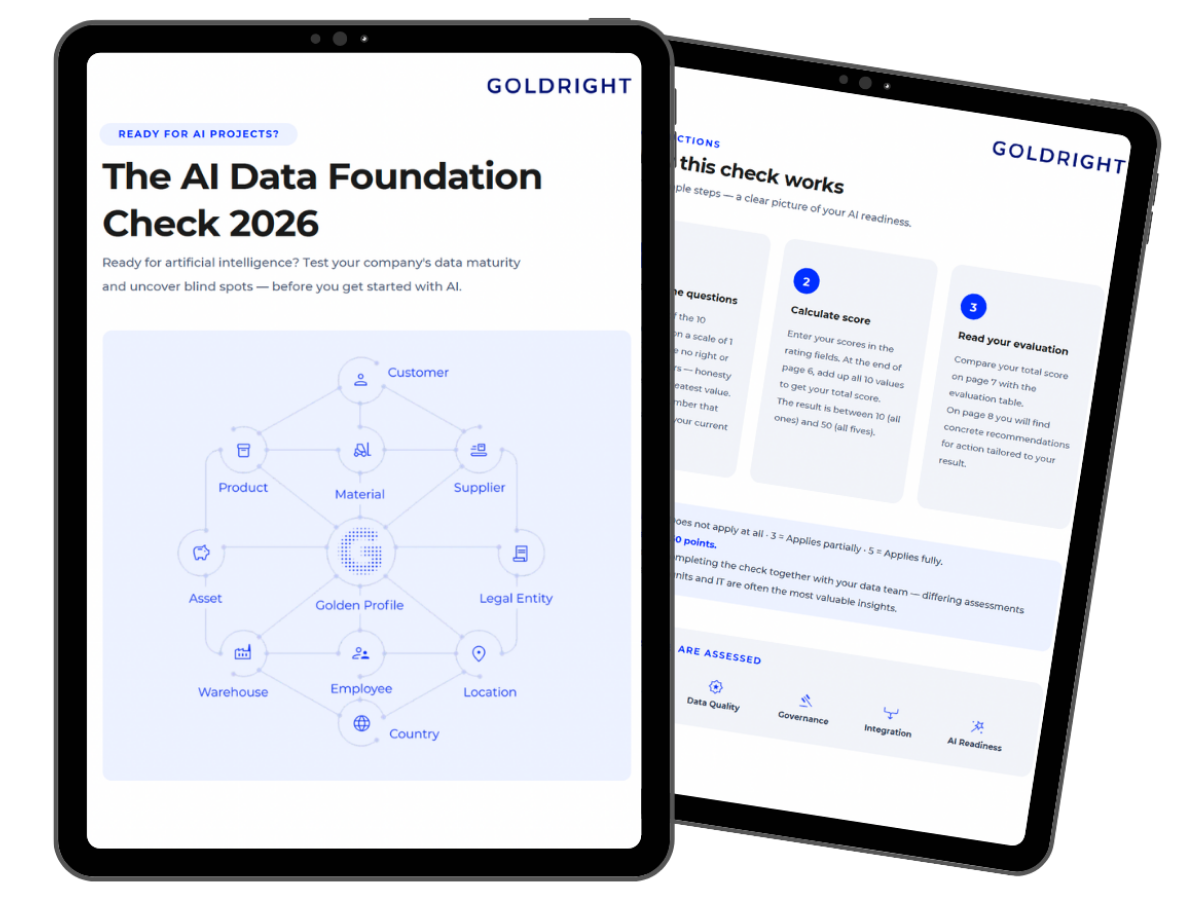
Are your golden records maintained—or were they just cleaned up once?
Most CDOs know that their master data was cleaned up at some point. Very few know how much their golden records have drifted apart since then. The AI Data Foundation Check provides you with a clear assessment of your current master data maturity—including specific areas for action—in just 15 minutes.
Assessment score for all data dimensions
Ready-to-use roadmap template
100% free
Best Practices — How to Maintain Master Data Instead of Just Cleaning It Up Once
Best Practice 1: Document survivorship rules in writing; don’t just configure them in the system
Rules that are stored only in the tool but are not understood by anyone outside the admin team become a risk every time there is a personnel change. Successful teams document every rule along with its rationale—in a way that is transparent to both business units and auditors alike.
Best Practice 2: Organize data stewardship as a network rather than a centralized team
A single, centralized data quality team cannot scale across many domains. Successful organizations embed data stewards directly within the business units—with clear subject-matter expertise related to the data they are responsible for, and a central governance body that defines standards and escalation paths.
Best Practice 3: Automated Quality Checks Instead of Manual Spot Checks
Manual spot checks identify problems randomly and too late. Automated validation rules—required-field checks, format checks, plausibility rules—detect discrepancies as they arise, not just during the next audit.
Best Practice 4: Include Golden Record KPIs in Regular Management Reporting
As long as data quality metrics appear only in IT reporting, they remain an IT issue. If the duplicate rate or completeness rate becomes part of regular business reporting, data quality becomes a shared responsibility between IT and the business units.
Best Practice 5: Actively Train Business Units Instead of Merely Informing Them
Data stewards who do not understand the logic behind survivorship rules will make inconsistent individual decisions in the event of a conflict. Short, role-based training sessions at the outset and whenever there is a major process change significantly reduce the number of incorrect decisions.
Best Practice 6: Conduct governance reviews at fixed intervals rather than ad hoc
A quarterly governance review—with fixed dates, fixed participants, and a fixed agenda (unresolved conflicts, KPI trends, new attributes)—prevents golden record maintenance from becoming an optional task that gets lost in day-to-day operations.
Best Practice 7: Define escalation paths before the first conflict arises
If a survivorship rule cannot unambiguously resolve a conflict, it must be clear in advance who will make the decision and within what timeframe—not only at the moment the conflict arises. Companies that establish escalation paths reactively often find that unresolved cases remain pending for weeks because no one feels formally responsible.
Best Practice 8: Budget realistically for maintenance costs, not just for setup
The ongoing operation of a Golden Record incurs recurring costs—for data stewardship capacity, for monitoring infrastructure, and for periodic governance reviews. Companies that budget only for the initial setup project regularly find themselves in a situation where, due to a lack of funding, maintenance effectively ceases as soon as the project team is disbanded.
A Comparison of Approaches to Maintaining Golden Record Master Data
One of the most common questions in consulting sessions is: “Isn’t an Excel cleanup once a quarter enough—why do we need dedicated MDM?” The answer depends less on the size of the company than on the number of systems that simultaneously write to the same entity—the more source systems with equal authority, the faster manual maintenance reaches its limits. This table compares the most common approaches to the ongoing maintenance of Golden Records based on the criteria that determine success or failure in practice.
Criterion | Manual maintenance (Excel/lists) | Selective data quality tools | Native ERP master data module | Dedicated MDM (Goldright) |
Survivorship Rules | None; decided on a case-by-case basis | Partially; usually not cross-domain | Rarely; usually the most recent import takes precedence | Fully configurable; low-code |
Data Stewardship Workflow | Not supported | Rarely integrated | Virtually nonexistent | Natively integrated with approval processes |
Synchronization with source systems | Manual, error-prone | Mostly unidirectional | Limited to within the ERP | Bidirectional, multi-system |
Quality Monitoring | Selective Sampling | Partially automated, often isolated | Virtually nonexistent | Continuous, KPI dashboard |
Historical Data | Not available | Limited | Limited | Point-in-time for all entities |
Scalability across domains | Very low | Medium, mostly domain-specific | Low, system-dependent | High, multi-domain |
Audit and Compliance Suitability | Very Low | Medium | Limited | High, Complete Audit Trail |
Conclusion: Manual maintenance and ad hoc tools can create a Golden Record in the short term—but they cannot maintain it over the long term. Only dedicated master data management—which combines survivorship rules, data stewardship workflows, and automated synchronization—can turn a one-time, cleaned-up dataset into a truly well-maintained Golden Record.
Case Study — How an Energy Provider Keeps Its Asset Master Data Permanently Synchronized
The following case study has been anonymized for data protection reasons. It is based on a real MDM project in the energy sector.
Initial Situation
A regional energy utility with multiple grid companies managed asset and metering point data in three separate systems: a technical asset inventory, the SAP system for billing, and a separate GIS application for grid planning. Just one year after a comprehensive data cleanup, the discrepancy rate between the three systems was back above 20%—even though the initial cleanup had been considered a success.
The Challenge
The cause was not poor data quality at the time of the cleanup, but rather the lack of any maintenance logic afterward: Technical changes to assets were recorded in the asset inventory but were not automatically reported back to SAP and GIS. There was no survivorship rule in place in the event that a technician in the field recorded values different from those entered by the planning team in the office. The situation was exacerbated by the fact that the original cleanup project was formally considered complete—the responsible project team had already been disbanded, and neither the budget nor the responsibility for ongoing maintenance had been formally assigned. Although data conflicts were occasionally noticed, they were not systematically addressed due to a lack of defined responsibility; instead, they were “resolved” through ad hoc emails between network planning and IT—without these solutions ever being formalized into a permanent rule.
The Goldright Approach
Goldright implemented the Agile Data Manager as the central golden record instance for asset and metering point data. The focus was not on initial data cleansing, but on survivorship rules: On-site technical data collection was given defined priority over planning data, with automated escalation to a data steward for attributes that could not be resolved based on rules. Bidirectional synchronization with SAP and the GIS system was configured using low-code.
Results after 9 months
Discrepancy rate between systems: reduced from over 20% to under 3%—and has remained stable ever since, not just achieved on an ad hoc basis
Manual reconciliation efforts between network planning and billing: reduced by 58%
Unresolved data conflicts: average processing time reduced from several weeks to under 48 hours
Audit preparation: Full traceability of all system changes via integrated version history
Lessons learned from the case: The key difference from the previous cleanup was not the data quality on the start date, but rather the establishment of survivorship rules and data stewardship as an ongoing process—not as a one-time project.
How far are your golden records from their initial state?
A cleanup project always feels like a success on the day of acceptance. The AI Data Foundation Check shows you in 15 minutes whether your Golden Records have actually been maintained since then—or are already drifting apart again.
Where are the biggest discrepancies currently occurring?
Which domains lack defined survivorship rules?
What is the next concrete step?
Pitfalls — What Often Goes Wrong in the Ongoing Maintenance of Golden Records
Pitfall 1: Treating Cleanup and Maintenance as a Single Project
A cleanup project has an end date. Golden Record maintenance does not. If both are managed under the same project plan, maintenance effectively ends with the official project completion—usually just when the budget and attention are needed for the next initiative. Successful organizations separate the two endeavors from the start: cleanup as a time-limited project, and maintenance as an ongoing operational task with its own recurring budget.
Pitfall 2: Survivorship Rules Exist Only Implicitly in the Minds of Individual Employees
When conflict resolution rules are not documented but exist only as “tacit knowledge” held by individual employees, consistency breaks down with every personnel change. What is decided correctly today will be decided differently a year from now—without anyone noticing the contradiction.
Pitfall 3: Assigning data stewardship without allocating actual time
A data steward whose primary role is already at 100% capacity will let conflict cases pile up until they become business-critical. Without a defined time budget, data stewardship remains nothing more than a statement of intent.
Pitfall 4: Setting up synchronization in only one direction
If the Golden Record is populated from source systems but corrections made to the Golden Record are not propagated back to the source systems, two parallel truths will persist—only this time with the misleading impression that the problem has already been solved.
Pitfall 5: Introducing Quality KPIs Only After a Specific Incident
Many companies only begin systematic monitoring after an AI project has failed due to poor data or an audit has uncovered deficiencies. Continuous monitoring should be in place from the very first day the Golden Record is used, not as a reaction to an incident.
Pitfall 6: Introducing new attributes and source systems without a governance review
Every new system and every new required field increases the complexity of the survivorship logic. If these are “built into” existing processes without a review, blind spots can arise that are not noticed until the affected data is already in production.
Conclusion — Golden Record Master Data Is an Ongoing Maintenance Task, Not a One-Time Project
The core message of this article can be summed up in one sentence: A Golden Record that is not actively managed will cease to be a Golden Record within a few months.
Building a consolidated, cleansed master data set is no longer a major technical hurdle today. The real challenge—and the real competitive advantage—lies in the ability to keep Golden Records consistently up to date over the long term: through documented survivorship rules, operational data stewardship, automated synchronization, and continuous quality monitoring.
For CDOs and Heads of Data Analytics, this means a shift in perspective: away from the question “How do we get our data clean?” toward the question “How do we ensure that our data stays clean?” It is precisely this second question that determines whether AI initiatives, compliance requirements, and operational automation rest on a solid foundation—or on one that begins to crumble as soon as the next data change occurs.
The good news: The transition from a one-time cleanup to ongoing governance isn’t a major project that has to start from scratch. Companies that have already established a “golden record” typically have most of the necessary data in place—the issue is usually not a lack of clean source data, but rather a lack of survivorship rules, data stewardship capacity, and monitoring to actively maintain this state. This makes the first step smaller than many CDOs assume—and all the more urgent to take it now, rather than waiting for the next visible incident.
Goldright supports precisely this transition from a one-time cleanup to ongoing Golden Record operations—with over 20 years of experience, proven track record, and a clear stance: A Golden Record is not a project deliverable. It is an operational process that must be actively managed.
The first step is an honest assessment of how well your Golden Records are actually maintained. The AI Data Foundation Check provides you with this foundation—in just 15 minutes.
Häufige Fragen zur Verwaltung von Golden Record Stammdaten
- Survivorship rules are predefined, automated rules that determine which value is adopted into the Golden Record when there are conflicting entries from multiple source systems—for example, based on source system priority, recency, or completeness. They form the technical foundation without which no Golden Record can remain consistently accurate over time. Good survivorship rules are defined on a per-attribute basis, not across the board for each system, since the reliability of a source varies depending on
- Operational responsibility lies with data stewards, who are embedded in the respective business units and, within a defined time allocation, resolve conflicts, evaluate new attributes, and address quality deviations. Strategically, the CDO bears overall responsibility for the underlying governance structure. A clear separation is important: IT provides the technical platform and automation, while data stewards from the business units make the substantive decisions in cases of conflict.
- Ideally, in real time or near real time via automated synchronization with the source systems—not in periodic batch runs. The longer the interval between a change in the source system and its processing in the Golden Record, the greater the window of opportunity for inconsistencies.
- Without a defined survivorship rule, the outcome is usually left to chance—the most recently processed import takes precedence. With a defined rule, the conflict is either automatically resolved based on documented priority or escalated to a data steward for manual approval.
- A traditional master record exists within a single system and reflects that system’s isolated view. A Golden Record is the result of an active consolidation process across multiple systems—including survivorship rules, source documentation, and ongoing synchronization. A master record can be accurate yet still not be a Golden Record if it reflects the view of only one system and is not reconciled with other systems.
- A lack of synchronization between the golden record and source systems. If updates are set up to flow in only one direction—from the source system to the golden record, but not back—parallel, conflicting data sets will re-emerge without being noticed at first. Added to this is a lack of data stewardship capacity: Without personnel responsible for resolving conflicts in day-to-day operations, unaddressed discrepancies pile up until the data set is effectively invalidated once again.
- Data lineage provides a complete record of which source system an attribute originated from and how it has changed over time. It is a prerequisite for being able to demonstrate the quality of data maintenance—for example, to auditors or in the context of the data requirements of the EU AI Act for high-risk AI systems.
- Through continuously tracked KPIs: duplicate rate, completeness of required attributes, average time to resolve open data conflicts, and discrepancy rate between the Golden Record and connected systems. What matters most is the trend of these metrics over time, not a single measurement.
- Goldright configures survivorship rules, data stewardship workflows, and bidirectional synchronization using low-code—without requiring a development project for every process adjustment. Native point-in-time versioning comprehensively documents every change, and automated quality monitoring identifies discrepancies before they become business-critical. With over 20 years of experience and clients such as ÖBB, ANDRITZ AG, and GRAWE, the focus is on domains that other providers often neglect: master data man
Sources
Bitkom e. V.: Digitalisierung der Wirtschaft: Fast jedes Unternehmen beschäftigt sich mit KI
Bitkom e. V.: Deutsche Unternehmen nutzen ihre Daten kaum
FIR e. V. an der RWTH Aachen / Knapp:consult: Studie „Stammdatenmanagement in der produzierenden Industrie" (Forschungsprojekt STAIRS)
Europäische Kommission: EU AI Act — Regulation (EU) 2024/1689
Gartner: Lack of AI-Ready Data Puts AI Projects at Risk
Forrester: Data Quality Is The Primary Factor Limiting B2B GenAI Adoption
McKinsey & Company: The State of AI in 2025: Agents, Innovation, and Transformation