July 23, 2026

What Is Master Data? An Overview of the Definition, Types, and Importance

Philipp Seibald

By Philipp Seibald

Vice President Sales

22 min read

Share this post

Anyone reading this article will understand what master data is, what types exist, and how it differs from transaction data. Using concrete examples, you’ll learn what constitutes a company’s master data, what defines master data quality, and how to successfully manage master data professionally. Includes comparison tables, a real-world example, and an FAQ section covering the most common questions about master data.

Key Points

  • Definition: Master data (also known as master records) consists of the core data—which rarely changes—related to business objects such as customers, suppliers, products, materials, and employees.

  • Distinction: Unlike transaction data, which is generated on an ongoing basis (e.g., orders, postings), master data remains constant over long periods of time.

  • Types: The most important master data includes customer master data, supplier master data, material and item master data, HR master data, and legal entity data.

  • Relevance: Master data is the lifeblood of every company—every invoice, every analysis, and every process relies on it.

  • Quality matters: According to Gartner, poor data quality costs companies an average of at least $12.9 million per year.

  • Maintenance is an ongoing process: Master data maintenance is not a one-time project, but a continuous process with clear responsibilities.

  • The Foundation for AI: Clean master data is also the foundation of every AI initiative—read more about this in the article on Master Data Management and AI Readiness.

What Is Master Data? The Definition

Master data refers to all core data stored within a company that changes only rarely and describes fundamental business objects. This includes information about customers, suppliers, products, materials, employees, investments, and organizational units. It is also often referred to as master data.

It represents the fundamental, permanently required information that a company repeatedly accesses in its business processes. A customer retains their name and tax ID number for years, and a material retains its part number and technical specifications. It is precisely this consistency that defines data as master data.

Master data thus serves as the stable reference system upon which all transactions are based. Without unique customer, product, and supplier data, it is impossible to place an order, issue an invoice, or generate an analysis. In this sense, master data is not a technical detail but a strategic asset that enables a comprehensive view of business operations.

Ideally, a single, verified data record per business object—the so-called “Golden Record”—is created from many scattered sources. Our article on the Golden Record in master data management describes how this is created and why it forms the foundation of corporate data.

It is important to be clear about the terminology: “Stammdaten” and “Master Data” refer to the same thing. Master data is often confused with reference data—however, reference data such as country codes or currencies are standardized classification values that are rarely company-specific, whereas master data describes the company’s individual business objects. This distinction helps to properly prioritize maintenance efforts.

Master Data and Transaction Data: The Difference

The difference between master data and transaction data can be illustrated with a simple example. For an electricity meter, the meter number and location are master data because they remain constant over the years. The meter reading and annual consumption, on the other hand, are transaction data because they change continuously.

Master data, therefore, describes who or what something is, while transaction data documents what happens to that object. A customer is considered master data, while an individual order is transaction data. Items are master data, and their inventory withdrawals are transaction data. In practice, a distinction is also made between inventory data and reference data.

Data Type

Frequency of Changes

Example

Purpose

Master Data

Very rare

Customer address, item number

Describes business objects

Transaction Data

Ongoing

Orders, Bookings, Meter Readings

Documents Transactions

Inventory Data

Periodic

Inventory levels, account balances

Current quantity/value status

Reference Data

Rare, standardized

Country codes, currencies

Classified and standardized

This distinction is more than just an academic one. It determines which data must be maintained on an ongoing basis and governed by clear rules, and which data is generated anew during day-to-day operations anyway. Mixing master data and transaction data overloads maintenance processes and causes you to lose focus on the few, yet business-critical, core objects.

What types of master data are there?

Master data can be divided into several domains. Each domain has its own required attributes, a leading system, and a specific purpose. As a rule of thumb: Anything that permanently describes a business object and is used by multiple processes is considered master data.

Customer Master Data

Customer master data includes name, address, VAT ID, payment terms, and contact person. It serves as the foundation for invoicing, sales, and customer communication, and, as personal data, is subject to the GDPR. It is also the area where duplicate records most directly distort revenue—which is why many companies start their master data initiatives right here.

Supplier Master Data

Supplier master data includes bank account information, payment terms, tax data, and purchasing terms. Errors here lead directly to incorrect payments or fraud risks—accuracy is particularly critical in this area.

Material and Product Master Data

Material master data and product master data describe products and raw materials using part numbers, technical specifications, dimensions, and classifications. They are central to production, logistics, and e-commerce and are often managed in ERP and PIM systems. Duplicates are particularly costly here: The same item listed under two different numbers leads to duplicate inventory, incorrect orders, and inaccurate contribution margin calculations.

HR Master Data

HR master data describes the permanent characteristics of employees: employee ID, role, cost center, hire date, and organizational assignment. It forms the basis for payroll, authorization assignment, and reporting.

Legal Entity and Organizational Data

Legal entity data maps companies, investments, and legal structures—which are crucial for group consolidation and compliance. Goldright addresses this challenging domain with the Legal Entity Manager.

Master Data Type

Example Attributes

Leading System

Critical Benefits

Customer Master Data

Name, Address, VAT ID, Terms and Conditions

CRM / ERP

Invoicing, Sales, GDPR

Supplier Master Data

Bank Information, Payment Terms

ERP (SAP MM)

Procurement, Fraud Prevention

Material/
Product master data

Product number, specifications, dimensions

ERP / PIM

Production, logistics, e-commerce

HR Master Data

Employee ID, Role, Cost Center

HR-System

Payroll, Authorizations, Reporting

Legal Entity Data

Company, Equity Interest, LEI

Legal Entity Manager

Consolidation, Compliance

Which master data takes precedence depends on the industry. In manufacturing and retail, material and product master data are paramount because production and logistics depend on them. In the service sector and sales, customer master data takes center stage. In the energy industry, plant and meter master data are central, while in healthcare, patient and material master data are key. Despite these differing priorities, the same principle applies everywhere: Without unique master data, core processes come to a standstill.

Master Data in Practice: SAP, HR, and Personal Data

As abstract as the term may sound, in practice, every company encounters master data in very concrete ways. Experience shows that three areas raise the most questions.

Master Data in SAP and Other ERP Systems

In SAP systems, master data is managed by module and domain: customer and vendor master data in Sales and Distribution and Materials Management, material master data in Materials Management, and asset master data in Asset Management. This approach is consistent within a single SAP instance.

The problem arises when scaling: Large companies often operate multiple SAP instances resulting from organically grown landscapes and acquisitions. In such cases, each instance maintains its own version of the same vendor. A higher-level system consolidates these sources into a single, unified master data record.

HR Master Data and Personal Data

Personal master data includes stable identifying characteristics such as name, date of birth, address, or employee ID number. In an HR context, this is supplemented by role, cost center, and hire date. This data is subject to the GDPR and requires particularly careful maintenance and traceability—so that obligations to provide information and delete data can be reliably fulfilled.

Why Is Master Data So Important?

Master data is the lifeblood of a company. Every order, every invoice, every report, and every analysis relies on it. If the master data is incorrect, the error propagates through all downstream processes—from a misaddressed delivery note to an incorrect corporate consolidation.

1. Master Data Ensures Efficient Processes

Accurate master data is essential for smooth operations. A supplier entered twice leads to duplicate payments; an incorrectly classified material leads to incorrect orders. When master data is accurate, ordering, invoicing, and reporting run smoothly without the need for manual corrections.

2. Master data is the foundation for sound decisions

Managers make decisions based on analyses—and these are only as good as the underlying master data. Without a clear understanding of your customers, products, and suppliers, you can neither plan reliably nor trust your key performance indicators. Inconsistent master data produces inconsistent reports.

3. Poor data quality costs measurable money

The costs of poor master data are rarely visible in a single invoice—they are spread across many processes. Gartner estimates the average cost of poor data quality at at least $12.9 million per year per company. Additionally, an analysis by data quality expert Thomas Redman shows that erroneous data can wipe out 15 to 25% of revenue.

4. Master data is the foundation for compliance and automation

Regulatory reports, audits, and automated processes require accurate, traceable master data. Without a reliable data foundation, any automation—and any AI application—simply scales up existing errors. Learn more about why clean master data is also the foundation of every AI strategy.

What Is Master Data Quality? The Five Dimensions

Master data quality describes how well a dataset fulfills its purpose. It is not a matter of gut feeling, but rather something that can be measured. In practice, a model consisting of five dimensions has proven effective—only by considering them separately can one make targeted investments, rather than speaking in general terms about “bad data.”

Dimension

Key Question

Typical KPI

Completeness

Have all required fields been filled in?

Percentage of complete data records

Accuracy

Do the values reflect reality?

Error rate per sample

Consistency

Do the systems match?

Discrepancy rate between systems

Uniqueness

Is there only one record per object?

Duplicate Rate

Timeliness

Is the data up to date?

Average age of the data records

The most business-critical dimension is usually uniqueness. Duplicates are the most costly and most common quality defect: A supplier entered twice leads to duplicate payments, and a duplicate customer skews any revenue analysis. Industry benchmarks show that companies without formal master data processes regularly have duplicate rates of 10 to 30%.

Prioritization is key: Not every dimension is equally critical for every domain. For supplier bank details, accuracy is paramount; for customer master data, uniqueness is key; and for legally relevant legal entity data, timeliness is essential. A good target framework defines, for each domain, which dimension must meet which threshold.

The costs of poor quality are spread across many small items: duplicate payments, manual processing of every invoice, delayed monthly closings, and shortages in the supply chain. Each item may seem small on its own, but collectively they add up to the damage documented by Gartner. Added to this is the loss of trust: When executives no longer trust their own numbers, it slows down every decision.

What Does Master Data Maintenance Mean?

Master data maintenance refers to the continuous process of capturing, updating, verifying, and cleansing master data throughout its entire lifecycle. It begins with the creation of a new data record, continues throughout its use and modification, and ends with its archiving or deactivation.

Crucially, master data maintenance is not a one-time project but an ongoing operational process. Without established rules and responsibilities, even a freshly cleaned-up dataset will deteriorate again within a few months—because new employees, new systems, and new processes constantly introduce fresh inconsistencies.

The Lifecycle of Master Data

Master data follows a clear lifecycle, and quality risks arise at every stage. It begins with creation: a new customer, a new material, or a new company is entered into the system. If validation is missing at this stage, typos and duplicates find their way into the database from the very beginning.

This is followed by the usage phase, during which dozens of processes and systems access the data record. Next comes maintenance, where addresses, terms, or specifications must be consistently updated. The final stage is archiving or deactivation—for example, when a supplier is discontinued. Effective master data management supports each of these phases with rules, assigned responsibilities, and a traceable change history.

Good master data maintenance relies on four elements: clearly designated data owners, mandatory fields and validation rules, defined approval workflows, and monitoring of quality KPIs. Only this interplay transforms manual data anarchy into controlled, reliable master data.

How is master data captured and structured?

For master data to serve its purpose, it must be captured consistently and clearly structured. The first step is to establish a canonical data model for each domain: a binding definition of which attributes a data record contains, which of these are required, and in what format they are captured. This transforms data that has been “captured haphazardly” into a structured, analyzable dataset.

Second, rules are needed regarding data origin: Which source system is the primary source for which field? For example, a supplier’s account data comes from the ERP system, while contact information comes from the CRM. This assignment prevents multiple systems from populating the same field differently and thereby creating inconsistencies.

Third, validation rules ensure quality right from the point of entry. Format checks, required fields, and duplicate checks catch errors before they make it into the database. When a company manages its master data according to these three principles—data model, clear source, and validation—it creates a foundation that is sustainable and can be maintained centrally.

How is your master data doing?

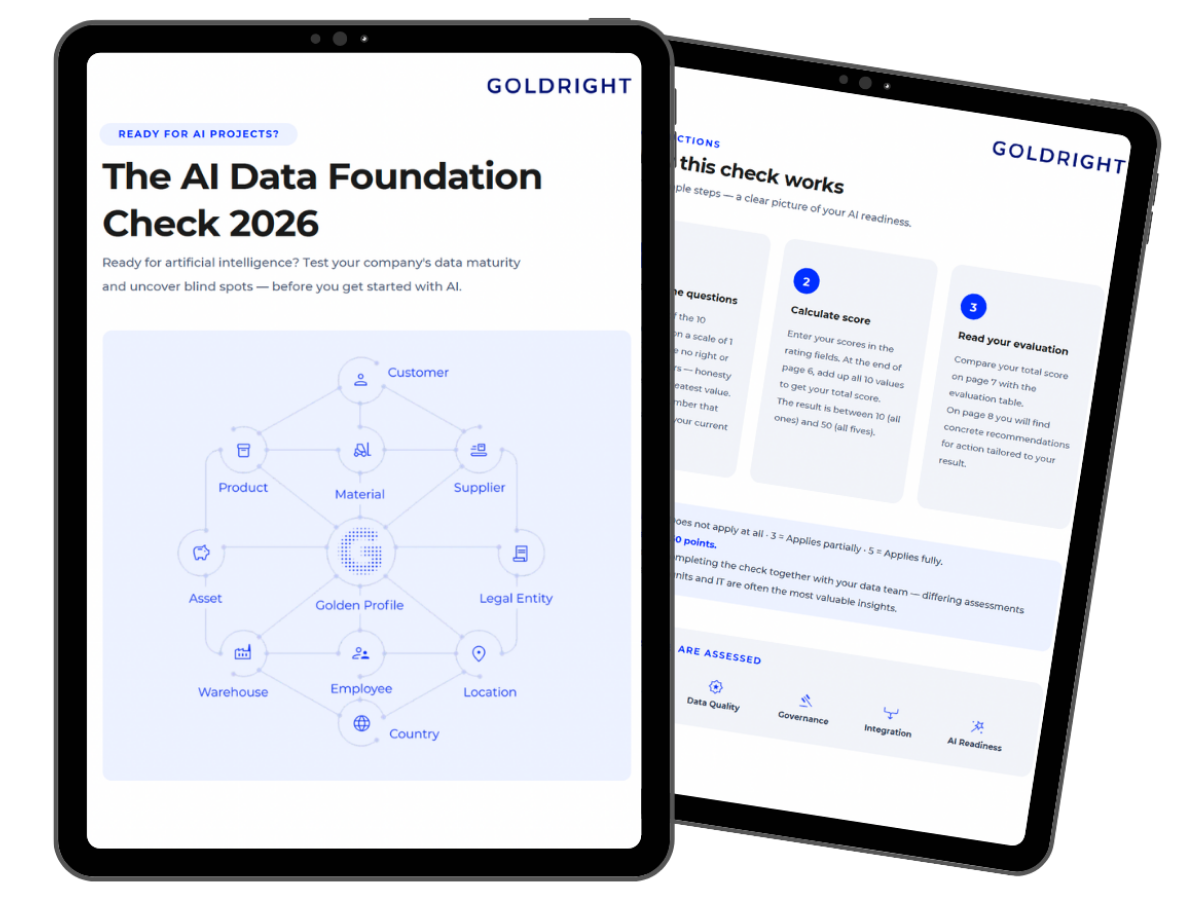
Many organizations underestimate how far their data foundation is from being truly reliable. The AI Data Foundation Check provides you with a clear assessment of your master data maturity in just 15 minutes and identifies specific areas for action.

  • Evaluation score for all data dimensions

  • Ready-to-use roadmap template

  • 100% Free

What is Master Data Management?

Master data management—also known as MDM—is the discipline that combines technology, processes, and governance to ensure that master data remains consistent, complete, and up-to-date across all systems. The goal is a “golden record”: the single, verified data record for each business object that all systems and teams can trust.

Master data management is therefore not a single tool, but an ongoing operational mode. It combines the technical platform, clear responsibilities, and fixed rules into a system that ensures master data quality across all systems and locations.

Goldright addresses this area with the Agile Data Manager: a flexible, low-code-based approach that allows any master data domain to be quickly configured—including native historical tracking and versioning. For a detailed definition of Master Data Management and its role in AI, see the article on MDM and AI Readiness.

The Four Root Causes of Poor Master Data Quality

Before a company makes an investment, it should understand the actual causes of its master data problem. Based on over 20 years of practical experience, Goldright has identified four recurring root causes—they are rarely technical in nature, but mostly organizational.

Root Cause 1: Evolving System Landscapes Without Centralized Governance

Most companies have grown over decades—both organically and through acquisitions. The result is a patchwork of ERP instances, legacy systems, in-house developments, and cloud applications. Each system maintains its own version of the truth regarding customers, products, and suppliers. Without a central authority, data chaos arises systematically and inevitably.

Root Cause 2: Lack of Data Ownership

“Whose data is this?”—in many organizations, this question remains unanswered. If no one takes responsibility for a dataset, no one actively maintains it. IT manages systems but not content; business units maintain content in spreadsheets but not in the system. The result is divergent versions and costly manual reconciliation.

Root Cause 3: No History Tracking and Versioning

Master data are not static objects. Suppliers change addresses, corporate structures are reorganized, and product specifications change. Systems without history tracking lose track of these changes—and with them, the ability to generate compliant reports for past time periods. In regulated industries, this poses a direct compliance risk.

Root Cause 4: Manual Maintenance Without Fixed Rules

Excel spreadsheets, email chains, and manual entries without validation are commonplace in many companies. Each employee creates master data at their own discretion. Without required fields, validation rules, and approval workflows, every new data record creates new chaos—and data quality declines faster than it can be manually corrected.

Best Practices for Master Data Management

Based on over 20 years of practical experience, we can identify six principles that distinguish successful master data projects from failed ones. They may sound unspectacular—but that is precisely what makes them valuable.

1. Clarify Responsibilities Before Selecting Technology

Before selecting a tool, it must be clear who the data owner is for each domain and what rules apply. A well-defined governance model prevents the new system from becoming just another data silo. Technology acts as an amplifier: it makes good governance scalable—and makes poor governance visible more quickly.

2. Start with one domain, not all of them

No company consolidates all domains at once. Successful projects start where the benefits are greatest—usually with customer or supplier master data. Quick success in an initial domain provides the track record needed to secure the budget for the next ones..

3. Involve business units early on

Master data management fails when it is perceived as an IT diktat. Business units understand the business significance of a field—IT knows only its technical structure. Only by working together can a data model be created that works in day-to-day operations.

4. Define measurable quality goals

“Better data” is not a goal. “Reducing the duplicate rate from 28% to under 2% in six months” is one. Measurable goals enable progress tracking and protect against never-ending cleanups with no finish line, as well as against premature termination.

5. Embed Validation at the Source

Errors are best caught before they enter the system. Automated required fields and validation rules during data entry prevent low-quality data records from being created in the first place—this is more effective than any post-processing cleanup.

6. Establish maintenance as an ongoing process

A one-time cleanup without a permanent process loses its value within months. Only the transition from a project to a continuous operational mode—with monitoring and clear escalation paths—ensures quality in the long term.

Master Data Management Compared: MDM vs. PIM vs. DAM vs. ERP

A common question is: What is the difference between Master Data Management, PIM, DAM, and the master data modules of an ERP system? The following table provides clear distinctions.

Criterion

MDM

PIM

DAM

ERP Master Data

Primary Domain

All Master Data

Product Data

Digital Assets

Module-Specific

Primary Users

Governance, Business Units

Marketing, E-Commerce

Creative Teams

ERP Key Users, IT

Governance Depth

High (Multi-Domain)

Medium

Low

Low to Medium

Historization

Point-in-Time

Limited

Versioning

Limited

Compliance Suitability

Very High (Audit Trail)

Medium

Low

Limited

Typical Providers

Goldright, Informatica, Stibo

Akeneo, Contentserv

Bynder, Canto

SAP MDG, Oracle


MDM is the most comprehensive approach and the only one that enables a true, cross-domain master data strategy. PIM and DAM address specific areas; ERP master data modules are system-specific and create silos of their own. In practice, these systems often complement each other: A PIM enriches product data, while MDM maintains the overarching “golden record” and provides all systems with the reliable source of truth.

A common misconception is that a powerful ERP system like SAP S/4HANA makes standalone master data management unnecessary. This is true within a single instance—but as soon as multiple systems manage the same objects, a higher-level, system-independent instance is needed to maintain the unified master data record. This is precisely the role that a dedicated MDM system fulfills.

Case Study: Clean Supplier Master Data in Six Months

The following case study has been anonymized for data protection reasons and is based on a real-world project.

Initial Situation

An international industrial group with over 80 subsidiaries in 14 countries maintained its supplier master data in four different SAP systems. The system contained over 34,000 records, of which internal analyses identified more than 28% as containing duplicates, outdated bank details, or inconsistent categorizations. This resulted in duplicate payments, a high manual reconciliation workload, and error-prone procurement processes.

Challenge

The real difficulty was not the technology, but governance. Supplier data was maintained by regional teams using different standards. There was no defined data owner, no uniform validation rules, and no version history. Each team considered its own version to be the correct one.

Approach

First, a master data inventory workshop was conducted. Subsequently, the Agile Data Manager was implemented as the central authority for supplier master data. The data model—including validation rules, required fields, and workflow logic—was configured using low-code technology in less than 10 weeks, with the regional teams remaining involved as data owners.

Results After Six Months

  • Duplicate Rate: Reduced from 28% to less than 1.5%

  • Manual Data Correction: Reduced by 67%

  • Supply Chain Error Rate: Decreased by 43% due to incorrect supplier data

  • Audit readiness: The first external audit was completed entirely digitally and without any gaps

Lessons from the Case: The key factor for success was not the technology, but clear data ownership and binding validation rules. In euros, the project paid for itself in the very first year—thanks to reduced manual effort and avoided erroneous payments.

Pitfalls: What Often Goes Wrong in Master Data Projects

Almost all failed master data projects fail for the same reasons—and almost never because of the technology. Those who are aware of these pitfalls can avoid them deliberately.

  • No sponsorship at the executive level: Without a clear commitment, projects fail due to budget cuts and resistance.

  • Technology first: A tool without a governance and data model only produces data garbage that’s more expensive to organize.

  • Big Bang instead of step-by-step: Large waterfall projects lose sponsorship before they go live. Better: Start with one domain, demonstrate results quickly, then expand.

  • Cleanup as a one-time project: Without an ongoing maintenance process, master data will revert to its original state within six months.

  • Business units left out: Data owners must come from the business units—IT only provides the platform.

  • No quality KPIs: Without measurable goals, there are no success criteria and no proof of value.

Is your master data robust enough?

Most companies know that their master data has room for improvement—but very few know just how much. The AI Data Foundation Check answers three questions in 15 minutes:

  • Where are your biggest master data risks?

  • Which domains are critical?

  • What is the next logical step?

Master Data and AI: A Brief Explanation of the Connection

Master data is also the foundation of every AI initiative. AI models are only as good as their data: Fragmented, inconsistent master data leads to incorrect predictions and unusable results. Without consistent master data, AI amplifies errors rather than improving efficiency.

Because this topic deserves its own in-depth treatment, we cover it extensively in a separate article—including a framework for AI-ready data: Master Data Management & AI Readiness 2026. For more on the role of the Golden Record as the single source of truth, see our article on the Golden Record.

FAQ: The Most Important Questions About Master Data

What is master data? (Definition)

Master data consists of a company’s core data—which rarely changes—that describes business objects such as customers, suppliers, products, materials, and employees. It forms the stable reference system that all business processes rely on. It is also referred to as master data.

What is included in master data?

The most important types of master data include customer master data, supplier master data, material and item master data, HR master data, as well as legal entity and organizational data. As a rule of thumb: Anything that permanently describes a business object and is used by multiple processes is considered master data.

What is the difference between master data and transaction data?

Master data rarely changes and describes business objects (e.g., customer address, item number). Transaction data changes constantly and documents transactions (e.g., purchase order, posting, meter reading). For an electricity meter, the meter number and location are master data, while the meter reading is transaction data.

What Is Master Data? A Simple Example

A typical example is customer master data: a customer’s name, address, and tax ID remain constant over the years and are used equally by sales, accounting, and shipping. An individual order placed by this customer, on the other hand, is transaction data.

What is personal master data?

Personal master data includes stable identity attributes such as name, date of birth, address, employee ID, or tax ID. In an HR context, this also includes role, cost center, and hire date. This data is subject to the GDPR and requires special care in terms of maintenance and traceability.

What is master data in SAP?

In SAP, master data is managed by module and domain—for example, customer and vendor master data in Sales and Distribution and Materials Management, or material master data in Materials Management. When companies operate multiple SAP instances, conflicting versions can easily arise, which overarching master data management resolves.

What does master data maintenance mean?

Master data maintenance is the continuous process of capturing, updating, checking, and cleansing master data throughout its entire lifecycle. It is not a one-time project, but an ongoing process with clear responsibilities, required fields, and validation rules.

What Is Master Data Quality and How Is It Measured?

Master data quality describes how complete, accurate, consistent, unique, and up-to-date a dataset is. It is measured using KPIs such as the duplicate rate, the degree of completeness of required fields, and the percentage of validated records. It makes sense to define, for each domain, which dimension must meet which threshold.

What is Master Data Management (MDM)?

Master Data Management (MDM) is the discipline—comprising technology, processes, and governance—that ensures master data remains consistent, complete, and up-to-date across all systems. The goal is a “golden record”—the single, verified data record for each business object.

Why is master data so important?

Because every invoice, every analysis, and every process relies on it. Incorrect master data propagates through all downstream processes and, according to Gartner, causes an average of at least $12.9 million in damage per year per company. Clean master data ensures efficient processes, reliable decisions, and compliance.

Who is responsible for master data within the company?

Operational responsibility lies with the data owners in the business units, while strategic oversight typically falls to the Chief Data Officer (CDO). IT provides the platform. This three-part structure—strategic leadership, business ownership, and technical platform—is the backbone of any effective master data management system.

What is the difference between a Golden Record and a Master Record?

A Master Record is the central data record within a single system. A Golden Record is the result of a consolidation process across multiple systems—the verified, system-independent truth about a business object.

Conclusion: Master data is the foundation of every company

The core message can be summarized in one sentence: Master data is the stable foundation on which every company operates. It describes who the customers, suppliers, products, and employees are—and everything the company does is built on this foundation.

Those who understand their master data, clearly define it, and consistently maintain it lay the foundation for efficient processes, reliable decisions, assured compliance, and—as a logical consequence—successful AI initiatives. Conversely, inaccurate master data incurs measurable costs and hinders any automation efforts.

The path to robust master data does not lie in a one-time cleanup, but in ongoing maintenance with clear responsibilities, fixed rules, and measurable quality goals. Goldright guides you along this path with over 20 years of experience and proven references such as ÖBB, ANDRITZ AG, and GRAWE. The first step is a clear assessment—the AI Data Foundation Check provides it in just 15 minutes.

Sources

Gartner: "Data Quality: Why it matters" - https://www.gartner.com/en/data-analytics/topics/data-quality

Gartner: "Master Data Management (MDM)", Glossary-Definition - https://www.gartner.com/en/information-technology/glossary/master-data-management-mdm

Gartner: "Lack of AI-Ready Data Puts AI Projects at Risk" - https://www.gartner.com/en/newsroom/press-releases/2025-02-26-lack-of-ai-ready-data-puts-ai-projects-at-risk

IBM: "What is Master Data Management?" - https://www.ibm.com/topics/master-data-management

Thomas Redman: "Impact of Poor Data Quality" - https://agiledata.org/essays/impact-of-poor-data-quality.html

Bitkom e.V.: "Datenqualität als Erfolgsfaktor für KI-Projekte" - https://www.bitkom.org

McKinsey & Company: "The State of AI (2025), abgerufen Juli 2026" - https://www.mckinsey.com/capabilities/quantumblack/our-insights/the-state-of-ai

European Comission: EU AI Act, Regulation (EU) 2024/1689 - https://eur-lex.europa.eu/legal-content/DE/TXT/?uri=CELEX:32024R1689

OECD: "AI and Data Governance: Policy Frameworks for Trustworthy AI" - https://www.oecd.org/going-digital/ai/