September 17, 2026
MDM Strategy: The Roadmap from Data Chaos to an AI-Ready Golden Source

By Gernot Lepuschitz
Chief Technology Officer
:format(webp))
21 min read
Share this post
Readers of this article will learn why most MDM strategies fail not because of the software, but because of a lack of governance; what the four root causes are; how a six-step framework leads from an analysis of the current state to a continuous operating model; and why an MDM strategy in 2026 will be inextricably linked to AI readiness and regulatory requirements (EU AI Act, NIS2).
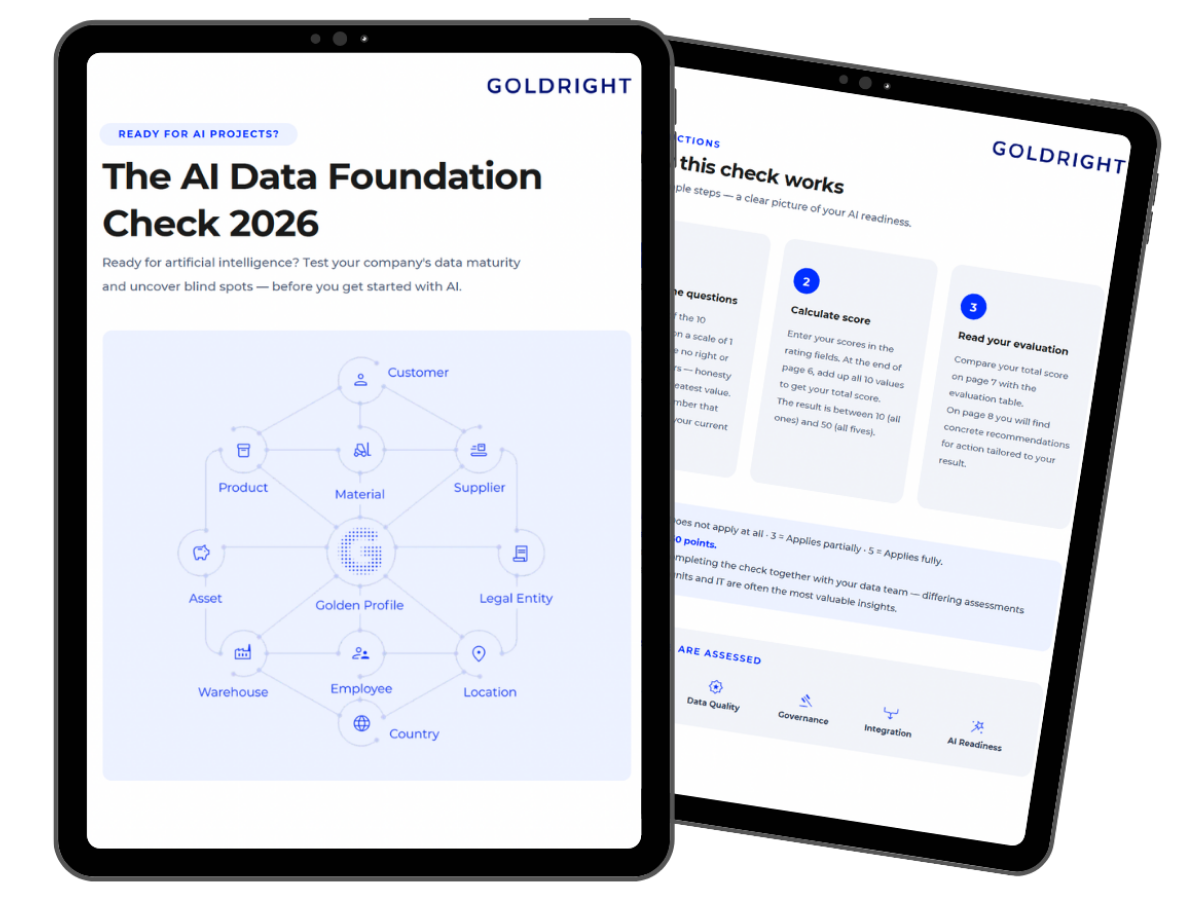
Is Your Master Data Ready for AI Projects?
Do you want to know where your organization currently stands and where the biggest gaps lie between the current state and AI readiness? Goldright’s AI Data Foundation Check provides a structured assessment of your master data foundation in just 20 minutes—serving as the starting point for Steps 1 and 2 of the framework above.
Evaluation score for all data dimensions
Ready-to-use roadmap template
100% free
AI Data Foundation Check: Where Does Your Organization Stand Today?
Before investing in a new system landscape, it’s worth taking a look at the actual foundation: your data. The AI Data Foundation Check provides a concise overview of which of the pitfalls mentioned above are already affecting your organization—and where you should start with Step 1 of your MDM framework.
Evaluation score for all data dimensions
Ready-to-use roadmap template
100% free
Frequently Asked Questions
- MDM and data governance are closely related but not identical. Data governance is the overarching framework—the totality of all policies, processes, roles, and responsibilities for a company’s data management. MDM is the operational implementation of data governance principles for master data. Data governance defines the rules of the game; MDM implements them for master data in terms of both technology and processes.
- A Golden Record is the single, cleaned-up, and complete data record for each object (e.g., a customer), consolidated from many conflicting source systems. It serves as the single source of truth—the authoritative truth that all systems, people, and AI applications can rely on.
- Ideally, overall responsibility lies with a C-level executive sponsor, often the Chief Data Officer. At the operational level, designated data owners for each business domain (e.g., Sales for customer master data, Purchasing for supplier master data) are responsible for the content, supported by data stewards and an interdisciplinary data governance board.
- The costs depend on the number of data domains, the system landscape, and the chosen rollout pace. A domain-by-domain, iterative approach (see Step 1 of the framework) reduces the initial risk: You start with a manageable budget in one domain and validate the business case with initial results before moving on to additional domains.
- The first measurable results—such as a reduced duplicate rate in a single domain—can often be achieved within a few months using an iterative approach. Full, enterprise-wide adoption as an operational model, on the other hand, is a continuous process spanning several years with no fixed end date.
- AI systems rely on structured, consistent, and validated data to deliver reliable—rather than probability-based—results. An MDM strategy provides this foundation. Conversely, modern MDM platforms with integrated AI assistants also support the maintenance of master data itself, for example, in duplicate detection or natural-language queries.
- No. The need arises as soon as multiple systems or locations maintain the same master data objects independently of one another. This also applies to medium-sized companies with multiple ERP instances or subsidiaries, as the real-world example in this article illustrates.
- Common metrics include the duplicate rate, the completeness of critical data fields, timeliness (the time between a change and system synchronization), the number of manual corrections, and business-impact metrics such as reporting time or the order error rate. It is crucial to collect these metrics as a baseline in Step 1 of the framework. This is the only way to demonstrate the impact of subsequent measures—an issue described in Chapter 14 as a common weakness.
- Article 10 of the EU AI Act requires that, for high-risk AI systems, training, validation, and test datasets be relevant, representative, largely error-free, and complete. A robust MDM strategy is the practical prerequisite for verifiably meeting this requirement.
- The most common mistakes include selecting software without first defining objectives, a lack of business-driven data ownership, a one-time rather than ongoing approach to data quality, and treating MDM as a temporary IT project rather than a permanent operational model.
- Begin with a single, business-critical data domain, conduct a focused analysis of the current state, and quantify the business case for that specific domain. A free AI Data Foundation Check can provide structured support for this initial assessment.
- Fundamental governance elements—roles, rules, and responsibilities—can be implemented organizationally even without software and already provide some of the benefits. However, as soon as multiple systems need to be automatically synchronized, archived, and distributed, a dedicated MDM platform becomes necessary. This is the only way to technically enforce governance requirements and avoid manual synchronization efforts.
- Prioritize the domain with the highest demonstrable business impact—as evidenced by recurring duplicate orders, complaints due to incorrect customer data, or a high volume of manual corrections in reporting. Step 1 of the framework described in this article (current state analysis) provides the data foundation for this prioritization, rather than relying on subjective assessments.