May 12, 2026
Workflow Management for Master Data: How to Make Approvals Fast, Verifiable, and Audit-Proof

By Selina Trummer
Product Marketing Manager
:format(webp))
18 min read
Share this post
Master data workflow management determines whether a new supplier is added to the ERP system in two days or two weeks—and whether updated bank account information is verified or simply accepted. This article shows you how to design creation, change, and approval processes so that responsibilities are clearly defined, verification is automated, and every change is traceable. It includes a role model, risk classes, a set of KPIs, and a real-world case study.
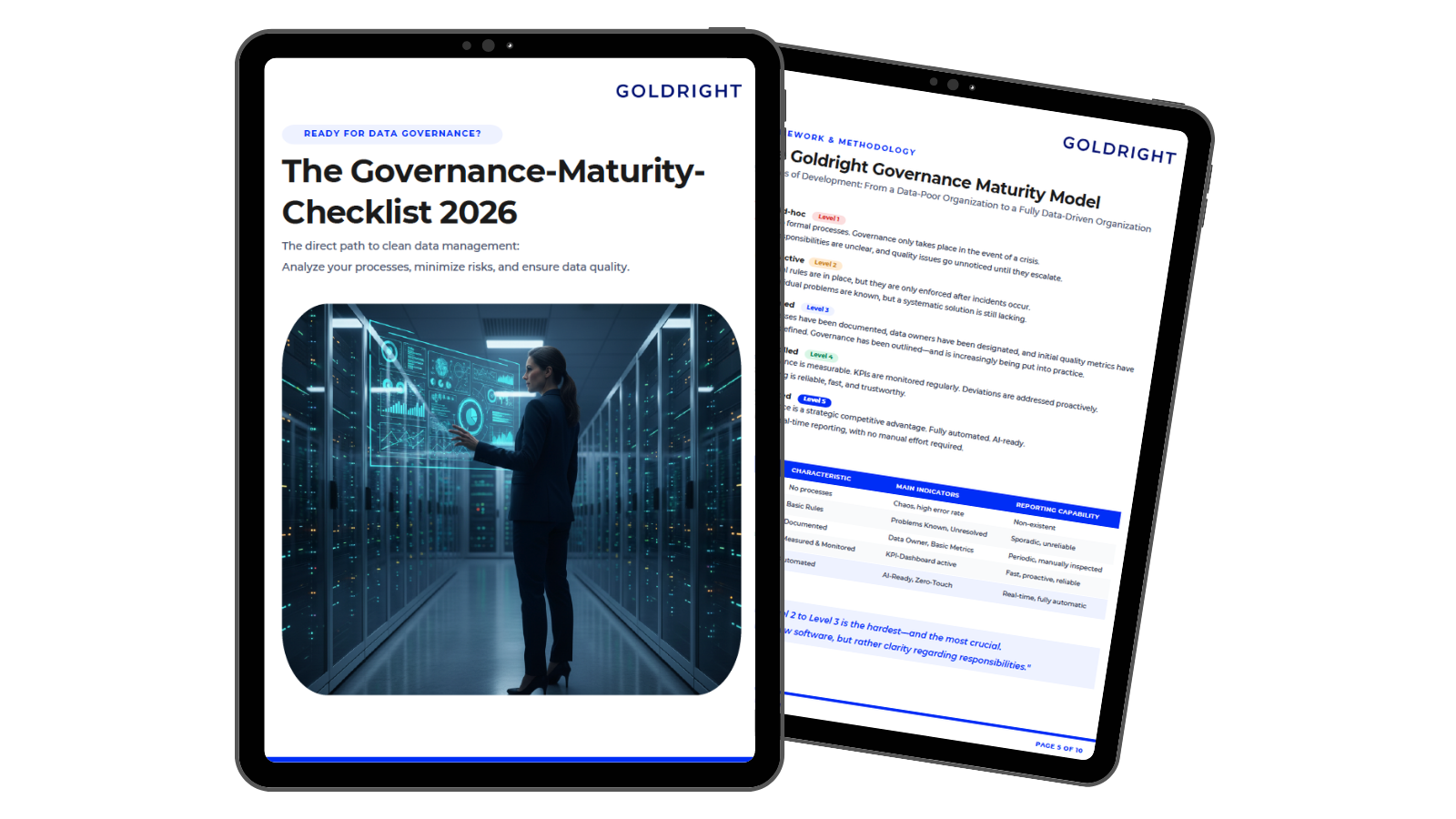
Where does your master data governance stand today?
The Governance Maturity Assessment shows you in just a few minutes how mature your roles, approval processes, and controls are—and which next step will have the greatest impact. It’s the ideal foundation for your first workflow workshop.
10-Question Checklist to Assess Your Governance Maturity
A field-tested 90-day plan you can start using right away
100% free and independent
Speeding up approvals without giving up control?
With the Governance Maturity Assessment, you can determine whether roles, risk classes, and audit trails are already effective in your company—or where workflows are currently stalling due to gaps in accountability.
10-Question Checklist to Assess Your Governance Maturity
A field-tested 90-day plan you can start using right away
100% free and independent
Frequently Asked Questions
- A master data workflow is a defined, system-supported process for creating, modifying, locking, or archiving master data. It specifies who initiates the process, which rules are automatically checked, who approves the data, and when the data record is distributed to target systems. Every step is logged.
- Master data maintenance refers to the ongoing process of entering, updating, and cleaning up data. Workflow management is the framework that governs this process: It defines the roles, sequence, approvals, and documentation for these activities.
- Start with a high-frequency process, such as supplier or material creation. First, define roles and risk classes, then set up the request with automated checks. Measure turnaround time and the first-time-right rate from the very beginning.
- At least three: a requester who submits the request, a data steward who performs a business-side review, and a data owner who is responsible for the data domain and approves critical changes. For certain attributes, additional business approvers—such as those from Controlling or Compliance—are also involved.
- The Agile Data Manager controls maintenance and approval workflows via a BPMN-based business process engine—directly on the Golden Record. Approvals can be configured in multiple stages and according to the dual-control principle; roles and permissions are managed through the integrated governance system; and the timestamp history documents every change with precise effective dates. Approved data is transferred to ERP, CRM, and BI systems.
- The GoBD requires that the original content and the fact that a change has been made remain identifiable. When master data is changed, the unambiguous meaning must be preserved in the transaction data; if necessary, master data must be archived with validity information. Furthermore, the change history must not be alterable retroactively (Rz. 111).
- In a single-system environment, the answer is often yes. However, as soon as master data is used across multiple systems—ERP, CRM, PLM, HR—the ERP workflow lacks a cross-domain perspective. A workflow integrated with MDM validates data against the golden record and distributes it centrally to all target systems.
- That depends on the risk class. The following are generally accepted industry guidelines: non-critical changes should be approved immediately and automatically; moderate changes within one business day; and critical changes within two business days. It is essential that SLAs be defined and measured.
- Whenever a change has direct financial or legal implications—such as with bank account information, tax ID numbers, credit limits, or corporate structures. For bank account information, additional confirmation should be obtained through an independent channel.
- Common metrics include the duplicate rate, the completeness of critical data fields, timeliness (the time between a change and system synchronization), the number of manual corrections, and business-impact metrics such as reporting time or the order error rate. It is crucial to collect these metrics as a baseline in Step 1 of the framework. This is the only way to demonstrate the impact of subsequent measures—an issue described in Chapter 14 as a common weakness.
- AI can suggest classifications, detect duplicates, and flag anomalies. However, it does not replace the approval process. It makes sense to include AI suggestions as a separate verification step in the workflow so that every data entry remains traceable.