September 10, 2026

List of Shareholders: Obligations, Deadlines, and Pitfalls You Should Be Aware Of

Philipp Seibald

By Philipp Seibald

Vice President Sales

25 min read

Share this post

A single error in the list of shareholders is enough: shareholders lose their voting rights, a purchase made in good faith suddenly becomes legally valid, and the managing director faces personal liability. In this article you will learn who is required to maintain the list of shareholders under Section 40 of the German Limited Liability Companies Act (GmbHG), what deadlines and fines apply, how GmbHs, KGs, and GbRs differ legally—and why the list is more than just a formality for the commercial register.
Key Points

  • The list of shareholders is a mandatory requirement under Section 40 of the German Limited Liability Companies Act (GmbHG) and applies exclusively to GmbHs and UGs (with limited liability)—not to KGs or GbRs.

  • The management is generally responsible for this; if a notary was involved in the change, the notary submits the list (Section 40(2) GmbHG).

  • Under Section 16 of the GmbHG, the list serves as proof of legitimacy vis-à-vis the company and, under certain conditions, enables the acquisition of shares in good faith.

  • Inaccurate or late lists may result in administrative fines of up to 25,000 euros and personal liability for the management.

  • If the list is complete and up-to-date, the GmbH may invoke the presumption of notification under § 20(2) GwG and is not required to file a separate transparency register report—this benefit does not apply in the event of errors.

  • Violations of the transparency register reporting requirement can be penalized with fines of up to 1,000,000 euros (for systematic violations) or up to 5,000,000 euros for obligated parties under Section 2 of the GwG.

  • Anyone managing multiple legal entities needs a structured process rather than manual Excel lists—a free legal entity audit check is provided later in this article.

What is a list of shareholders?

The list of shareholders is the official record, filed with the commercial register, of all shareholders of a GmbH or UG (with limited liability) and their respective shares. The legal basis for this is Section 40 of the German Limited Liability Companies Act (GmbHG): According to this provision, the management must submit an updated list to the commercial register “immediately after any change in the identity of the shareholders or the extent of their ownership interest takes effect.”

The first list of shareholders must be prepared upon the company’s formation and submitted together with the application for entry in the Commercial Register; thereafter, it must be updated following every change in shareholding. The list must include the following information for each shareholder: last name, first name, date of birth, and place of residence; the par values and serial numbers of the shares; and the respective percentage of ownership in the share capital. If a shareholder is itself a legal entity, the company name, registered office, registry court, and registry number must also be included. The specific requirements are governed by the Shareholder List Regulation (GesLV), which is based on Section 40(4) of the Limited Liability Companies Act (GmbHG).

The list of shareholders acquired its current legal effect through the Act on the Modernization of Limited Liability Company Law and the Prevention of Abuse (MoMiG), which took effect on November 1, 2008. Only since then has an entry in the list had the effect of establishing legal standing under Section 16 of the German Limited Liability Companies Act (GmbHG) and, under certain conditions, enabled the acquisition of shares in good faith—previously, the list was merely a documentation requirement without any comparable legal consequence. This reform is the reason why the list today carries far more weight than a mere administrative document: it plays a decisive role in determining who is treated as a shareholder in legal transactions.

Since its entry into force, the Shareholder List Regulation (GesLV) has specified the formal requirements set forth in Section 40(4) of the GmbHG: Among other things, it regulates how the percentage share of the share capital is to be calculated and presented when a shareholder holds multiple shares, and how transitional cases involving older lists that do not yet comply with the GesLV are to be handled. In addition, Section 40(5) of the GmbHG allows state governments to require submission in a structured, machine-readable format—a step toward a fully digital, automatically analyzable registry system designed to reduce the risk of manual errors on the part of the registry.

Who needs a list of shareholders?

One point that often causes confusion in practice: A list of shareholders as defined in Section 40 of the German Limited Liability Companies Act (GmbHG) applies exclusively to the GmbH and the UG (with limited liability)—both of which are corporations with share capital and shares. A KG or GbR does not maintain a list of shareholders under this provision. In the case of a KG, limited partners are indeed entered in the Commercial Register (Section HRA), but only with their liability amount, not with their actual capital share.

The GbR, on the other hand, has been able to voluntarily register as an eGbR in the new corporate registry since the MoPeG took effect (January 1, 2024)—this, too, must be clearly distinguished from the GmbH’s list of shareholders. So anyone searching for “list of KG shareholders” or “list of GbR shareholders” usually won’t get an honest answer: It’s the wrong question—the correct one is which reporting requirements apply to the respective legal form instead.

In practice, this means that anyone managing an ownership structure with multiple legal forms—such as a GmbH acting as a holding company with KG subsidiaries, as is common among German small and medium-sized enterprises—cannot apply a uniform assessment approach. Each company must be assessed individually to determine which set of regulations applies and who is responsible for providing which documentation.

The UG (limited liability) is subject to exactly the same requirements as the GmbH: Section 5a of the GmbH Act (GmbHG) provides for only specific exceptions for the UG—such as regarding the company name, capital contributions, contributions in kind, and the creation of reserves—while the general provisions of the GmbH Act continue to apply without restriction. Since Section 40 of the GmbHG is not among these exceptions, the requirement to maintain a list of shareholders automatically applies to every UG as well. Therefore, anyone managing multiple UGs as part of a start-up consortium or as individual companies within a group must take this requirement just as seriously as they would for a traditional GmbH with full share capital—a mistake that is often realized too late, especially in young, fast-growing companies.

Why is the list of shareholders relevant for CFOs and compliance officers?

For the managing director, the list of shareholders is a legal requirement. For CFOs and compliance officers, it is something else entirely: a central component of legal entity data upon which capital structures, profit distributions, ownership reports, and regulatory filings are based. Unlike many master data objects, the list of shareholders has a distinctive feature: It is not only relevant internally but is also publicly accessible and has immediate legal effect—meaning that an error does not remain confined to the company but becomes immediately visible to third parties and affects legal relationships with precisely those third parties. Five points illustrate why this issue is gaining importance:

The Liability Aspect

If the management submits an incorrect or late list, it faces administrative fines of up to 25,000 euros as well as personal liability to shareholders and creditors for any resulting damages (dejure.org, § 40 GmbHG; onlinebilanz.de, GmbH Shareholder List 2026).

The Transparency Register Aspect

Violations of the reporting requirements under the Money Laundering Act are penalized on a sliding scale in accordance with the Federal Administrative Office’s schedule of fines —up to 50,000 euros for simple negligence, up to 100,000 euros for recklessness, up to 150,000 euros for intent, and up to 1,000,000 euros for systematic or repeated violations. For entities subject to the Act pursuant to Section 2(1) of the Money Laundering Act—such as financial institutions and insurance companies—the penalty range is even as high as 5,000,000 euros or 10% of annual revenue.

The Cost Aspect at the Market Level

According to the “True Cost of Financial Crime Compliance” study by LexisNexis Risk Solutions—for which Forrester surveyed 1,181 decision-makers at financial institutions on its behalf—compliance costs for financial crime in the EMEA region alone total approximately 85 billion U.S. dollars annually; Germany was among the countries surveyed. A key cost driver identified consistently across these studies is the manual maintenance and verification of customer and ownership data—precisely the type of master data that includes the list of shareholders.

The structural Cause behind this

According to Gartner, by 2027, approximately 80% of data governance initiatives will fail because responsibilities and data quality are not clearly defined—resulting in an estimated average annual cost of $12.9 million due to poor data quality in companies. Legal entity data, such as the list of shareholders, is one aspect of this governance issue—often the least automated, because it is traditionally handled by the legal department rather than the data organization.

An often-underestimated Aspect: the Annual Financial Statements

As part of the audit, auditors routinely verify whether the ownership structures disclosed in the notes to the financial statements match the lists of shareholders filed with the commercial registry. If the internal accounting records differ from the registry records, this leads, at best, to inquiries that take time; at worst, to an audit qualification noted in the audit report. For CFOs seeking a smooth audit process, a consistently maintained list of shareholders is therefore also a key component of timely reporting to the supervisory board and shareholders.

In practice, these five points rarely occur in isolation.
An outdated list of shareholders does not only affect the registry file: It directly impacts the calculation of profit distributions, because these are based on the ownership percentages documented in the list. It affects tax assessments, because tax authorities also rely on the registry records when determining capital gains tax and profit distribution. And it affects every form of corporate finance transaction, because investors, banks, and auditors routinely compare the shareholder list with internal capital table documents before approving financing or a share purchase.

Taken together, the shareholder list is therefore not an isolated legal issue, but rather an indicator of how reliable a company’s legal entity data is overall—and thus an area where CFOs and compliance officers bear just as much responsibility as the legal department.

The Four Root Causes of Inaccurate Shareholder Lists

Hardly any company consciously chooses to maintain an outdated shareholder list. Errors almost always creep in gradually, stemming from organizational gaps rather than the negligence of individuals. In practice, most problems with shareholder lists can be traced back to four recurring causes, which appear in various combinations in nearly every corporate group.

Manual Maintenance in Excel or on Paper

As long as changes are entered manually into spreadsheets, the list’s up-to-date status depends on the discipline of individuals. A missed entry following a share transfer is often not noticed until an investor or auditor asks about it. This becomes particularly problematic when the Excel file is stored only locally on a single computer: there is no version history, no audit trail, and no automatic check to verify whether the total of the ownership percentages actually adds up to 100%.

Fragmented communication between the notary, management, and the legal department

According to Section 40(2) of the German Limited Liability Companies Act (GmbHG), if a notary is involved, the notary submits the list—but management remains responsible for the accuracy of its content. Without a clear handover process, gaps arise precisely at this interface: Management assumes that the notary has taken care of everything, while the notary was only responsible for the specific change he or she certified. Any prior discrepancies in the list that are unrelated to this process thus go unnoticed.

Restructurings and M&A Transactions as Stress Tests

In the case of share transfers, capital increases, or inheritances, multiple ownership structures change simultaneously, often across several companies within a group. If a centralized, version-controlled overview is not maintained during this phase, even experienced legal departments quickly lose track of the current status for each company—precisely because multiple deadlines (notarization, commercial register filing, internal approvals) are running in parallel.

Lack of Centralized Governance Across Multiple Legal Entities

Corporations with numerous subsidiaries often maintain shareholder lists on a decentralized basis—company by company—with different local contacts typically responsible for each one. Without a central registry that clearly defines responsibilities for each unit, consolidation for annual financial statements, ownership reports, or transparency registry filings becomes a manual special project—resulting in a correspondingly high workload for staff shortly before each deadline.

Not a Formality Problem, but a Master Data Problem

In many companies, the list of shareholders is treated as a mere legal formality: a document that the notary submits and that subsequently disappears into the file. This perspective fails to recognize what is at stake. The list is not a form—it is a master data object with direct legal effect.

Anyone listed in accordance with Section 16 of the German Limited Liability Companies Act (GmbHG) is considered a shareholder by the company, regardless of whether the underlying transfer was legally sound under civil law. An outdated entry in the list is therefore not an administrative error, but a data error with legal consequences.

This reinterpretation is not a rhetorical trick but a practical necessity: A problem with formalities can be solved with a one-time list of deadlines, whereas a master data problem can only be resolved with a process that continuously records, versions, and makes every change verifiable. Those who continue to treat the list of shareholders as a form will continue to be caught off guard by share transfers, inheritances, and restructurings—those who treat it as a master data object, on the other hand, build a process that accounts for such events from the outset.

It’s worth shifting your perspective: The question that CFOs and compliance officers should really be asking isn’t “How do we get the form submitted to the commercial registry on time?” but rather “How do we ensure that our legal entity data is always accurate, versioned, and auditable?” This is precisely the core task of master data management for legal entities—and the reason why Goldright treats this topic not only as a legal issue but also as a data issue (see also our guide to improving data quality).

This becomes particularly clear in industries where ownership structures are already at the heart of business operations. As part of KYC and AML processes, banks and insurance companies must be able to prove at any time who the beneficial owner of a company is—an outdated list of shareholders directly undermines this proof.

In the real estate industry, on the other hand, identifying the Ultimate Beneficial Owner (UBO) within nested property holding companies depends directly on how up-to-date the respective shareholder lists are; if one level of the structure is incorrectly documented, it delays a whole series of transactions because UBO chains can no longer be traced without gaps. In both cases, the list of shareholders is not a minor detail but a building block that plays a decisive role in determining the speed of entire business processes.

Approach: Retrieving, Viewing, and Verifying the List of Shareholders—Step by Step

Whether you’re a shareholder looking to verify your own stake, an investor conducting due diligence, or a CFO who wants to keep track of the legal entity data for the entire group, the process for retrieving, viewing, and verifying the accuracy of a list of shareholders follows the same basic pattern in all cases. Anyone who wishes to view a company’s list of shareholders or verify that their own list is up to date can follow these steps:

1. Retrieve the list of shareholders from the commercial register

The list is part of the publicly accessible register and can be retrieved online via the joint register portal of the German states (commercial register, maintained by the courts), typically for a small fee for document retrieval. The names, dates of birth, and places of residence of the shareholders are visible to everyone—a fact that many shareholders underestimate (onlinebilanz.de, GmbH-Gesellschafterliste 2026). For a quick initial assessment, the most recent registered file is usually sufficient; for a complete history—such as in the context of due diligence—the chronological registry extract, including all previous versions of the list, should be requested.

2. Verify the Timeliness of the Submitted List

The key factor is the date of the most recently submitted list compared to known changes in ownership. If the registry records differ from the company’s internal records, action is required—regardless of whether the discrepancy favors or disadvantages a shareholder. In practice, a simple “as-is vs. target” comparison is recommended: compare the internal cap table with the most recently submitted list, at least once a year and immediately after every known transaction.

3. Clarify responsibility

If a notary was involved in the most recent change, the formal obligation to file rests with the notary (Section 40(2) GmbHG); otherwise, it lies with the management (§ 40 (1) GmbHG). This responsibility should be documented for every company in the group, not just in the mind of a single person—especially because, in the case of internal restructurings without notarial certification, the obligation automatically remains with the management, even if the management has not actively pursued it.

4. Assess the Presumption of Notification to the Transparency Register

If the list of shareholders is complete and up to date, the GmbH may invoke § 20(2) of the Money Laundering Act (GwG) and is not required to submit a separate report to the Transparency Register. In the opinion of the Federal Administrative Office, this does not apply to limited partnerships (Kommanditgesellschaften), as the commercial register only shows the amount of liability—but not the actual capital share of the limited partners, the general partner’s capital interest, or the distribution of voting rights. For limited partnerships (KGs), this means: plan for active reporting; do not rely on the legal presumption. The same applies to GmbHs: the legal presumption is not a free pass but must be reevaluated with every change in ownership, as it applies only if the information is completely up to date.

5. Establish a Process Rather Than Relying on Individual Cases

Anyone managing more than a handful of legal entities should organize the review not on an ad hoc basis but on a regular, centralized schedule—ideally using a system that tracks changes over time, automatically monitors deadlines, and clearly maps out responsibilities for each company, rather than leaving them to email threads or the personal knowledge of individual employees.

Free Legal Entity Audit Check

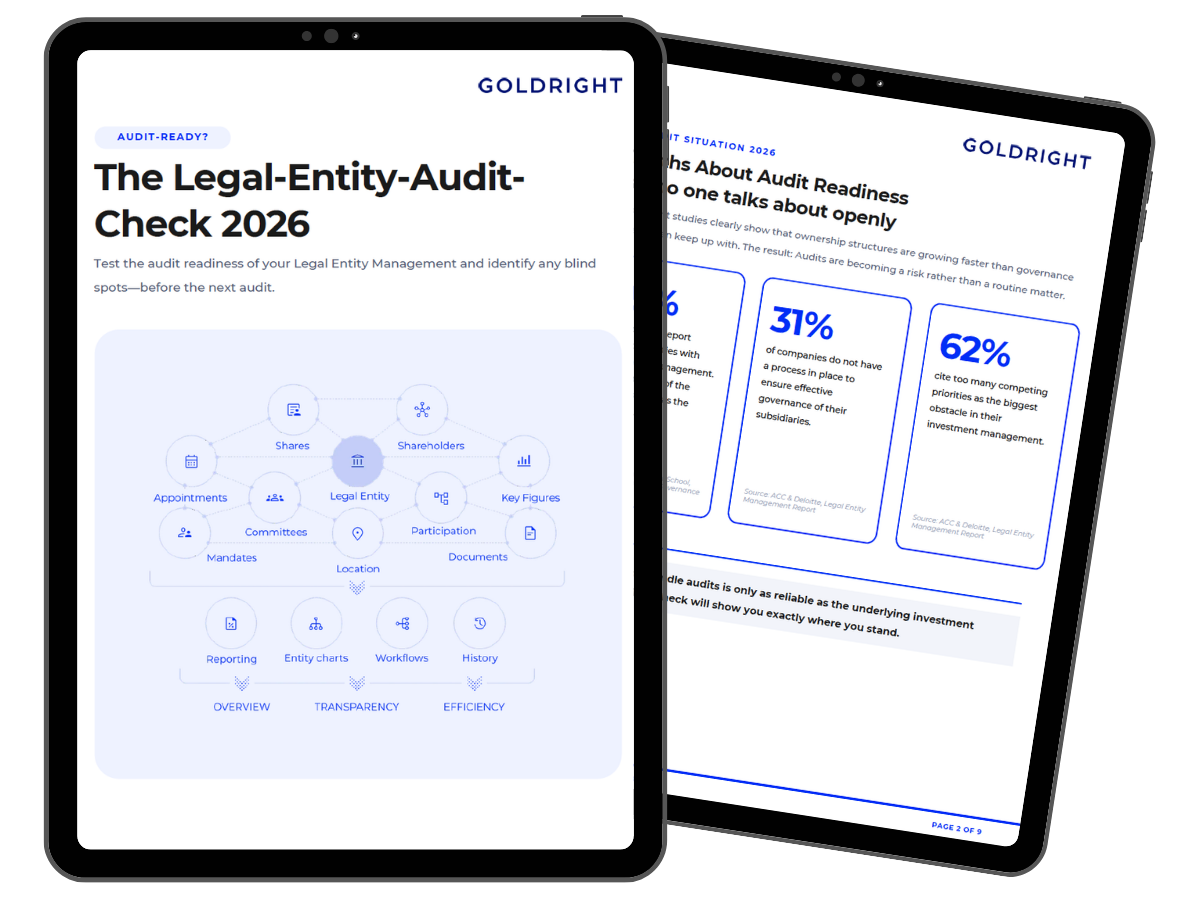
Do you manage multiple companies and are unsure whether all lists and filings are up to date? Goldright’s Legal Entity Audit Check shows you in just a few minutes where action is needed in your ownership structure.

  • 9-page practical guide as a ready-to-use PDF

  • 10-step self-assessment

  • Prioritized recommendations for action based on your score

  • 100% free

Best Practices for Reliable Legal Entity Data

Companies that consistently perform well when handling shareholder lists and transparency register filings typically share the following practices. None of these necessarily require new software—many can be implemented initially through organizational measures. However, their true value only becomes apparent when they are applied consistently across all legal entities within a group—not just for individual, particularly well-managed companies:

They maintain a centralized, version-controlled registry of all legal entities instead of individual, decentralized files - including a history so that every status can be traced retroactively to a specific cutoff date (“Who was a shareholder on which date?” ). This “point-in-time” capability is regularly crucial during tax audits, annual financial statement audits, and retroactive legal disputes because it can verify the status at that time without having to search through old emails or file folders.

They define clear responsibilities for each company: a designated person or role responsible for keeping the list up to date, regardless of whether a notary was involved in the respective filing. Ideally, this responsibility is part of a documented approval process, not just an informal assignment of duties.

They actively verify the presumption of notification under Section 20(2) of the Anti-Money Laundering Act (GwG) and document this verification - rather than tacitly relying on the completeness of their own list. A brief but documented annual review provides significantly more effective protection against administrative fines in cases of doubt than an unverified assumption.

They treat restructurings, share transfers, and M&A transactions as triggers for an immediate update review, not as a downstream administrative step to be completed at some point after the transaction is closed.

You link the list of shareholders to the rest of the company’s master data - addresses, registry numbers, client data, affiliated companies—rather than managing it in isolation within the legal department. Only this linkage makes it possible to generate reports, such as a group-wide ownership report, at the push of a button instead of after weeks of manual compilation.

Shareholder List, Commercial Register Entry, or Transparency Register Filing: A Comparison of Legal Structures

The three most common legal forms among German small and medium-sized enterprises—GmbH/UG, KG, and GbR—follow entirely different rules when it comes to disclosing their ownership structures. Anyone operating a mixed structure—such as a GmbH holding company with KG subsidiaries—must clearly distinguish between these differences on a company-by-company basis; a uniform approach “for the entire group” is not legally viable. The following table summarizes the most important differences:

Legal Form

List of shareholders pursuant to § 40 GmbHG?

Registry entry regarding equity interests

Can the deemed notification under § 20(2) GwG be used?

GmbH / UG (limited liability)

Yes, required for every change

Commercial Register (Section HRB), list of shareholders as an attachment

Yes – provided the list is complete and up-to-date

KG

No, § 40 GmbHG does not apply

Commercial Register (Section HRA), only the liability amounts of the limited partners

No – according to the Federal Administrative Court (BVA), there is generally a separate reporting obligation to the Transparency Register

GbR / eGbR

No, Section 40 of the GmbHG does not apply

Since the MoPeG (January 1, 2024), the corporate registry (eGbR) is optional

No – eGbRs are subject to a separate reporting requirement to the transparency registry

In practice, this means—particularly for investment controllers and compliance teams—that the question “Do we have an accurate list of shareholders for this company?” only makes sense for GmbHs and UGs. For KGs and GbRs, the correct question is instead “Have we fulfilled our reporting obligation to the transparency register, and can we provide proof of this?” —two distinct checks that, ideally, are mapped side by side in a central legal entity registry so that no company within the group falls through the cracks.

Practical Example: When an Outdated List Becomes a Compliance Issue

The following scenario has been anonymized and is presented as an example.

A medium-sized corporate group with approximately 15 subsidiaries was preparing for a financing round. As part of the due diligence process, the law firm retained for the project compared the lists of shareholders filed with the commercial register with the group’s internal capital table documents. For three companies, the information did not match: A share transfer from the previous year had not been reflected in one subsidiary’s list because the information had not been documented and passed on between the notary, the legal department, and management. At a second company, a shareholder who had died two years earlier was still listed as a shareholder because the inheritance had never been reported to the commercial register.

The result was not a dramatic legal dispute, but a noticeable delay: The affected lists had to be corrected at short notice, notarized, and resubmitted before the transaction could proceed—several weeks during which the financing round effectively came to a standstill while the legal department and an external law firm reconstructed the history of each affected company. From the investors’ perspective, this did not inspire confidence: If even the formal list of shareholders is not reliably maintained, the question inevitably arises as to the state of the group’s other master data.

This case exemplifies why investors and auditors are increasingly treating shareholder lists as an integral part of the due diligence process—and why the effort involved in establishing a centralized legal entity registry usually pays off even before the first transaction, rather than being addressed under time pressure during an ongoing financing round.

Pitfalls: What to Avoid When Dealing with Shareholder Lists

Most problems related to shareholder lists are not isolated incidents but recurring patterns that can be avoided with a little care. Legal departments and management teams encounter five of these particularly frequently.

1. The assumption that responsibility automatically lies with the appointed notary

The fact is: The notary submits the list only if he or she was involved in the respective change (Section 40(2) of the German Limited Liability Companies Act [GmbHG]); in all other cases—such as internal restructurings without notarial certification—the management remains responsible. This misconception persists because, in transactions handled by a notary, management is accustomed to the notary “taking care of everything”—and unconsciously applies this pattern even to cases where no notary was involved at all.

2. Relying on the presumption of notification without actually having reviewed one’s own list

If the list is incomplete or out of date, Section 20(2) of the Anti-Money Laundering Act (GwG) does not apply—with the result that, in addition to the incorrect list of shareholders, there is also a failure to file a transparency register report, which is subject to a separate fine.

3. Inheritance Cases

When business shares are transferred through inheritance, the list of shareholders does not automatically update. Without active monitoring, deceased individuals may remain listed as shareholders—sometimes for years—which leads to delays at the latest during the next profit distribution or transaction, because the actual heirs must first prove their rights.

4. Calculating the Percentage Ownership Itself

If shares are split, consolidated, or renumbered, the percentage figures must also be recalculated in accordance with the provisions of the GesLV. If only the par value is updated but not the percentage, the result is a formally incomplete list—with the same legal consequences as a missing entry.

5. Underestimating the Public Accessibility of the List

The names, dates of birth, and places of residence of the shareholders are accessible to anyone who retrieves the list from the Commercial Register. This is required by law and constitutes a special statutory provision alongside the general data protection requirements of the GDPR; however, it should still be made clear when communicating with shareholders to avoid surprises—especially for shareholders who value discretion for personal or security reasons and may not be aware that their private data is publicly accessible through the registry.

Free Legal Entity Audit Check

Ownership structures are growing faster than most companies can keep their master data up to date. With Goldright’s Legal Entity Audit Check, you’ll receive an initial, no-obligation assessment of how consistent and auditable your ownership data actually is across the entire group.

  • 9-page practical guide as a ready-to-use PDF

  • 10-step self-assessment

  • Prioritized recommendations for action based on your score

  • 100% free

Outlook: The Digital Evolution of the Shareholder List

Historically, the shareholder list has been a document in a paper file—scanned, filed in a registry binder, and read by people. Section 40(5) of the German Limited Liability Companies Act (GmbHG) already paves the way for a different future: State governments may require that information regarding the list of shareholders be submitted in a structured, machine-readable format, with reference to Section 387(2) of the Family Proceedings Act (FamFG). This is more than just a technical footnote: A machine-readable list of shareholders can be automatically reconciled with internal master data, rather than being manually verified against a PDF extract from the registry.

For companies with many legal entities, this is the real opportunity: moving away from the question “Where can we get an up-to-date copy of the list?” toward a system that continuously synchronizes registry changes with the company’s own ownership registry and automatically reports discrepancies. Those who invest today in a centralized, structured legal entity registry are already prepared for this development—and at the same time create the data foundation upon which reliable AI-driven analyses of ownership structures can be built in the first place. Unstructured, paper-based, or inconsistently maintained shareholder data, on the other hand, is unsuitable for automated analysis and AI applications from the outset, regardless of how powerful the system used may be.

Conclusion: Viewing the List of Shareholders as a Master Data Task

At first glance, the list of shareholders appears to be a minor legal requirement: a table, a few mandatory details, and a filing with the commercial register. Upon closer inspection, however, it serves as a litmus test for how well a company manages its legal entity data—with direct implications for shareholder rights, acquisition in good faith, transparency register reporting obligations, and, in serious cases, the personal liability of management. The ranges of fines outlined in this article—up to 1,000,000 euros for systematic violations and up to 5,000,000 euros for obligated parties under Section 2 of the Anti-Money Laundering Act (GwG)—demonstrate that this is not a theoretical risk, but a real factor that should not be overlooked in any compliance or financial planning.

Anyone managing just a handful of companies can keep track of them manually with due care. Anyone responsible for ten, fifty, or a hundred legal entities—for example, as the CFO or Head of Compliance of a corporate group with a complex ownership structure—needs a structured, version-controlled, and auditable process, not yet another folder full of Excel lists. The four most common causes of erroneous lists described in this article—manual maintenance, fragmented communication with notaries, unmanaged restructuring phases, and a lack of centralized governance—cannot be resolved by individuals exercising greater care, but only through clear lines of responsibility and a centralized system that automatically tracks changes and issues timely warnings before deadlines are missed.

This is exactly where Goldright’s Legal Entity Manager comes in: a centralized registry for ownership structures, with a history recorded as of each reporting date, automated workflows for change notifications, and clear responsibilities for each company. If you’d like to know where your own ownership structure stands today and whether all shareholder lists and transparency register filings are consistent across the entire group, the free Legal Entity Audit Check is the easiest first step toward that goal.

Frequently Asked Questions

The list of shareholders is the official register filed with the Commercial Register that lists all shareholders of a GmbH or UG (with limited liability), including their names, dates of birth, places of residence, and corresponding shares (§ 40 GmbHG). It is more than just a formality because, since the MoMiG of 2008, it has had a legitimizing effect and thus directly influences who is considered a shareholder in legal transactions.
The list is part of the publicly accessible registry file at the relevant commercial registry and can be accessed online through the joint registry portal of the federal states, usually for a small fee. For a complete history, we recommend obtaining a chronological registry extract that includes all previous versions of the list.
Generally, the management. If a notary was involved in the underlying change, the notary submits the list and certifies that the amended entries correspond to the transactions the notary oversaw (Section 40(2) of the German Limited Liability Companies Act (GmbHG)). In the case of internal changes without notary involvement, the management remains responsible throughout the process.
The list is submitted electronically—signed by the management or the notary involved—through the competent registry courts. Section 40(5) of the Limited Liability Companies Act (GmbHG) also allows state governments to require a structured, machine-readable submission.
It contains, in tabular form, the last name, first name, date of birth, and place of residence of each shareholder, as well as the par value, serial numbers, and percentage of ownership of the shares; for shareholders that are legal entities themselves, it also includes the company name, registered office, registry court, and registry number. The format and calculation details are governed by the Shareholder List Regulation (GesLV).
No. Section 40 of the GmbH Act (GmbHG) applies only to GmbHs and UGs (with limited liability). For a KG, limited partners are listed in the Commercial Register (Section HRA) only by their liability amount, not by their actual capital share. According to the Federal Administrative Office, a separate filing with the Transparency Register is generally still required for KGs, as they cannot invoke the presumption of notification.
No, there is no list of members for a GbR under § 40 GmbHG either. Since the MoPeG took effect (January 1, 2024), a GbR may voluntarily register as an eGbR in the new corporate registry, which triggers separate transparency registry obligations that must be considered independently of the GmbH’s list of shareholders.
Shareholders who are not listed cannot temporarily assert their rights against the company; a third party may acquire shares in good faith based on the incorrect list; and the management is personally liable as joint and several debtors for any damages resulting therefrom to the affected shareholders or the company’s creditors.
Anyone who believes they have been wrongfully omitted from the list or listed incorrectly may have an objection to the list entered. Pursuant to Section 16(3) of the German Limited Liability Companies Act (GmbHG), this objection prevents a bona fide acquisition based on the incorrect information and should be filed promptly in the event of discrepancies, as it has immediate legal protective effect.
Not necessarily: If the list of shareholders is complete and up-to-date, the presumption of notification under Section 20(2) of the Money Laundering Act (GwG) applies to the GmbH, and a separate report is not required. If the list is incomplete or outdated, this benefit no longer applies, and a separate report to the Transparency Register becomes necessary.
Depending on the severity, fines range from 50,000 euros (negligence) and 150,000 euros (intent) as a general rule, up to 1,000,000 euros for systematic or repeated violations, and up to 5,000,000 euros or 10% of annual revenue for entities subject to the reporting obligation under Section 2(1) of the Anti-Money Laundering Act (GwG), such as financial institutions and insurance companies.
After every change in the identity of the shareholders or in the size of their holdings—the law does not specify a fixed deadline but requires immediate submission. In practice, delays of several weeks without a justifiable reason are already considered a breach of duty.

Sources

dejure.org: § 40 GmbHG – List of Shareholders, Authority to Issue Regulations - https://dejure.org/gesetze/GmbHG/40.html

dejure.org: § 16 GmbHG – Legal Status in Relation to the Company - https://dejure.org/gesetze/GmbHG/16.html

Gesetze im Internet (Bundesministerium der Justiz): Shareholder List Regulation (GesLV) - https://www.gesetze-im-internet.de/geslv/BJNR087000018.html

onlinebilanz.de: "GmbH-Gesellschafterliste 2026 – Praktische Pflichten & Fristen" - https://onlinebilanz.de/gmbh-gesellschafterliste/

PwC Legal: "Einschränkende Auslegung der Mitteilungsfiktion des § 20 Abs. 2 GwG für Kommanditgesellschaften" - https://legal.pwc.de/de/news/fachbeitraege/einschraenkende-auslegung-der-mitteilungsfiktion-des-paragraph-20-abs-2-gwg-fuer-kommanditgesellschaften

PwC Legal: "Die eingetragene Gesellschaft bürgerlichen Rechts (eGbR) und ihre Pflicht zur Mitteilung wirtschaftlich Berechtigter an das Transparenzregister - https://legal.pwc.de/de/news/fachbeitraege/die-eingetragene-gesellschaft-burgerlichen-rechts-egbr-und-ihre-pflicht-zur-mitteilung-wirtschaftlich-berechtigter-an-das-transparenzregister

JUHN Partner: "Transparenzregister – welche Bußgelder drohen bei Ordnungswidrigkeiten?" - https://www.juhn.com/fachwissen/gmbh-steuerrecht/bussgelder-transparenzregister/

LexisNexis Risk Solutions / Forrester: "True Cost of Financial Crime Compliance Study" - https://risk.lexisnexis.com/global/en/about-us/press-room/press-release/20240306-true-cost-of-compliance-emea

Gartner: Press Release "Gartner Predicts 80% of D&A Governance Initiatives Will Fail by 2027, Due to a Lack of a Real or Manufactured Crisis" - https://www.gartner.com/en/newsroom/press-releases/2024-02-28-gartner-predicts-80-percent-of-data-and-analytics-governance-initiatives-will-fail-by-2027-due-to-a-lack-of-a-real-or-manufactured-crisis-

dejure.org: § 5a GmbHG – Entrepreneurial Company - https://dejure.org/gesetze/GmbHG/5a.html

juraforum.de: § 40 GmbHG – Section 40 of the German Limited Liability Companies Act (GmbHG) – List of Shareholders, Authority to Issue Regulations (including reference to the Shareholder List Regulation (GesLV) and paragraph 5 on machine-readable transmission) - https://www.juraforum.de/gesetze/gmbhg/40-liste-der-gesellschafter-verordnungsermaechtigung

Wikipedia: Act on the Modernization of Limited Liability Company Law and the Prevention of Abuse (MoMiG) - https://de.wikipedia.org/wiki/Gesetz_zur_Modernisierung_des_GmbH-Rechts_und_zur_Bek%C3%A4mpfung_von_Missbr%C3%A4uchen