September 2, 2026

LEI Number: The Underestimated Compliance Risk Factor in Your Entity Structure

Philipp Seibald

By Philipp Seibald

Vice President Sales

26 min read

Share this post

A LEI number is more than just a tedious formality before your next securities transaction. In this article, you’ll learn what a Legal Entity Identifier is, how much it costs to apply for one, and what regulations—from EMIR to MiFID II to DORA—require. Above all, we’ll show you that the real risk isn’t the initial application, but rather the ongoing management of these identifiers across multiple companies. Read on to learn how CFOs and compliance officers are structurally managing this risk.
Key Points

  • An LEI (Legal Entity Identifier) is a 20-character alphanumeric code defined by ISO 17442 that uniquely identifies legal entities worldwide.

  • As of the end of March 2026, according to GLEIF, there were more than 3.02 million active LEIs for the first time - a quarterly growth rate of 3.4%.

  • Initial registration costs between approximately €45 and €80 per year, depending on the issuing authority, plus a GLEIF system fee of $11 per LEI per year, which is included in the fees.

  • Since January 3, 2018, under MiFID II/MiFIR, banks are no longer permitted to execute reportable securities transactions without a valid LEI number - known as “No LEI, no trade” (ESMA).

  • A LEI number must be renewed annually; according to GLEIF, the global renewal rate currently stands at 56.6%, and at 61.1% in EU countries.

  • With the Digital Operational Resilience Act (DORA), the LEI requirement has been extended to virtually all regulated financial firms as of 2025 (BaFin).

  • The real risk lies not in the individual application process, but in the decentralized, often Excel-based management of numerous LEI numbers across the entire corporate group - a pattern that mirrors the group’s overall legal entity management practices.

What is an LEI number?

An LEI number, which stands for Legal Entity Identifier, is a globally unique, 20-character alphanumeric code used to identify legal entities in financial markets. The standard is defined in ISO 17442 and is administered by the Global Legal Entity Identifier Foundation (GLEIF) , a nonprofit organization headquartered in Basel that was established in 2014 by the G20 and the Financial Stability Board.

Essentially, every LEI number answers three questions: Who is who? Who belongs to whom? And who owns what? In this way, the Legal Entity Identifier serves as a kind of international ID for companies, foundations, funds, and other legal entities.

Technically, every LEI number under ISO 17442 consists of three parts. The first four characters indicate which entity issued the number—the so-called Local Operating Unit (LOU), or issuing authority for short. Characters 5 through 18 form the actual identifier assigned by the issuing authority. The last two characters are check digits, calculated using the MOD-97-10 method in accordance with ISO/IEC 7064—they ensure that the code is correct and has not been tampered with.

The difference from a standard commercial registry number: The LEI number is internationally recognized, vendor-neutral, and linked to a publicly accessible data record—including the company’s name, legal form, registered office, parent company, and status. This is precisely what makes it so valuable to regulatory authorities, banks, and business partners: It is machine-readable and can be used across systems—including as a building block for automated compliance and AI processes. More on this in the section on vLEI below.

For companies with a straightforward corporate structure, obtaining an LEI number is usually a one-time administrative task. For corporate groups with numerous domestic and foreign subsidiaries, special-purpose entities, and equity investments, however, it quickly becomes a data management issue in its own right: Every company subject to LEI requirements needs its own valid and regularly validated code—and each of these codes expires according to its own schedule, independent of the fiscal year or other reporting deadlines.

Important to note in practice: An LEI number is not assigned once and then valid forever. It must be renewed at least once a year and re-verified by the issuing authority (GLEIF). As we will show later, it is precisely this annual renewal cycle that poses the actual operational risk for companies with many subsidiaries.

Why was the LEI number introduced in the first place?

The LEI number was created in the wake of the 2008–2009 financial crisis. At that time, regulatory authorities around the world realized that there was no standardized way to identify companies globally. This made it difficult to track risks between banks. In 2011, the G20 tasked the Financial Stability Board (FSB) with developing a global Legal Entity Identifier. The first LEI codes were issued as early as late 2012. In June 2014, the GLEIF was founded as the central administrative body of the Global LEI System.

Since then, the LEI number has been used for an ever-increasing range of purposes—from derivatives reporting and securities trading to ICT reporting under DORA. This is no coincidence: Once established, a cost-effective and internationally recognized standard can easily be reused for new regulatory purposes, rather than inventing a separate identifier for every new regulation.

LEI and vLEI: From Reporting to a Digital Anchor of Trust

With the verifiable LEI (vLEI), the GLEIF is further developing the traditional LEI number. The vLEI is a digital, tamper-proof version of the LEI number. It is based on a cryptographic method known as the “Trust-over-IP” model and is designed to securely verify a company’s identity even in automated processes. While the traditional LEI is primarily used today for reporting to regulatory authorities, the vLEI targets new applications: automated contract execution, digital signatures, and verifying corporate identity with systems and AI agents.

For CFOs and compliance officers, this means that investing in a clean, up-to-date LEI database will pay off well beyond the scope of traditional reporting requirements. Those who already maintain their legal entity master data in a consistent and machine-readable manner are laying the groundwork for adopting future vLEI-based processes without significant rework—an aspect that is directly linked to the question of master data’s AI readiness.

Who assigns LEI numbers? Local Operating Units explained

GLEIF itself does not issue LEI numbers directly to companies. Instead, it delegates this task to a global network of so-called Local Operating Units (LOUs)—known in German as “issuing agencies.” These agencies accept applications, verify company data against the commercial register and other official sources, and issue the actual LEI code. Each issuing agency must adhere to the same global quality standard under ISO 17442, but differs in terms of price, customer service, and additional services such as automated renewal reminders.

In Germany, WM Datenservice—a subsidiary of the Bundesanzeiger-Verlag Group—is the established LOU, accredited for many years, with a direct link to the German commercial register. In addition, numerous other GLEIF-accredited providers and intermediaries—such as GS1 Germany, LEIReg, or specialized online registrars—have established themselves; they all rely on the same infrastructure but differ in price and service level. For companies, this means: The actual LEI code is validated identically by every authorized entity and is equally recognized internationally—the difference lies in price, support, and the quality of the reminder and renewal processes, not in the validity of the code itself.

How do I find a company’s LEI number?

Every LEI number that has been assigned can be found in the public, free GLEIF search registry—no registration or fee required. The search can be performed either by company name or directly using the 20-digit code, and returns not only the current status (“issued” or “lapsed”) but also the legal form, registered office, and, if available, the parent company. For business partners, banks, and auditors, this public registry is often the first port of call for verifying the validity of an LEI number prior to a transaction.

For companies with many subsidiaries, however, this method is only suitable for individual queries. Those who wish to regularly check the LEI status of several dozen or even hundreds of subsidiaries should rely on an automated, structured comparison with the GLEIF database rather than manually looking up each subsidiary individually—an approach described in more detail in the section on the solution.

Why Is the LEI Number Relevant?

The importance of the LEI number has been growing steadily for years—driven by regulation, cross-border capital flows, and the increasing digitization of reporting processes. Six key metrics illustrate why this topic will be on the agenda of CFOs and compliance officers in 2026.

1. The active LEI population is growing faster than ever before. According to the GLEIF quarterly report for Q1 2026, there are now more than 3.02 million active LEI numbers for the first time—an increase of approximately 100,000 new registrations in the first quarter alone, representing quarterly growth of 3.4%. Emerging markets are experiencing particularly dynamic growth: India grew by 8.1%, Brazil by 9.0%, and Latvia by as much as 11.5%.

2. Regulatory pressure is noticeably increasing. Gartner forecasts that investments by legal and compliance departments in governance, risk, and compliance (GRC) tools will rise by 50% by the end of 2026. LEI management is an integral part of this GRC agenda because it lies at the intersection of legal, tax, treasury, and regulatory reporting.

3. New regulations are affecting more companies. Under the Digital Operational Resilience Act (DORA), the LEI code has been a mandatory identification code for all regulated financial firms in ICT reporting since 2025—without a registered LEI code, the reporting process cannot be used (BaFin). As a result, the LEI requirement now extends far beyond traditional securities dealers.

4. In practice, the management of many legal entities is underdeveloped. The joint Legal Entity Management Report by ACC and Deloitte shows that 38% of the companies surveyed manage their entity data exclusively in Excel, and 31% have no formalized process for managing their subsidiaries. Twenty-six percent reported that individual companies were not properly registered with regulatory authorities (“not in good standing”)—a direct risk for LEI maintenance as well.

5. Discipline regarding renewal remains a weak point. Even by 2026, the global LEI renewal rate, according to GLEIF, will be only 56.6%, and outside the EU, as low as 49.6%. By comparison, Japan achieves 89.3%—proof that structured processes make all the difference.

6. Data quality is becoming a significant cost factor. According to a 2023 Forrester report cited by IBM, more than a quarter of companies lose more than $5 million annually due to poor data quality, with 7% losing more than $25 million. A recent 2025 survey by the IBM Institute for Business Value also shows that 43% of chief operating officers rank data quality issues as their top data priority—legal entity and LEI data are directly affected by this as part of the master data landscape.

For companies with international ownership structures, this means that the LEI number is no longer a peripheral issue for the treasury department, but rather a recurring data point relevant to audits that must be maintained with the same level of reliability as any other master data attribute of a company.

LEI Numbers by Industry: What Matters

The basic LEI requirement is similar across industries, but its practical relevance and typical pitfalls vary significantly depending on the sector.

Financial service providers and capital market participants represent the original use case for LEI numbers: Banks, investment firms, and fund management companies need them for derivatives and securities reporting under EMIR and MiFID II/MiFIR, as well as, increasingly, for ICT reporting under DORA. This is where the LEI requirement is most firmly established, but also enforced most strictly: Without a valid LEI, the transaction simply will not be executed.

Insurance companies are subject to their own, clearly defined obligation: According to guidelines from the European Insurance and Occupational Pensions Authority (EIOPA), insurers, reinsurers, insurance groups, and occupational pension funds were required to provide their LEI numbers under Solvency II by June 30, 2015 (leireg.de, citing EIOPA). Since insurance groups often maintain complex, multi-tiered corporate structures with numerous special-purpose entities, consolidated LEI management is particularly closely integrated with the rest of their legal entity management in this context.

Real estate and investment companies need an LEI number whenever property companies or fund vehicles enter into reportable financing or securities transactions. Since real estate portfolios often consist of a complex structure of property and holding companies, the LEI quickly becomes another data point that must be accurately documented for every real estate or equity transaction and—for example, during a due diligence review—must be verifiable at short notice.

Energy providers, with their numerous joint ventures, project companies, and stakes in grid operators, face a structural challenge similar to that of insurers: Every new project company—such as one for a renewable energy project—can trigger its own LEI requirement as soon as financing or hedging transactions are involved. Without a centralized overview, there is a risk of gradually losing control across many small, fragmented project companies.

Industrial and manufacturing companies rarely need an LEI number for their core operations, but they often require one for intra-group treasury activities, hedging transactions, or international M&A transactions. Particularly in the case of acquisitions, newly acquired companies often bring their own LEI—issued by a different issuing authority—with them—a classic trigger for the root causes of poor LEI management described in the next section.

As varied as the triggers may be across different industries—whether securities trading, Solvency II reporting, real estate transactions, or acquisitions—the underlying structural pattern is the same across all sectors: As soon as a corporate group comprises more than a handful of legally independent companies, LEI management transforms from a one-time formality into an ongoing data maintenance task. Those who fail to organize this task deliberately leave it to the whims of individual departments—with the consequences described in the next section.

The Four Root Causes of Poor LEI Management

When LEI numbers expire, are applied for twice, or are renewed only under time pressure, this is rarely due to the application process itself—which is usually completed within a few days. The actual causes run deeper and can be traced back to four patterns that recur in many corporate groups.

The first cause is a lack of centralized responsibility. In many companies, LEI maintenance is decentralized among individual subsidiaries or departments such as Treasury, Legal, or Tax—often without a clear assignment of who is specifically responsible for which company. The ACC/Deloitte report describes precisely this pattern: 31% of the companies surveyed have no defined process for managing their subsidiaries. If a responsible person changes positions or leaves the company, the tacit knowledge regarding upcoming LEI deadlines is often lost without a handover.

The second cause is the lack of a centralized overview of deadlines. An LEI number must be renewed annually. With hundreds of companies having different issuance dates, this results in a corresponding number of deadlines scattered throughout the year. Without automated reminders, companies rely on the email inboxes of individual staff members—a risk in the event of personnel changes or vacation periods. In practice, this pattern is evident in the fact that renewals often go unnoticed until a bank or business partner flags an already expired LEI—at a time when the transaction is already under time pressure.

The third cause is the Excel-based siloed solution. When LEI numbers, expiration dates, and issuing authorities are maintained in local spreadsheets rather than in a centralized system, conflicting data sets arise. The ACC/Deloitte report estimates that 38% of companies use Excel exclusively for their legal entity management—while 62% are dissatisfied with the technology they use. Such spreadsheets are usually stored locally on individual computers, resulting in multiple, conflicting versions existing in parallel.

The fourth cause is treating the LEI as a one-time procurement task rather than an ongoing process. Many companies only apply for a LEI number reactively, once a specific business transaction requires it—such as before a securities transaction. Without a link to the company’s ongoing master data management, the LEI remains an isolated piece of data that is easily overlooked during the next restructuring, name change, or merger. This becomes particularly evident in the case of carve-outs or mergers, when the old company—along with its LEI—disappears, but the new entity continues to operate without its own up-to-date LEI.

In short, there are four patterns that repeatedly reinforce one another in practice:

  • Lack of central responsibility for LEI maintenance per company

  • No automated, group-wide overview of renewal dates

  • Excel-based siloed solutions instead of a central, linked dataset

  • LEI treated as a one-time procurement task rather than part of ongoing master data maintenance


All four causes have one thing in common: they are not technical gaps, but organizational ones. This is precisely why the problem cannot be solved simply by switching LEI issuing authorities, but only through a clearly defined, repeatable process that addresses responsibility, deadline monitoring, and data integration in equal measure.

Not a Procurement Problem, but a Lifecycle Problem

A common misconception is that once you’ve applied for a LEI number, the matter is settled. In fact, the initial application is the easiest part of the process—it takes just a few business days if the documentation is complete and, as the next section shows, costs a manageable 45 to 80 euros. The real risk arises only afterward, throughout the company’s entire lifecycle.

Every LEI number goes through a cycle of registration, annual validation, a possible change of issuing authority (transfer), updates in the event of address or ownership changes, and, in extreme cases, deactivation upon the company’s liquidation or merger. Each of these steps is a potential point of error—not because it is complicated, but because in many companies, no one is specifically assigned to handle it.

Thus, the LEI challenge is structurally identical to what applies to legal entity management as a whole: The problem is not the one-time collection of data, but its continuous, reliable maintenance over the years and across dozens or hundreds of legal entities. Those who view LEI management as part of a company’s ongoing governance rather than as a one-time formality solve the problem at its root.

Here’s how the lifecycle nature of the process plays out in practice: A medium-sized corporate group with 40 active subsidiaries in eight countries routinely applies for an LEI number for each new subsidiary—the initial registration is typically completed within a few days. Over the following years, however, responsibilities shift; acquisitions add further subsidiaries with their own LEI numbers held by other issuing authorities; and the original Excel list grows to several hundred rows with inconsistent expiration dates. When a bank then randomly checks the LEI status of several subsidiaries as part of a financing round, it often becomes apparent that: Some of the numbers have “lapsed,” others are registered twice, and no one can say offhand who is responsible for the affected entities. It is precisely this pattern—which is very common in practice—that can be structurally avoided by following the five steps described below, rather than having to address it only when a crisis arises.

Solution: Five Steps to Audit-Proof LEI Management

A robust process for LEI management can be established in five steps, regardless of a company’s size.

Step 1: Inventory. For each legal entity within the group, determine whether it has an LEI number, what its status is (issued, lapsed, pending transfer), and when the next renewal is due. This inventory can be cross-referenced with the public GLEIF database, which is available free of charge. Experience shows that this first step alone uncovers duplicate registrations, outdated legal entity information, or companies without an LEI.

Step 2: Assign central responsibility. Designate a responsible role for LEI maintenance for each company and across the entire group—regardless of whether this role is organizationally located within Legal, Treasury, or a central entity management function. What matters is a clear, documented assignment, not formal departmental affiliation. This assignment should be documented in writing and actively transferred whenever organizational changes occur.

Step 3: Consolidate the issuing authority. Check whether your companies hold LEI numbers with different, sometimes more expensive, issuing authorities. Transferring these to a single, GLEIF-accredited Local Operating Unit is usually free of charge and provides a unified overview of billing and processes. This not only reduces administrative complexity but also facilitates price negotiations for larger volumes.

Step 4: Set up renewal automation. Instead of manual calendar reminders, we recommend automated deadline monitoring that triggers renewals well before expiration and escalates the issue if no responsible party responds. Multi-year packages from contracting authorities can further reduce the risk, but they are no substitute for a structured process. It is important to have a tiered reminder system—for example, 90, 30, and 7 days before expiration—to ensure there is sufficient response time even if individual responsible parties are absent.

Step 5: Link the LEI to the company’s master data. Instead of maintaining the LEI number in isolation, it should be an integral part of the central company master record—linked to commercial registry data, ownership structures, and reporting requirements. Only in this way will it remain automatically tracked during restructurings, name changes, or mergers, rather than having to be manually updated each time a change occurs.

How audit-ready is your entity structure really—including LEI status?

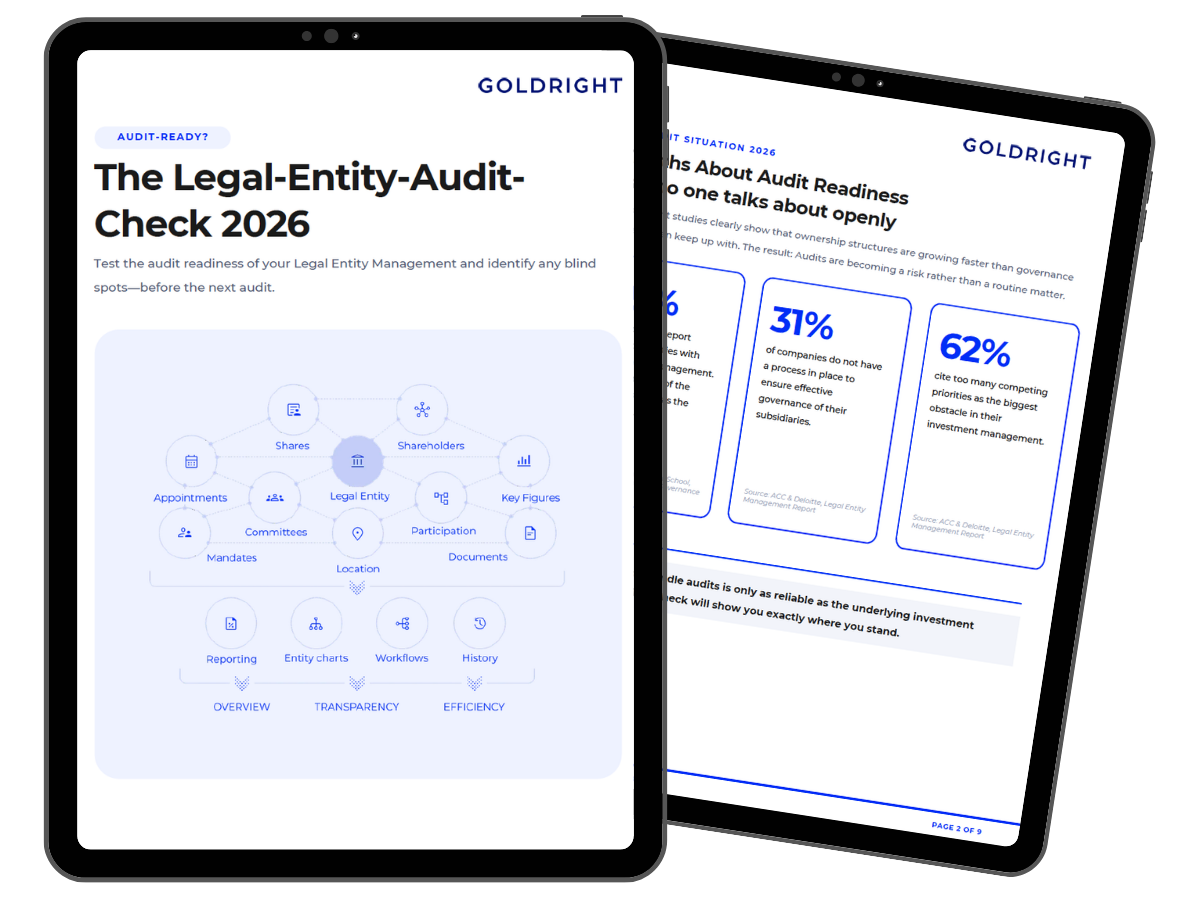
Goldright’s Legal Entity Audit Check uses targeted questions to identify blind spots in your investment and entity management in just 15 minutes and provides prioritized recommendations for action.

  • 9-page practical guide as a ready-to-use PDF

  • 10-step self-assessment

  • Prioritized recommendations for action based on your score

  • 100% free

Best Practices: What Really Works in Practice

Companies that successfully manage their LEI administration share several recurring practices. It is less about choosing a specific software solution or issuing authority and more about the consistency with which they treat LEI maintenance as a fixed, recurring process—rather than as an annual exception.

They consolidate all LEI numbers with a single issuing authority, rather than maintaining multiple contracts with various local operating units that have developed over time. This not only reduces costs but, more importantly, minimizes the number of different processing and billing cycles that would otherwise have to be monitored individually.

They make targeted use of multi-year packages where planning certainty exists—such as for stable holding companies—but deliberately refrain from doing so for companies facing foreseeable restructurings, so as not to tie up unnecessary advance payments. This differentiated approach on a company-by-company basis, however, requires that restructuring plans and LEI management be coordinated in the first place.

They integrate LEI maintenance into the onboarding and offboarding processes for companies: When a new company is established, the LEI application is triggered automatically, just as the timely deactivation is triggered upon liquidation—similar to the processes already established in legal entity management for start-ups and liquidations. In this way, the LEI becomes part of the standard checklist for every new company from the very beginning.

They comprehensively document status changes, making it possible at any time to trace, with precision down to the specific date, which company held a valid LEI on a given date—proof that is regularly requested in connection with securities transactions, lending, or audits. Without consistent historical tracking, this question can often be answered retrospectively only with a considerable amount of manual research.

They report the LEI status to management on a regular basis, rather than checking it only when there is an urgent need. Simple, quarterly reporting on the number of active, soon-to-expire, and already expired LEIs creates transparency at the decision-making level and brings the issue to light before it becomes a problem.

Applying for an LEI Number: Provider and Cost Comparison 2026

The cost of an LEI number consists of the service fee charged by the issuing agency and a globally uniform GLEIF system fee included in that amount, which currently amounts to 11 U.S. dollars per LEI per year (LEI Register). Since this system fee is identical for all issuing agencies, price differences between providers result exclusively from their own service margins, not from varying GLEIF costs. The following overview shows sample prices from selected GLEIF-accredited issuing agencies and registrars for the DACH region (as of August 2026; prices are net plus sales tax; prices are subject to change).

Registration Authority / Registrar

Initial Registration (1 year)

Renewal (1 year)

Multi-Year Option

Special Feature

WM Datenservice / Bundesanzeiger

According to the current price list

According to the current price list

Yes

Official German LOU, direct connection to Bundesanzeiger

LEIReg

80 €

70 €

Upon request

Free transfer, free auto-renewal option

Register-LEI (Österreich)

59 € (1 year) / 45 €/year (5 years)

Included in the multi-year package

Up to 24% discount (5 years)

Payment by invoice available

LEI Register

59 € (1 year) / 45 €/year (5 years)

65 € (1 year) / 49 €/year (5 years)

Up to 25% discount (5 years)

GLEIF fee (11 USD/year) clearly stated

GS1 Germany (lei.direct)

According to the current price list

According to the current price list

Possible up to 5 years

Processing time: 36–48 hours, free transfer

For companies with only one or a few legal entities, choosing the most affordable provider is usually the most cost-effective decision. For corporate groups with many legal entities, however, the price per LEI is less important than the question of how to monitor dozens or hundreds of expiration dates centrally, in a consolidated manner, and reliably—an aspect that pure registrars naturally do not cover, because they focus only on the application process and not on group-wide governance.

An often-overlooked cost factor is the internal administrative burden: Even with low external fees of 45 to 80 euros per LEI per year, having hundreds of subsidiaries results in significant internal costs for research, coordination, and tracking of pending renewals—costs that do not appear in any issuing authority’s price list but certainly add up in a corporate group’s overall budget. Anyone seeking to reduce this internal effort should therefore not view the external fee in isolation but evaluate it alongside the effort required for internal process management.

To put this into perspective, here’s a simple example: With 50 companies and an average renewal fee of about 60 euros per year, the external costs amount to approximately 3,000 euros annually—a manageable amount in a corporate context. In practice, the internal coordination effort required for 50 individual renewal deadlines spread out over the course of the year often significantly exceeds this external cost, especially when coordination must be done manually and without a centralized overview of deadlines.

Which regulations require an LEI number?

The LEI requirement is enshrined in several European regulations, which differ in their scope of application and the consequences of non-compliance.

Regulation

Effective Date

Who Is Affected

Consequences of Not Having a Valid LEI

EMIR (Derivatives Reporting Requirements)

Reporting requirement effective February 12, 2014

Financial and non-financial counterparties to derivative transactions

Transaction reporting to trade repositories is not fully possible without unique identification

MiFID II / MiFIR

Effective January 3, 2018

Legal entities that engage in reportable securities transactions

“No LEI, no trade” – Banks are not permitted to execute the transaction

MAR (Market Abuse Regulation)

Ongoing

Issuers of financial instruments

Lack of unique issuer identification in reporting

Solvency II

Effective June 30, 2015

Insurers, reinsurers, insurance groups, occupational pension plans

The absence of an LEI complicates regulatory reporting to EIOPA and national supervisory authorities

DORA (Digital Operational Resilience Act)

Part of the ongoing ICT reporting process starting in 2025

All regulated financial institutions

No access to the BaFin reporting process (MVP) without a registered LEI code

It’s striking: With each new wave of regulation—most recently DORA—the number of companies required to have an LEI number is growing, while expectations regarding data quality and timeliness are rising. Companies that already manage their LEIs in a structured manner are better prepared for future regulatory changes than those that handle the issue on a case-by-case basis.

Pitfalls: What to Avoid in LEI Management

Even experienced compliance and finance teams repeatedly fall into the same traps when managing LEIs. We encounter the following five patterns particularly frequently in practice—regardless of whether the organization is an international conglomerate or a medium-sized company with few but complex holdings.

A common mistake is to wait until just before a transaction to apply for an LEI. While the processing time at most issuing agencies is only a few business days, this is not guaranteed—for example, if commercial registry data does not match exactly. In the worst-case scenario, this approach jeopardizes the completion of time-sensitive transactions.

Another pitfall is ignoring the “lapsed” status. When an LEI number expires, it is not deleted but merely marked as “lapsed”—it technically remains in existence, but its data is no longer considered valid. For business partners and regulatory authorities, this is a warning sign, even if it does not trigger an automatic penalty; in practice, however, it regularly leads to follow-up inquiries, delays, or additional effort to clarify the situation.

It is also risky to separate LEI management from the rest of corporate governance. If a company is liquidated, merged, or renamed without the deactivation or updating of the LEI being part of the standard process, orphaned or erroneous records are created in the public GLEIF registry—with potential reputational consequences vis-à-vis business partners who routinely check this public data.

The effort involved in managing multiple issuing agencies simultaneously is also frequently underestimated. As corporate groups grow through acquisitions, they often inherit LEI contracts from various local operating units with differing expiration dates, prices, and points of contact. Without consolidation, managing renewals becomes disproportionately time-consuming—an effect that intensifies with each additional acquisition and often only becomes apparent during a group-wide review.

Finally, the lack of clarity regarding responsibilities among legal, treasury, and external advisors is a recurring problem. When no one is clearly responsible for a company’s LEI status, everyone ends up relying on everyone else—until a pending transaction, an audit, or a bank inquiry exposes the gap and forces last-minute corrective action that could easily have been avoided with clear processes.

Before the next audit: Do you know your blind spots?

The Legal Entity Audit Check takes just 15 minutes to show you how well your companies—including their LEI status—are prepared for the next audit, and provides specific, prioritized recommendations for action based on your results.

  • 10-Step Self-Assessment

  • Prioritized Recommendations for Action Based on Your Score

  • 100% Free

Conclusion: An LEI number is a must; managing it is optional

Applying for an LEI number is straightforward today: a processing time of just a few business days, manageable costs ranging from €45 to €80 per year, and a standardized process at every accredited issuing agency. The real challenge begins afterward—when one LEI number turns into ten, a hundred, or several hundred, spread across national subsidiaries, legal entities, and time zones, each with its own annual expiration date.

With over 3 million active LEIs worldwide, a global renewal rate of just 56.6%, and a regulatory landscape that is constantly expanding—from EMIR to MiFID II, Solvency II, and DORA—it becomes clear: LEI maintenance is not a one-time procurement project, but an ongoing governance process. Companies that organize this process in a decentralized, manual manner and without a centralized overview of deadlines face a risk that only becomes apparent during the next transaction, audit, or reporting—but then immediately and usually under considerable time pressure.

A look at the four root causes also reveals that it is not a lack of technology or regulatory knowledge that causes LEI numbers to expire, but rather a lack of accountability, a lack of visibility into deadlines, and the separation of LEI management from the rest of master data governance. Each of these causes can be remedied with relatively simple organizational measures—provided the issue is treated for what it is: an integral part of corporate governance, not an annual administrative reminder.

Those who instead view the LEI number as an integral part of legal entity management and central corporate master data—linked to clear responsibilities and automated deadline monitoring—can transform a recurring compliance obligation into a controlled, audit-ready process. Goldright’s Legal Entity Manager enables you to do exactly that—LEI status, expiration dates, and investment data all in one place, rather than scattered across dozens of local spreadsheets, supplemented by the historical tracking and governance functions necessary for an audit-ready result. Find out just how audit-ready your own entity structure is today—including LEI status—with the free Legal Entity Audit Check in just 15 minutes.

Frequently Asked Questions

A LEI number is a globally unique 20-digit code that identifies a legal entity—such as a GmbH, AG, or foundation. You can think of it as an international ID for companies. Authorized issuing agencies issue these numbers on behalf of the GLEIF. Without a valid LEI number, many reportable financial transactions cannot be carried out.
In general, any legal entity that engages in reportable securities or derivatives transactions, is an issuer of financial instruments, or is a regulated financial firm subject to regulations such as DORA or Solvency II requires an LEI number. Foundations and nonprofit organizations also require an LEI as soon as they enter into such financial transactions. Natural persons, on the other hand, do not need an LEI number.
Depending on the issuing agency, the cost for initial registration is usually between €45 and €80 per year; the cost for annual renewal is often slightly higher. Multi-year packages reduce the effective annual price by up to 25%. All prices include a GLEIF system fee, which is currently $11 per LEI per year.
If the documentation is complete, the application process at most authorized issuing agencies is completed within a few business days—in some cases, even within 36 to 48 hours. Delays occur primarily when proof of power of attorney or registration is missing, or when the company’s information does not match the commercial register.
Yes. An LEI number must be renewed at least once a year and revalidated by the issuing agency. If this is not done, its status in the GLEIF registry changes from “issued” to “lapsed”—the LEI technically remains in existence, but is no longer considered to be currently validated.
An expired (“lapsed”) LEI number is not automatically deleted, but it loses its validated status. Banks may reject transactions involving a non-validated LEI, and business partners often view this as a compliance red flag. Reactivation is done through a regular renewal with the relevant issuing authority, during which the company’s data must be validated again—depending on how up-to-date the submitted documents are, this may take additional time.
Yes, a transfer between authorized issuing agencies is possible and is offered free of charge by most providers. The existing LEI code remains unchanged—the only thing that changes is which issuing agency performs the annual validation.
No. The commercial register number is national and specific to a legal form, while the LEI number is an international, ISO-standardized identifier that is uniformly recognized by regulatory authorities worldwide. Both numbers identify the same company, but they serve different purposes and are issued by different authorities.
Among the most important regulations are EMIR for derivatives reporting, MiFID II/MiFIR for securities transactions, the Market Abuse Regulation (MAR) for issuers, Solvency II for insurance companies, and, starting in 2025, the Digital Operational Resilience Act (DORA) for regulated financial firms. Depending on the industry, additional sector-specific reporting requirements may apply, which is why it is advisable to regularly review your own regulatory exposure, particularly when expanding your business.
The vLEI (verifiable LEI) is a digitally verifiable enhancement of the traditional LEI number developed by the GLEIF, based on cryptographic evidence. While the traditional LEI is primarily used for regulatory reporting, the vLEI aims to make organizational identity verifiably tamper-proof even in automated, AI-supported processes (GLEIF).
For corporate groups with many legal entities, it is beneficial to consolidate management with a single issuing authority, implement automated deadline monitoring, and link LEI data to the central corporate master record. A Legal Entity Manager displays LEI status, expiration dates, and responsibilities right alongside all other investment data, thereby making deadline monitoring part of ongoing governance rather than a separate Excel spreadsheet.
No, generally speaking, only entities that engage in reportable financial transactions, issue securities, or fall under one of the aforementioned regulations are required to have an LEI number. A purely operational, unlisted GmbH that does not engage in such financial transactions is generally not required to have one. However, this may change if the company engages in intra-group hedging transactions, a capital market issuance, or an M&A transaction with counterparties subject to LEI requirements.

Sources

GLEIF: "Organizational Identity - The Legal Entity Identifier" - gleif.org

GLEIF: "The LEI in Numbers: Active LEI Population Surpasses 3 Million in Q1 2026" - gleif.org

GLEIF: "The Legal Entity Identifier (LEI): Questions and Answers" - gleif.org

GLEIF: "Introducing the verifiable LEI (vLEI)" - gleif.org

GLEIF: "The Power of Transparency: A Closer Look at LEI Renewal Rates" - gleif.org

ESMA: "ESMA issues statement on LEI implementation under MiFID II" - esma.europa.eu

cms.law: "Legal Entity Identifier (LEI) – Pflicht zur Identifizierung am Finanzmarkt "- cms.law

BaFin: "Benötigt jedes Finanzunternehmen einen Legal Entity Identifier (LEI)-Code?" - bafin.de

Hettwer Beratung: "Fachwissen EMIR: General Entity Identifier (GEI/LEI)" - hettwer-beratung.de

Lexology: "EMIR trade reporting requirements come into effect 12 February 2014" - lexology.com

Deutsches Stiftungszentrum: "LEI – Legal Entity Identifier für meldepflichtige Wertpapiergeschäfte" - deutsches-stiftungszentrum.de

LEI Register: "Kosten für LEI-Beantragung und -Verlängerung" - leinummer.de

Register-LEI Österreich: "LEI Nummer Kosten & Preise" - register-lei.at

LEIReg: "Pricing" - leireg.de

GS1 Germany: "LEI - Legal Entity Identifier" - gs1-germany.de

WM Datenservice - LEI-Portal: "Apply for or transfer your LEI" - wm-leiportal.org

IBM: "A compounding threat: The true cost of poor dat quality" - ibm.com

Gartner: "Gartner Predicts Legal and Compliance Department Investment in Governance, Risk, and Compliance Tools Will Increase 50% by 2026" - gartner.com

ACC & Deloitte: " ACC, In Collaboration with Deloitte, Release 2023 Legal Entity Management Report" - acc.com

LEIReg: "EIOPA-guidelines on the use of the Legal Entity Identifier" - leireg.de