August 11, 2026
Master Data Management: Definition & Practice

By Gernot Lepuschitz
Chief Technology Officer
:format(webp))
22 min read
Share this post
Anyone who reads this article will not only understand what master data management is, but also why it often gets stuck in most companies. You’ll get a solid definition, a direct comparison of the four implementation styles, a six-phase operating model, and the key metrics you can use to demonstrate progress.
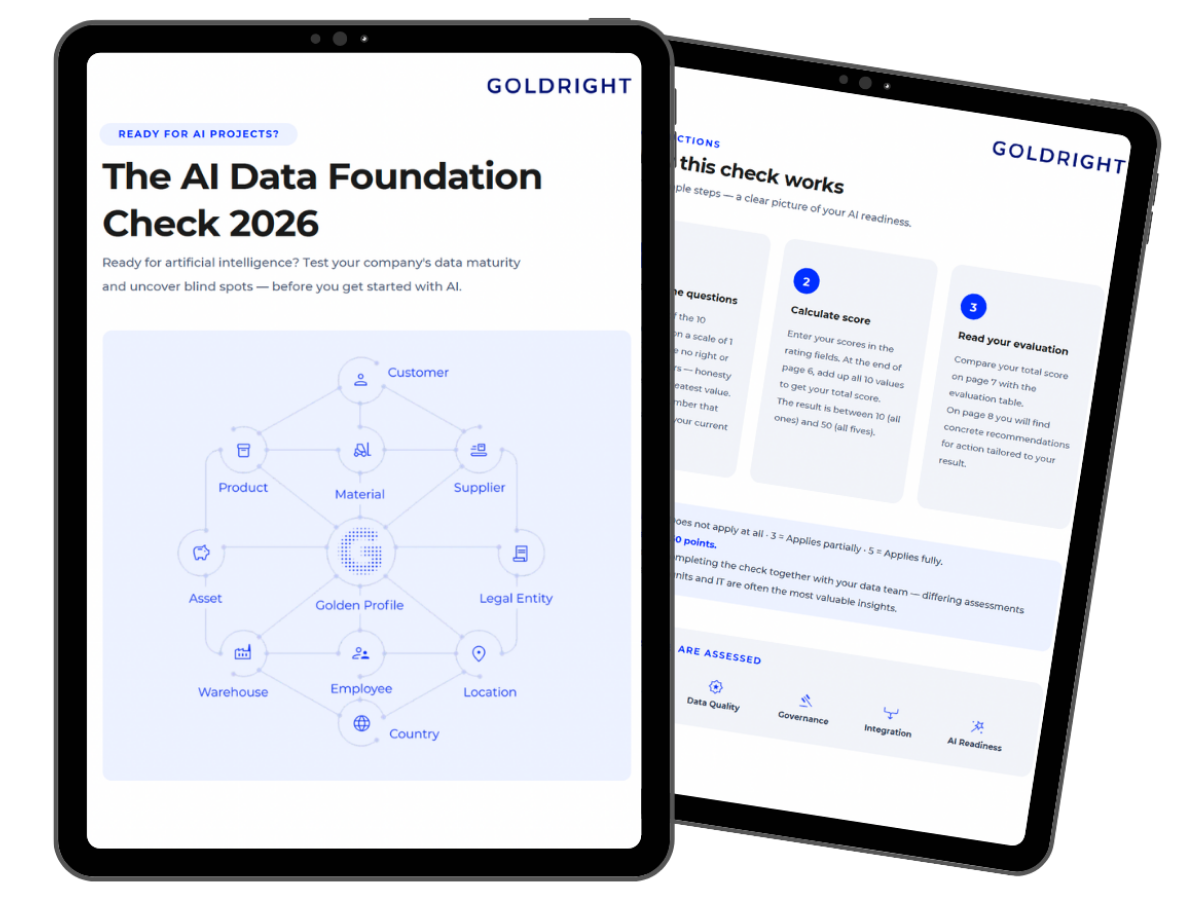
Is Your Master Data Ready for AI Projects?
Many organizations overestimate the quality of their master data until their first AI project fails. Our AI Data Foundation Check provides you with a clear assessment of your current master data maturity in just 15 minutes and identifies specific areas for action.
Evaluation score for all data dimensions
Ready-to-use roadmap template
100% free
Before You Invest in Technology: Do You Know Where You Stand?
Our AI Data Foundation Check guides you through the key dimensions that determine the success of an MDM program—domains, quality, ownership, architecture, and measurability.
Structured self-assessment across the relevant data dimensions
Evaluation score with classification
Roadmap template for prioritizing your first domain
100% free
Frequently Asked Questions about Master Data Management
- Master Data Management (MDM) is the centralized, cross-system management of key business data—such as information on customers, products, suppliers, and organizational units. The goal is to maintain a consistent “golden record” for each data object as a single source of truth, thereby providing a reliable data foundation for reporting, automation, and AI.
- Master data consists of a company’s core data—which rarely changes—that describes business objects such as customers, suppliers, products, materials, and employees. It forms the stable reference system that all business processes rely on. It is also referred to as master data.
- The most important types of master data include customer master data, supplier master data, material and item master data, HR master data, as well as legal entity and organizational data. As a rule of thumb: Anything that permanently describes a business object and is used by multiple processes is considered master data.
- MDM addresses all critical master data domains within an organization: customers, suppliers, products, locations, and legal entities. PIM specializes in product information—primarily for marketing purposes such as e-commerce, catalogs, and sales channels. The key difference: PIM optimizes product content for external communication. MDM ensures the operational and cross-system consistency of master data.
- MDM and data governance are closely related but not identical. Data governance is the overarching framework—the totality of all policies, processes, roles, and responsibilities for a company’s data management. MDM is the operational implementation of data governance principles for master data. Data governance defines the rules of the game; MDM implements them for master data in terms of both technology and processes.
- Four styles have become established: Registry (centralized index with cross-references, no physical data storage), Consolidation (consolidation and cleansing for analytics; source systems remain the primary data sources), Coexistence (centralized golden record, synchronized copies in the source systems, bidirectional), and Centralized (MDM as the sole authoritative source). They differ in terms of the level of intervention, the consistency that can be achieved, and the effort required.
- Yes. SAP S/4HANA is an excellent ERP system. It is not an MDM system. S/4HANA manages master data within its own system boundaries—but most companies do not have a pure S/4HANA landscape. They have S/4HANA plus CRM plus legacy systems plus cloud applications. MDM complements SAP S/4HANA by acting as a cross-system integration hub: The Golden Record is managed in the MDM system and synchronized bidirectionally with S/4HANA and all other systems.
- The honest answer: It depends heavily on the starting point, the number of domains, and organizational complexity. As a rough guide based on real-world experience: a pilot for a domain of medium complexity often takes several months; a broader implementation across multiple domains typically takes one to two years; and a group-wide MDM program takes several years and is implemented iteratively rather than as a “big bang.” These timeframes are general estimates based on experience and are not guaranteed.
- The range is wide: costs vary greatly depending on company size, the number of system integrations, and domains. A reliable, robust cost estimate can only be provided based on an individual assessment. Generic flat rates without a project-specific basis are deliberately not mentioned to avoid disseminating unsubstantiated figures. The ROI stems primarily from reduced error costs, accelerated processes, avoided compliance risks, and enabled AI use cases.
- Operational responsibility lies with the data owners in the business units, while strategic oversight typically falls to the Chief Data Officer (CDO). IT provides the platform. This three-part structure—strategic leadership, business ownership, and technical platform—is the backbone of any effective master data management system.
- The Golden Record is the single, consolidated, and authoritative version of a data entity—such as a customer, supplier, or legal entity. The data owner defines which attributes constitute the Golden Record and which source systems are considered authoritative. The Golden Record is the operational goal of every MDM-supported governance framework.
- MDM is relevant for any company that works with multiple systems, multiple locations, or multiple domains. This includes medium-sized companies with approximately 200 or more employees and significant ERP landscapes.
- MDM is a prerequisite for a functioning AI strategy, not a parallel initiative. AI models—whether for predictive analytics, generative AI, or process automation—are directly dependent on the quality, consistency, and completeness of the data. Without a Golden Record, AI scales errors—not efficiency.