July 31, 2026
MCP Server in Master Data Management: The Bridge Between the Golden Record and AI Agents

By Gernot Lepuschitz
Chief Technology Officer
:format(webp))
23 min read
Share this post
Since July 1, 2026, the native Goldright MCP Server has been connecting the Enterprise Suite’s Golden Record directly to AI agents. This article explains what MCP is truly capable of, why the protocol is ineffective without a consolidated Golden Record, and how you can pave the way for trustworthy enterprise AI through granular rights management and a seamless audit trail.
Key Points
The Model Context Protocol (MCP) is an open standard, initiated by Anthropic in November 2024, that connects AI applications to external data sources and tools in a structured and standardized way. Since December 2025, MCP has been further developed in a vendor-neutral manner under the Linux Foundation.
Master Data Management (MDM) provides what AI agents lack: verified, versioned, and access-controlled master data from a Golden Record — an organization’s single source of truth.
An MCP server for Master Data Management bridges both worlds: AI assistants and autonomous agents access verified master data via a standardized interface, rather than relying on fragmented systems or outdated copies.
Without a solid data foundation, any enterprise AI remains unpredictable. Gartner predicts that by the end of 2026, approximately 60% of all AI projects will be abandoned due to a lack of AI-ready data.
The Goldright MCP server has been generally available to Goldright Enterprise Suite customers since July 1, 2026—with granular access control and a complete audit trail directly from the Golden Record.
Every company that wants to deploy AI agents in production by 2026 faces the same architectural question: How can reliable business context be incorporated into the language model—in a controlled, traceable manner, and without having to build a separate interface for each application?
The answer to this question consists of two components that are still discussed separately in most strategy meetings: the MCP Server as a standardized connection layer and Master Data Management as the source of verified truth. Only together do they form an enterprise AI that can be trusted to make decisions.
This article explains what the Model Context Protocol is, why it solves only half the problem without a Golden Record—and how the new Goldright MCP Server natively brings both levels together.
What is MCP (Model Context Protocol)?
The Model Context Protocol (MCP) is an open, open-source standard that defines how AI applications access external data sources, tools, and systems in a structured way.
MCP was launched in November 2024 by Anthropic, the company behind the AI assistant Claude. Instead of programming a separate interface for every combination of AI model and data source, a company makes its data available once via an MCP server—and any MCP-enabled AI application can access it.
The architecture follows a clear role model defined in the official specification:
The MCP Host is the AI application that users interact with—such as Claude, ChatGPT, or Microsoft Copilot.
The MCP Client is the component within the host that manages the connection to a server.
The MCP Server provides data sources, tools, and functions in a structured manner—such as a company’s master data repository.
Important for understanding the architecture: The language model itself does not communicate directly with the server. The MCP Host acts as an intermediary between the model and the MCP Server, validates requests, and controls which tools are available to the model. This intermediary layer is not a technical detail—it is where control takes place.
In just one year, MCP has evolved from the Anthropic project into an industry standard: OpenAI adopted the standard in March 2025, Google followed suit in April 2025, and Microsoft announced native MCP support in Windows at Build 2025. In December 2025, Anthropic transferred the protocol to the Agentic AI Foundation under the Linux Foundation—supported by OpenAI, Google, Microsoft, AWS, Cloudflare, and Bloomberg. At that point, there were already more than 10,000 active public MCP servers.
For decision-makers, this means that MCP is no longer a bet on a single vendor standard. It is vendor-neutral infrastructure—comparable to what HTTP has achieved for the web or USB-C for hardware connections.
Why MCP and not traditional APIs?
The legitimate question every enterprise architect asks: We already have APIs. Why another protocol?
The answer lies in the integration effort. Traditional API integrations follow the M×N pattern: M AI applications multiplied by N data sources result in M×N individual interfaces—each with its own authentication, data format, error handling, and maintenance requirements. With five AI applications and twenty systems, that’s a hundred integrations that need to be built, documented, and maintained over the years.
MCP reduces this pattern to M+N: Each data source provides a single MCP server, and each AI application implements a single MCP client. After that, all combinations are possible without requiring new integration code.
The second difference is conceptual in nature. A traditional API responds exactly to the requests for which it was programmed. An MCP server, on the other hand, describes its own capabilities: The AI application recognizes at runtime which data sources, tools, and queries are available and selects the appropriate one based on context. It is precisely this self-description that makes MCP suitable for agent-based use cases in which the specific query is not known in advance.
And the third difference concerns future-proofing: Anyone who builds a point-to-point integration today between a specific LLM and their ERP system locks themselves into that exact combination. Anyone who deploys an MCP server remains open to any model the market brings forth in the coming years.
The Three Building Blocks of an MCP Server: Resources, Tools, Prompts
To understand why MCP is so well-suited for master data, it’s worth taking a quick look at the specification. An MCP server delivers its capabilities through three basic building blocks:
Resources are structured data sets that an AI application can read—in the context of MDM, for example, a legal entity record, an organizational structure as of a specific date, or a supplier master record. Resources are the natural vehicle for the Golden Record.
Tools are executable functions that the model can invoke via the host—such as a search for all companies with an ownership stake exceeding 50% or resolving a duplicate to the leading record.
Prompts are reusable templates provided by the server for typical queries—they standardize how business users formulate recurring questions about the data.
A key factor in the governance assessment is an architectural principle that is often overlooked: The server defines what is possible—not the model.
An MCP server for master data precisely determines which resources are readable and which tools are accessible. The language model cannot extend this framework; it can only select what the server offers, and even that is mediated by the MCP Host. For data owners, this means that control lies on the data side, not on the model side.
This characteristic fundamentally distinguishes MCP from approaches in which training or fine-tuning data is incorporated into a model. Master data provided via MCP does not become part of the model—it is retrieved at runtime, remains in the source, and continues to be subject to every change, every approval, and every revocation there. If an ownership percentage changes in the Golden Record, the new value applies the next time it is queried. No need for retraining, no outdated copy in the model.
Why is MCP relevant to Master Data Management?
MCP solves the connectivity problem. It does not solve the “single source of truth” problem.
This is where many AI strategies will fail in 2026—and the reason why MCP Server and Master Data Management go hand in hand. A standardized protocol reliably transports data from A to B. Whether this data is correct, up-to-date, unique, and approved is not determined by the protocol. That is determined by the data source.
This is exactly where Master Data Management comes in. An MDM system like the Goldright Enterprise Suite consolidates master data—legal entities, organizational structures, identities, and customer, product, and supplier data—from fragmented source systems into a Golden Record: a verified, versioned, and historized data record for each business object. This single source of truth is the data foundation upon which reporting, compliance, and, increasingly, AI applications are built.
Combining the two creates a clear division of labor: MDM guarantees the quality of the answer, while MCP guarantees the standardized path to it. Anyone who has only one of the two faces a problem—either perfect data that no AI can access, or a perfectly integrated AI that accesses contradictory data.
The Problem: Fragmented Systems and Hallucinating AI Agents
Let’s take a sober look at the current situation in most corporations. The same legal entity exists under a different name in the ERP system than in the CRM system. The ownership structure is stored in an Excel spreadsheet that was last updated before the annual financial statements were prepared. Three systems have three different addresses for the same supplier—and none of them knows which one is correct.
For human users, this is a nuisance. For AI agents, it’s a structural risk. A language model that encounters contradictory or incomplete data does what it was built to do: it generates a plausible-sounding response. But plausible is not the same as correct. Without reliable real-time context, the model fills in the gaps with probabilities—it hallucinates or delivers outdated results without the user noticing.
The numbers speak for themselves. According to McKinsey’s State of AI Report, 88% of companies now use AI in at least one business function—so its adoption has long been a reality. At the same time, a Gartner survey of data management leaders shows that 63% of organizations either don’t know or doubt whether their data practices are suitable for AI. The gap between AI ambition and data reality is the real challenge—not model selection.
The facts in numbers—four verified metrics for context:
88% of companies use AI in at least one business function (McKinsey)
63 % of organizations have no data management practices for AI—or their practices are inadequate (Gartner)
60 % of AI projects without AI-ready data will be discontinued by the end of 2026 (Gartner)
80 % der Data-&-Analytics-Governance-Initiativen scheitern laut Gartner bis 2027 ohne Kopplung an priorisierte Geschäftsergebnisse (Gartner)
Four numbers, one pattern: AI adoption is here, but the data foundation is missing—and it is precisely this discrepancy that causes projects to fail, not the quality of the models.
And this gap cannot be closed with a protocol. A forecast presented by Gartner at the 2026 Data & Analytics Summit is remarkably candid: According to it, by 2028, 60% of agent-based analytics projects that rely exclusively on MCP—without a semantic and data-driven foundation—will fail. This aligns with our engineering experience: An MCP server sitting in front of a data swamp is a very efficient way to scale incorrect answers.
Without a data foundation, any enterprise AI remains unpredictable
A language model operates probabilistically—it calculates probabilities. A golden record operates deterministically—it provides facts. Trustworthy enterprise AI emerges precisely where probabilistic models access deterministic data sources. Without this foundation, any enterprise AI remains unpredictable.
The implication for CDOs and data owners: Anyone who wants to deploy AI agents productively needs a data foundation that meets several criteria. The data must be consolidated (one Golden Record instead of five versions), controlled (clear ownership, approval processes, permissions), and traceable (versioning and historization of every data point). Master Data Management delivers precisely these characteristics—and through MCP, they become available for AI applications for the first time without the need for an integration project.
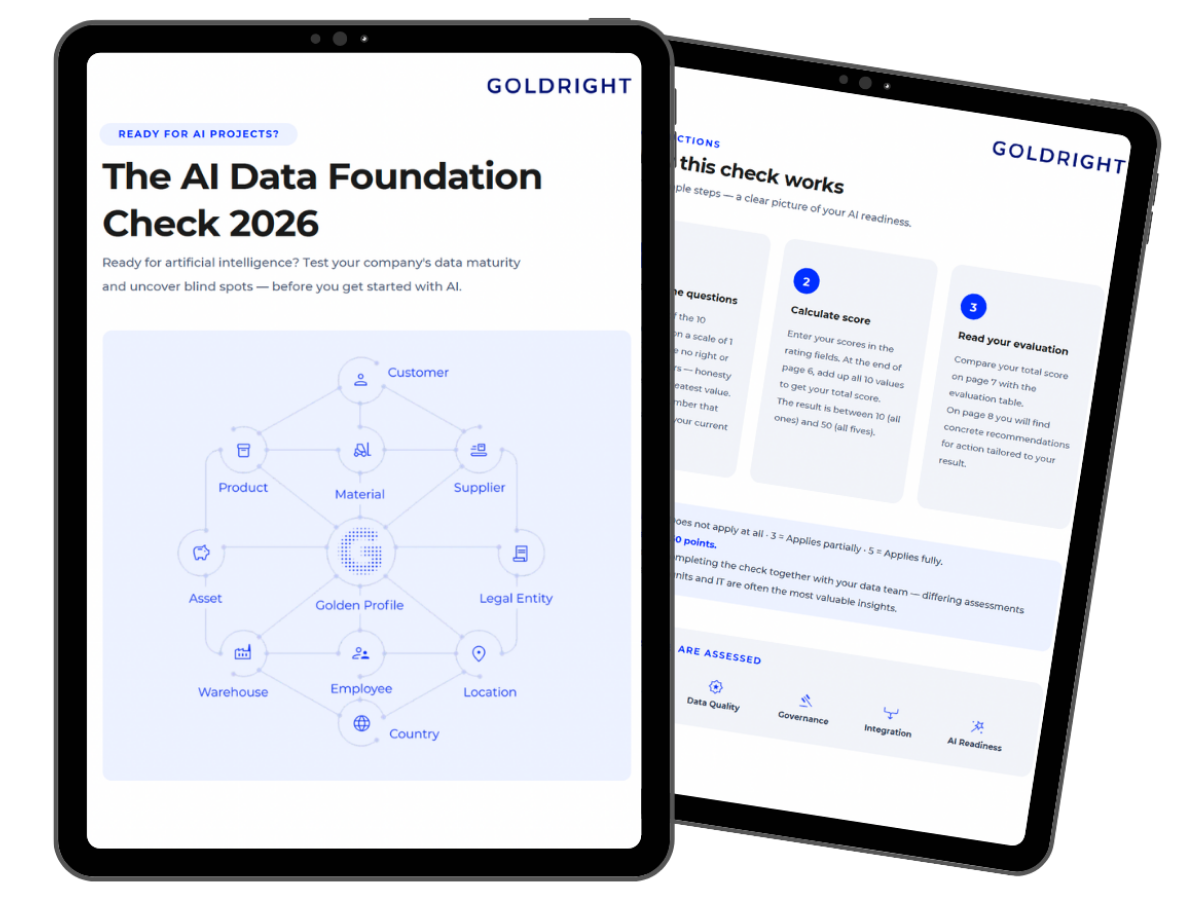
Is Your Data Ready for AI?
Many organizations underestimate how far their data foundation is from true AI readiness—until their first AI project fails. Our AI Data Foundation Check provides you with a clear assessment of your current master data maturity in just 15 minutes and identifies specific areas for action.
Evaluation score for all data dimensions
Ready-to-use roadmap template
100% free
What “AI-Ready Data” Specifically Means for Master Data
The term “AI-ready data” appears in every other strategy presentation—rarely with a solid definition. When applied to master data, however, it can be defined precisely. For an AI agent to work reliably with corporate data, five conditions must be met:
Uniqueness: For each business object, there is exactly one master record—the “golden record.” Duplicates and system variants are resolved or unambiguously referenced to the master record.
Timeliness: Changes are incorporated into the master record in a controlled and timely manner, rather than getting lost in individual source systems.
Historization: Every previous state can be reconstructed with precision down to the specific date. Without versioning, an AI simply cannot correctly answer questions about the past—such as “What did the structure look like at the end of the fiscal year?”
Authorization: For each data object, it is defined who is permitted to view and modify it. These rules must be enforceable by machine, not merely documented.
Traceability: The origin, approval status, and change history of each value are documented and retrievable.
The plain-and-simple conclusion: These five conditions are exactly the requirements profile of a professional master data management system. At its core, AI readiness is not an AI discipline—it is a data discipline that begins long before the first agent is deployed. Those who meet these requirements can integrate AI applications in a matter of weeks. Those who skip them connect their agents via MCP to a dataset that even humans don’t trust.
We’ve described in detail how to systematically build such a foundation in our guide to the Data Governance Framework and in our introductory article on the Golden Record in Master Data Management.
The Goldright MCP Server: From the Golden Record to the AI Brain
Since July 1, 2026, the Goldright MCP Server has been generally available to all Goldright Enterprise Suite customers. This allows a company’s verified data—legal entities, organizational structures, identities, and master data across all domains—to be fed directly, in compliance with regulations, and in real time into AI assistants and autonomous agents.
The decision to embed MCP natively into the Enterprise Suite rather than building it as a separate add-on was a deliberate architectural choice. An add-on would have meant that data would be exported, cached, and duplicated—thereby reproducing the very fragmentation that MDM is designed to eliminate. Native integration means that the MCP Server serves as an additional, controlled gateway to the same Golden Record that the suite’s web interface, reporting engine, and configurable APIs also use. One truth, multiple access points—not multiple truths.
In practice, this means: A user in investment management asks her AI assistant which subsidiaries were part of a specific holding company as of December 31, 2025. The MCP Host forwards the request to the Goldright MCP Server, which answers it based on the historical investment structure from the Legal Entity Manager—versioned, accurate to the specific date, and with documented provenance. No Excel searches, no guesswork, no outdated data.
How the Integration Works: Granular Access Control and a Seamless Audit Trail
Technically, the integration consists of three layers that answer the key questions for enterprise architects:
1. User-Level Access Control
The Goldright MCP server adopts the existing access control model of the Enterprise Suite. The AI application sees only the data objects and attributes for which the currently logged-in user is authorized—and nothing more. A controller sees different sections of the Golden Record than a compliance officer. There is no generic “full AI access” that bypasses existing governance structures.
2. Seamless audit trail
Every access via the MCP server is logged: which user, which query, which data objects, and at what time. For regulated industries, this is not a convenience feature but a prerequisite for allowing AI access in the first place. When an auditor asks on what data basis an AI-supported analysis was generated, the answer is a log excerpt—not a shrug.
3. Structured Provisioning Instead of Data Export
The MCP server describes the available data domains and queries in a machine-readable format. AI applications recognize at runtime which resources are available and retrieve only the specific data segments they need. The data remains within the Enterprise Suite; no uncontrolled copies are created outside the governance perimeter.
These three layers are the difference between “we’ve connected our data to AI” and “we’ve opened our data to AI in a controlled manner.” The first statement rightly alarms every CISO. The second is a robust architectural statement.
Three Real-World Application Scenarios
Three typical queries—the kind that arise daily in the business units of our target industries—illustrate how integration changes day-to-day work:
Investment Management Scenario:
“Show me all direct and indirect investments exceeding 25% as of the cutoff date of December 31, 2025, including changes from the previous year.”
Previously: Cross-referencing multiple Excel lists, inquiries to the legal department, one to two days of processing time.
With MCP integration: The AI assistant retrieves the historical equity structure from the Legal Entity Manager and provides an overview accurate as of the specified date, including changes—based on audited, versioned data and only within the scope of the requesting user’s permissions.
Compliance and Audit Scenario:
“What board mandates did Person X hold from 2023 to 2025, and when was this data last approved?”
The answer is derived from the historical mandate portfolio—including approval status and change history. The audit trail simultaneously documents that this exact query took place. For audit preparation, this means: the ability to provide information in seconds rather than days of research.
Purchasing and Supplier Management Scenario:
“Is there already a master record for this new supplier, and what group-wide connections exist with our existing suppliers?”
The agent checks against the harmonized supplier master, detects duplicates before creation, and reveals interconnections that would remain undetected in fragmented systems—a direct lever against duplicate entries, incorrect orders, and overlooked cluster risks.
The common thread among the three scenarios: These are not spectacular AI feats. They are everyday business questions that previously required manual research to answer—and which, with the combination of the Golden Record and MCP access, become routine queries. That is precisely where the measurable productivity gain arises: not in the demo, but in day-to-day operations.
An Honest Look at Security: What MCP Doesn’t Automatically Solve
Technical integrity also involves the other side of the coin. MCP is a protocol—not a security guarantee. In an open ecosystem that now includes thousands of public MCP servers, legitimate security concerns were discussed in 2025: What happens if users integrate unverified third-party servers? How can you ensure that a tool actually does what its description claims? Anyone who ignores these questions and indiscriminately connects servers from community directories to corporate data is acting negligently—regardless of how well the protocol itself is specified.
This is precisely where the difference lies between an open ecosystem and a native enterprise integration. The Goldright MCP server is not an anonymous community component, but rather an integral part of the Enterprise Suite: It runs within the existing governance perimeter, its functionality is defined and documented, and it is subject to the same release, testing, and audit processes as every other component of the platform. The attack surface associated with an untested third-party chain never arises in the first place.
Nevertheless, three responsibilities remain with the company—and should be included in any implementation plan: the deliberate selection and approval of the MCP hosts used (which AI applications are actually allowed to connect?), the integrity of the authorization model (AI access reveals overly generous legacy permissions), and training users on how to handle AI-powered information. A clean MCP server does not exempt a company from sound operational management. Those who take both seriously will achieve an AI integration that withstands critical scrutiny by the CISO and internal audit—and that is precisely the standard by which enterprise software must be measured.
The Perspective from an Engineering standpoint
“With our MCP integration, we bridge the gap between MDM quality and AI reliability. Companies can interact with their data risk-free—for transparent, compliance-compliant decisions without hallucinations.”
The technical explanation behind this statement is as follows: A language model “hallucinates” when it lacks reliable context and fills in gaps with probabilities. The MCP integration replaces precisely these gaps with verified facts from the Golden Record—including source and date. The model doesn’t have to guess which ownership stake applies. It queries the system and receives the verified value. Deterministic data for probabilistic models: That is the division of labor upon which reliable enterprise AI is built.
Benefits of Native MCP Integration for Enterprise Customers
The value of MCP integration isn’t measured by the fact that “AI is now connected.” It’s measured by the specific risks it eliminates and the work it makes redundant. Across the three areas that matter most to data stewards—compliance, precision, and AI readiness—the results look like this.
Compliance: Governance applies to AI as well.
The most common concern in our discussions with data owners is not “Does this work?” but “Who controls this?” Native integration answers this question structurally: The MDM system’s permissions, approval processes, and ownership rules apply unchanged to every AI access request. No shadow data set, no ungoverned copy, and no workarounds are created. Governance thus shifts from being a hindrance to an enabler: precisely because every access is controlled and logged, business units can approve AI tools in the first place.
Precision: Answers with a chain of custody.
The Golden Record provides not only a value but also its context—version, reference date, source, and approval status. AI responses generated on this basis are not guesses, but traceable statements with a documented data foundation. For decisions that must stand up to scrutiny by supervisory boards, auditors, or regulators, this difference is not gradual but categorical.
AI Readiness: One server instead of twenty projects.
Every new AI application—today an assistant in investment management, tomorrow an autonomous agent in procurement—accesses the same MCP server. The integration project is eliminated; the time required for integration drops from months to the time it takes to configure a single connection. Companies that make their data foundation MCP-ready today decouple their AI roadmap from the bottleneck of interface development.
Auditability Instead of Assumptions
This point deserves separate consideration because it is regularly overlooked in AI discussions. The relevant question in enterprise AI is rarely “Was the answer good?”—it is “Can we verify what the answer is based on?”
With the combination of a historized Golden Record and logged MCP access, every AI-supported response can be reconstructed: Which data version was the basis for the answer? Who had which permissions at the time of the query? When was the underlying dataset last approved, and by whom? In the event of an audit, this traceability is the difference between a log extract and an uncomfortable discussion.
For data managers, this results in a remarkable side effect: MCP integration makes the value of the data foundation visible in day-to-day operations for the first time. For a long time, data quality was an investment whose returns disappeared into the depths of reporting. When every business unit receives verified, report-date-accurate answers in seconds via an AI assistant, the abstract governance argument becomes a tangible productivity gain.
Industry Relevance: Where Reliable Master Data Determines AI Success
Integration is relevant wherever AI agents rely on master data that complies with regulations. In the core industries served by the Goldright Enterprise Suite, this is illustrated by specific scenarios:
Finance: Banks and financial service providers must demonstrate ownership structures, close interdependencies, and legal entity data in a manner that complies with regulatory requirements. An AI assistant that answers these questions using the verified Golden Record—rather than an outdated overview—streamlines audit preparation and reduces regulatory risk.
Manufacturing: In the manufacturing sector, consistent material, supplier, and plant data determine delivery capability. Agents that answer procurement questions based on harmonized master data prevent classic ordering errors caused by duplicate part numbers.
Energy: Energy providers navigate complex ownership and asset structures involving joint ventures and grid companies. AI-generated, auditable structural views accurate to a specific reporting date accelerate reporting and compliance verification.
Insurance: Insurers require complete client and organizational structures across all units. The combination of historical data and AI access makes reconstructing historical structures a matter of seconds.
Real Estate: In investment management, the rapid identification of ultimate beneficial owners (UBOs) in nested structures determines transaction speed. An AI agent with access to the Golden Record answers.
The common thread: In all these industries, an incorrect AI response is not only impractical but also has implications for liability and regulatory compliance. That is precisely why controlled access to verified master data is not just a “nice-to-have” here, but the key to productive AI.
MCP Server vs. Traditional API Integration: The Difference
A systematic comparison is worthwhile when making architectural decisions. Both approaches have their merits—but when it comes to connecting AI applications to master data, they differ fundamentally:
Criterion | Traditional API integration | MCP server (native to MDM) |
Integration Effort | Individual interface per AI application and data source (M×N problem) | A standardized interface for all MCP-enabled AI applications (M+N) |
Standardization | Proprietary, defined on a per-project basis | Open standard under Linux Foundation governance, vendor-neutral |
Ability detection | AI must be hard-coded to know which endpoints exist | The server describes data sources and tools itself; runtime detection |
Suitability for AI Agents | Limited — fixed endpoints for predefined queries | High — agents select appropriate resources based on context |
Permissions | Must be implemented separately for each integration | For the Goldright MCP Server, adopts the existing permission model of the Enterprise Suite |
Audit Trail | Depends on the specific implementation | Seamless logging of every access, natively integrated |
Data Management | Frequent exports and temporary storage required | Data remains in the Golden Record; retrieval of structured excerpts |
Maintenance | Maintain each interface individually; adjustments required when changing models | One server; new AI applications without additional integration code |
Future-Proof | Tied to a specific model-system combination | Open to any MCP-enabled model, today and in the future |
The assessment from an engineering perspective: Traditional APIs remain the right tool for deterministic system-to-system processes—the Enterprise Suite’s bidirectional ERP integration continues to run via configurable APIs, and for good reason. For connecting AI applications whose queries are not fixed at development time, the MCP server is the structurally superior model. It’s not an either/or situation, but rather a clear division of tasks.
Getting Started: The Path to an MCP-Ready Data Foundation
For CDOs and data owners who are actively planning the integration, a pragmatic approach has proven effective in our projects—it deliberately starts not with AI, but with the data:
Step 1 — Prioritize data domains.
Not all master data is equally relevant for getting started with AI. Begin with the domain where incorrect answers cause the most damage today or where manual research takes the most time—in a corporate setting, these are often legal entities and ownership structures; in an industrial setting, they are supplier and material master records.e.
Step 2 — Assess Golden Record readiness.
Evaluate the prioritized domain against the five criteria for AI-ready data: uniqueness, timeliness, historical data, authorization, and traceability. Gaps that become apparent here are not MCP issues—they are MDM tasks that must be addressed before integration.
Step 3 — Verify the authorization model.
MCP access inherits the existing authorization model. This is a strength—and at the same time, the moment of truth: Overly generous legacy permissions that no one had noticed before become relevant due to AI access. A focused authorization review before activation is time well spent.
Step 4 — Conduct a controlled pilot.
Start with a clearly defined user group and specific use cases. From day one, the audit trail provides the data foundation for evaluating usage, benefits, and open questions based on facts—rather than anecdotes.
Schritt 5 — Skalieren über denselben Server.
Every additional use case and every additional AI application uses the same interface. Expansion is a configuration and governance decision, not a new integration project.
The realistic timeline: With a well-maintained Golden Record, the path from decision to productive pilot operation is a matter of weeks, not quarters—because the most time-consuming part, the data foundation, is already in place. The quickest way to determine exactly where your organization stands on this path is through a direct conversation.
Is Your Data Ready for AI?
Many organizations underestimate how far their data foundation is from true AI readiness—until their first AI project fails. Our AI Data Foundation Check provides you with a clear assessment of your current master data maturity in just 15 minutes and identifies specific areas for action.
Evaluation score for all data dimensions
Ready-to-use roadmap template
100% free
Conclusion: MCP as the Foundation for Trustworthy Enterprise AI
The strategic framework is strikingly simple: MCP Server and Master Data Management each solve only half of the enterprise AI problem—together, they solve it completely.
The protocol standardizes access; the Golden Record guarantees that what lies at the end of that access are verified facts, not assumptions. Companies that invest only in models and agents in 2026, without making their data foundation MCP-compatible, are—to stick with the metaphor—building a house on sand. Gartner’s forecasts regarding abandoned AI projects are not scaremongering, but the measurable consequence of precisely this pattern.
With the Goldright MCP Server, the bridge between these two worlds has been available in production since July 1, 2026: the verified, historized, permission-controlled Golden Record of the Enterprise Suite—accessible to any MCP-enabled AI application, with a complete audit trail and without a single individual integration project.
Frequently Asked Questions About MCP and Goldright
- An MCP server is a software component that provides data sources, tools, and functions for AI applications in a structured manner based on the open Model Context Protocol. AI applications such as Claude, ChatGPT, or Microsoft Copilot connect to the server via an MCP client and can access its resources in a controlled manner. The standard was initiated by Anthropic and has been further developed in a vendor-neutral manner under the Linux Foundation since December 2025.
- The Goldright MCP Server is a native interface of the Goldright Enterprise Suite that makes the Golden Record—a company’s verified master data—available to AI applications in a standardized format without the need for custom programming. The Enterprise Suite’s access controls and audit trail remain in effect for all AI access.
- The MCP integration has been generally available to all Goldright Enterprise Suite customers since July 1, 2026. Existing customers should contact their Goldright representative directly for details on activation.
- In particular, for enterprise customers in finance, manufacturing, energy, insurance, and real estate—anywhere where AI assistants and autonomous agents rely on reliable, compliant master data and where responses must be auditable.
- The integration features granular access control at the user level and a comprehensive audit trail. AI applications see only the data that the respective user is authorized to access; every access event is logged and can be reconstructed retrospectively.
- A traditional API is a custom-programmed interface for predefined queries between two systems. MCP is an open standard in which a server describes its own data sources and tools, and any MCP-enabled AI application can access them without additional integration code. MCP is the more suitable pattern for AI agents with queries that are unknown in advance; traditional APIs remain useful for fixed system-to-system processes.
- Language models operate probabilistically: without reliable context, they generate plausible but potentially incorrect answers. Master data management provides this context in the form of a verified, versioned “golden record.” Gartner predicts that by the end of 2026, approximately 60% of AI projects will be abandoned due to a lack of AI-ready data—the data foundation determines AI success.
- No. The configurable APIs of the Goldright Enterprise Suite for ERP, CRM, and BI integrations remain unchanged. The MCP server supplements them with a standardized access method specifically for AI applications—both access methods access the same Golden Record.
- No. The Goldright MCP server adopts the Enterprise Suite’s existing authorization model. The AI application sees only the data objects and attributes for which the currently logged-in user has been granted access. There is no generic full access for AI.
- In principle, any application that supports the Model Context Protocol—including, among others, Claude, ChatGPT, Gemini, and Microsoft Copilot, as well as the company’s own MCP-based agents. Thanks to the open standard, the company is not tied to a specific AI provider.
Sources
Gartner: Lack of AI-ready data puts AI projects at risk
Gartner: Press Release: Gartner predicts 80% of D&A governance initiatives will fail by 2027
Anthropic: Introducing the model context protocol
Anthropic: Donating the model context protocol and establishing the agentic AI foundation
Model Context Protocol: What is the model context protocol (MPC)?
Tech Crunch: OpenAI adopts rival Anthropic's standard for connecting AI models to data
Tech Crunch: Google to embrace Anthropic's standard for connecting AI models to data
Windows Blog: Advancing Windows for AI development
McKinsey: The state of AI in 2025
NEO4J: Complimentary Gartner report on how to evaluate AI data readiness