September 10, 2026
List of Shareholders: Obligations, Deadlines, and Pitfalls You Should Be Aware Of

By Philipp Seibald
Vice President Sales
:format(webp))
25 min read
Share this post
A single error in the list of shareholders is enough: shareholders lose their voting rights, a purchase made in good faith suddenly becomes legally valid, and the managing director faces personal liability. In this article you will learn who is required to maintain the list of shareholders under Section 40 of the German Limited Liability Companies Act (GmbHG), what deadlines and fines apply, how GmbHs, KGs, and GbRs differ legally—and why the list is more than just a formality for the commercial register.
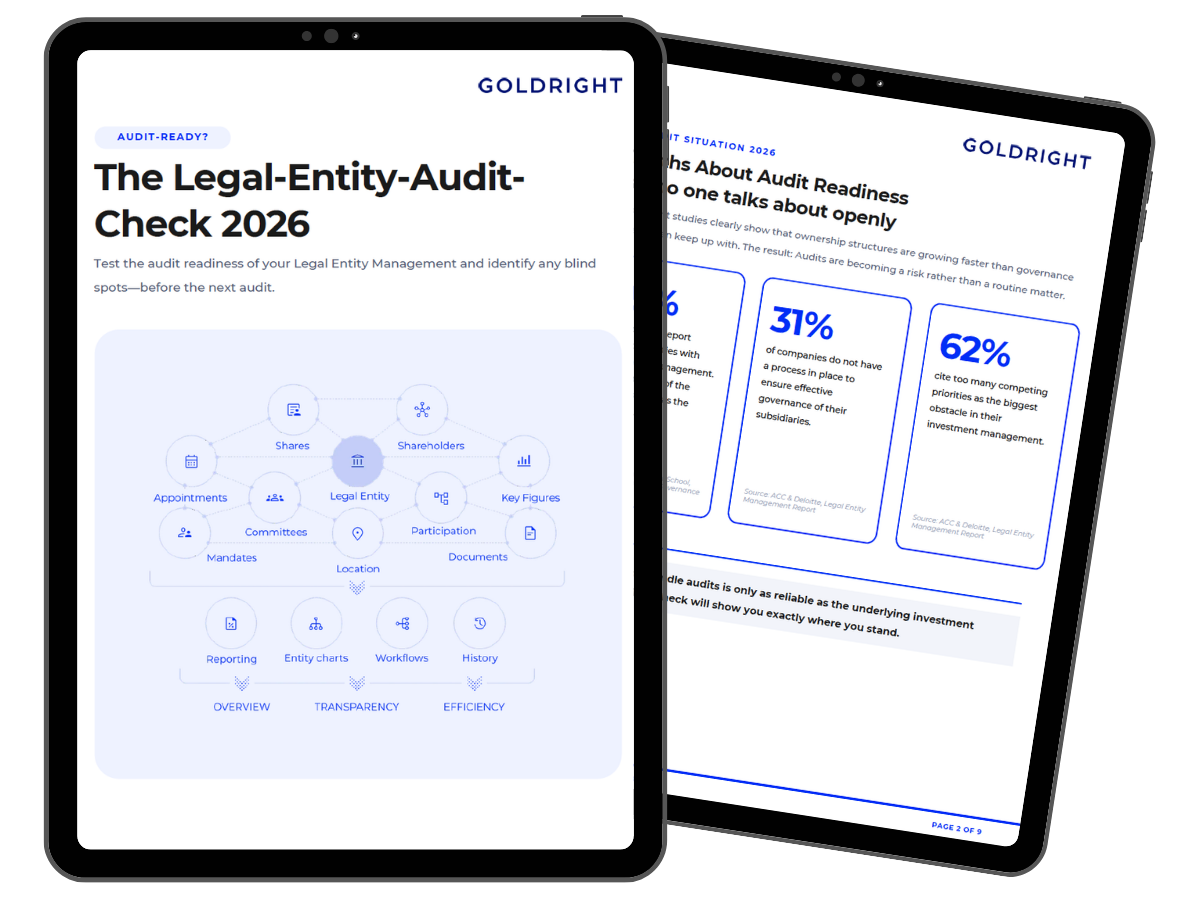
Free Legal Entity Audit Check
Do you manage multiple companies and are unsure whether all lists and filings are up to date? Goldright’s Legal Entity Audit Check shows you in just a few minutes where action is needed in your ownership structure.
9-page practical guide as a ready-to-use PDF
10-step self-assessment
Prioritized recommendations for action based on your score
100% free
Free Legal Entity Audit Check
Ownership structures are growing faster than most companies can keep their master data up to date. With Goldright’s Legal Entity Audit Check, you’ll receive an initial, no-obligation assessment of how consistent and auditable your ownership data actually is across the entire group.
9-page practical guide as a ready-to-use PDF
10-step self-assessment
Prioritized recommendations for action based on your score
100% free
Frequently Asked Questions
- The list of shareholders is the official register filed with the Commercial Register that lists all shareholders of a GmbH or UG (with limited liability), including their names, dates of birth, places of residence, and corresponding shares (§ 40 GmbHG). It is more than just a formality because, since the MoMiG of 2008, it has had a legitimizing effect and thus directly influences who is considered a shareholder in legal transactions.
- The list is part of the publicly accessible registry file at the relevant commercial registry and can be accessed online through the joint registry portal of the federal states, usually for a small fee. For a complete history, we recommend obtaining a chronological registry extract that includes all previous versions of the list.
- Generally, the management. If a notary was involved in the underlying change, the notary submits the list and certifies that the amended entries correspond to the transactions the notary oversaw (Section 40(2) of the German Limited Liability Companies Act (GmbHG)). In the case of internal changes without notary involvement, the management remains responsible throughout the process.
- The list is submitted electronically—signed by the management or the notary involved—through the competent registry courts. Section 40(5) of the Limited Liability Companies Act (GmbHG) also allows state governments to require a structured, machine-readable submission.
- It contains, in tabular form, the last name, first name, date of birth, and place of residence of each shareholder, as well as the par value, serial numbers, and percentage of ownership of the shares; for shareholders that are legal entities themselves, it also includes the company name, registered office, registry court, and registry number. The format and calculation details are governed by the Shareholder List Regulation (GesLV).
- No. Section 40 of the GmbH Act (GmbHG) applies only to GmbHs and UGs (with limited liability). For a KG, limited partners are listed in the Commercial Register (Section HRA) only by their liability amount, not by their actual capital share. According to the Federal Administrative Office, a separate filing with the Transparency Register is generally still required for KGs, as they cannot invoke the presumption of notification.
- No, there is no list of members for a GbR under § 40 GmbHG either. Since the MoPeG took effect (January 1, 2024), a GbR may voluntarily register as an eGbR in the new corporate registry, which triggers separate transparency registry obligations that must be considered independently of the GmbH’s list of shareholders.
- Shareholders who are not listed cannot temporarily assert their rights against the company; a third party may acquire shares in good faith based on the incorrect list; and the management is personally liable as joint and several debtors for any damages resulting therefrom to the affected shareholders or the company’s creditors.
- Anyone who believes they have been wrongfully omitted from the list or listed incorrectly may have an objection to the list entered. Pursuant to Section 16(3) of the German Limited Liability Companies Act (GmbHG), this objection prevents a bona fide acquisition based on the incorrect information and should be filed promptly in the event of discrepancies, as it has immediate legal protective effect.
- Not necessarily: If the list of shareholders is complete and up-to-date, the presumption of notification under Section 20(2) of the Money Laundering Act (GwG) applies to the GmbH, and a separate report is not required. If the list is incomplete or outdated, this benefit no longer applies, and a separate report to the Transparency Register becomes necessary.
- Depending on the severity, fines range from 50,000 euros (negligence) and 150,000 euros (intent) as a general rule, up to 1,000,000 euros for systematic or repeated violations, and up to 5,000,000 euros or 10% of annual revenue for entities subject to the reporting obligation under Section 2(1) of the Anti-Money Laundering Act (GwG), such as financial institutions and insurance companies.
- After every change in the identity of the shareholders or in the size of their holdings—the law does not specify a fixed deadline but requires immediate submission. In practice, delays of several weeks without a justifiable reason are already considered a breach of duty.